
Welcome back to the Final Fantasy Love/Hate series on IC2S! This time around, we’ll be looking at Final Fantasy VII! I didn’t get a chance to play FF7 on PS1 when it came out, but I can keenly remember reading my gaming magazines in the mid-2000s and feeling the excitement for the compilation of Final Fantasy VII games and media projects. I never actually ended up experiencing any of these extended universe projects, but I always found FF7 and the greater Final Fantasy universe extremely intriguing. I would end up playing through Final Fantasy VII on PSP in the early 2010s*, but I didn’t feel compelled to branch out from there for a long time. There’s probably a lot of reasons for this: JRPGs just weren’t my jam, Final Fantasy as a franchise was in a slump at the time, gaming magazines were basically dead so I wasn’t keeping up with “the culture”, etc. It wasn’t until the Magic: The Gathering x Final Fantasy cross-over happened that my interest in the franchise was truly rekindled, and after playing Final Fantasy VI, I was extremely curious to see how Final Fantasy VII held up in comparison. Was it better than I remembered? Read on to find out…
Some quick notes before we get into this. For this replay, I used the Steam version of FF7 on my Steam Deck, which is probably the best way to play the game today for one simple reason: mods! Installing and managing mods is fairly simple, allowing you to customize the experience to your liking. For my part, I mostly just did graphical enhancements and quality of life improvements, because I wanted it to still be close to the original experience, but there are mods available which can rebalance the game, add content, change the soundtrack, and even add voice acting! I want to bring this up for two reasons: 1) I don’t think it has effected any “Loves” or “Hates” I may have had if I played unmodded, but I want to just make readers aware of the context I played within, and 2) If you’re playing this game today, I absolutely recommend playing this version with your preferred mods for an idealized experience. If you want to just play the original game for free, then get a ROM and you’ll have a good enough time, but for the maximal experience today, the Steam version + mods is the way to go!
*I was working midnight shifts at a Tim Horton’s at this time. When I went on break, I’d bust out my PSP and grind away at the game. I don’t think I was using a guide, so I missed out on optional characters and nearly every side quest as I blundered my way through. Despite that, I recall making it to the final boss encounter (probably under-leveled and under-equipped), although I cannot for the life of me remember if I actually managed to beat Sephiroth or not.
Love
- The Characters – One of Final Fantasy VII‘s most enduring elements is its colourful and distinct cast of characters. Simply put, they are all memorable, distinctive, and the more we get to know them, the more interesting they end up being. The cast of characters is vast and eclectic, but the most important would have to be:
- Cloud is the quintessential JRPG protagonist: a moody, edgy, highly-skilled amnesiac with no aim in life beyond watching out for himself. However, as he sees the atrocities unleashed by the totalitarian Shinra corporation and realizes that his foe, Sephiroth, is involved with them, he slowly comes to find a purpose and discover how his fate is entwined with that of the planet.
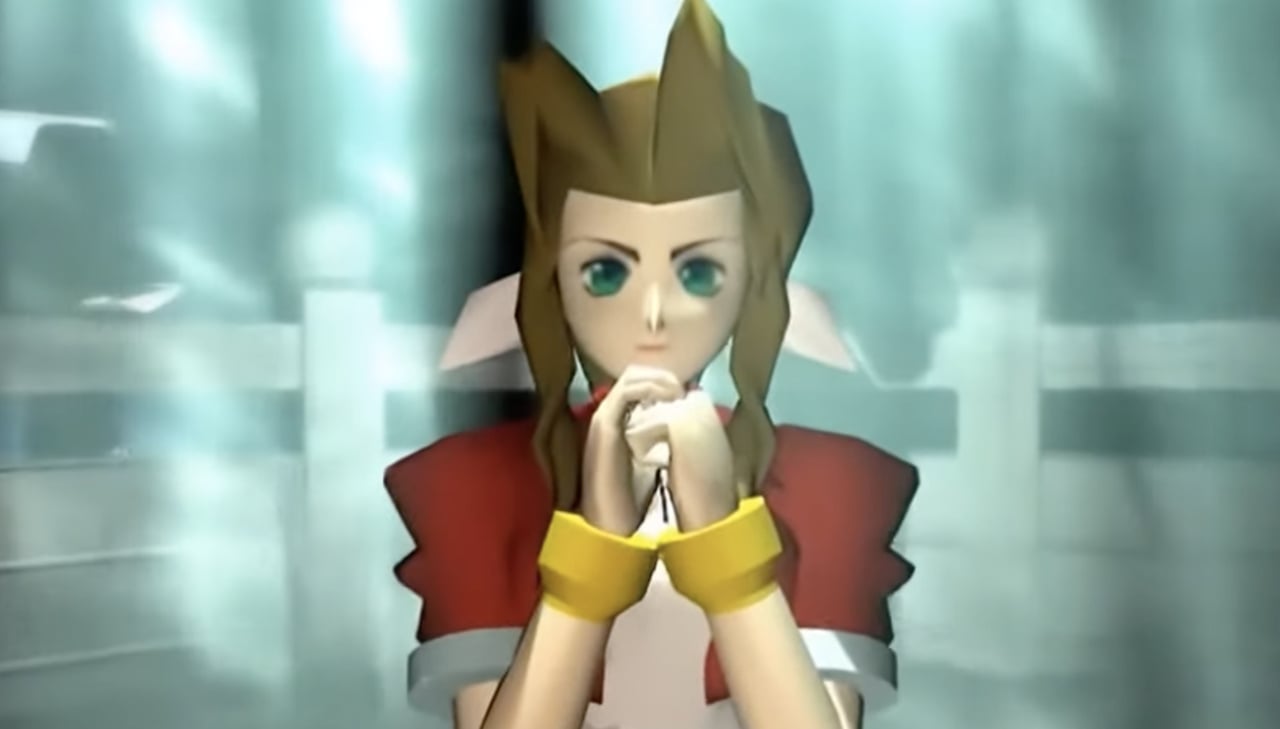
- Then there’s the initial love interest, Aerith. She seems delicate on first glance, with her talents skewing heavily towards healing and spellcasting. However, at several points in the story, she reveals a fearless personality, pushing others to do what’s right. Her part in Final Fantasy VII is straight-up legendary, being the crux of perhaps the most famous plot twist in video game history.
- There’s long been debate about whether Aerith or Tifa is the best love interest for Cloud, but I’ve always been on team Tifa. She’s arguably the secondary protagonist after Cloud, and a sizeable chunk of the narrative (not to mention some of the most impactful plot points) revolve around both her and Cloud. She’s this game’s “monk” archetype, and can put out an ungodly amount of melee damage by the time you hit the endgame. In spite of this, her character is somewhat reserved and unsure of herself, which just makes me want to give her a big hug and tell her that she’s stronger than she knows. Goddammit, I love Tifa, and I always will.
- Barret is just fucking cool. A huge brute of a man with a machine gun for an arm: that alone could carry the character, but what makes Barret truly awesome is his strong motivations. While he is abrasive on the outside, he’s a loving, caring father, and everything he does revolves around his love for his daughter, Marlene. He sees that Shinra are sucking the life out of the planet, and is compelled to fight back against this to secure a future for his daughter. This causes him to create and lead a full-on eco-terrorist group, AVALANCHE and take direct action against overwhelming odds… because what else are they supposed to do? Just let Shinra destroy the planet?
- The rest of the party members are perhaps less important to the overall narrative, but still fun and colourful. Red XIII initially comes across as somewhat snooty, but we soon realize that he’s effectively a teenager and in need of maturity and purpose (which he discovers over the course of the game). Cait Sith is very strange – he’s a robot cat/moogle which is being controlled by a Shinra executive in order to spy on the party. However, over the course of the game, he comes to believe in their cause and goes from a double-agent to a triple-agent. Cid is a washed-up pilot and mechanic, and is somehow even more abrasive than Barret, but when push comes to shove, he always does the right thing. He starts out believing that he’ll never accomplish his potential, but with some help from his newfound friends, he’s able to achieve his dreams while saving the planet. Then there’s the two optional characters: Yuffie and Vincent. Yuffie is an energetic and youthful scamp: a self-interested thief who initially joins the party in order to steal their Materia. However, when the party rescues her and forgives her for her deception, she decides to continue helping them fight Shinra. As for Vincent, he’s like if Cloud was even more moody and edgy. He was experimented on by Shinra, and his backstory is tied into the birth of Sephiroth. He agrees to help the party in order to get some revenge on Shinra.
- Finally… there’s Sephiroth. He’s every bit as intimidating and powerful and you’d want a JRPG final boss to be. Every time he shows up, you know something major is about to go down. This is cemented early on in the game, with his brutal rampage through Shinra headquarters, and then the revelation of his massacre of the town of Nibelheim… oh, y’know, and that one big moment halfway through the game. He’s a villain you love to hate, but you can also kind of understand why he is the way he is (as opposed to Final Fantasy VI‘s Kefka, who’s just gleefully evil for the sake of being evil).
- The Story – Final Fantasy VII‘s narrative isn’t exactly breaking any new ground, but for an early PS1-era game, it’s well-told and quite ambitious. Like prior Final Fantasy games, it plays out in a loose, “episodic” manner, with each “episode” feeling like a small, self-contained adventure before you move onto the next line of the quest (which could have a wildly different setting or tone, reinforcing the “episodic” feel). It all comes together thanks to several very well-executed narrative beats. It does get quite confusing around the halfway point, but with a bit of thought (and some wiki-trawling) it does make sense and is very grandiose for this era of gaming.
- The Presentation – Easily the most impressive aspect of FF7 upon its release was the game’s impressive, cinematic presentation. While technical restraints had forced all prior Final Fantasy games to be on a flat, 2D plane, FF7 entered the new console generation taking advantage of the potential of 3D. The mixture and layering of pre-rendered backgrounds, FMVs, and moving 3D models is extremely clever, harkening back to the matte paintings and rotoscoping of 1950s cinema in order to work around technological limits and create visuals that seem to defy technological limitations. It’s impressive stuff and, perhaps most importantly, just looks fucking cool. We need more games to leverage these sorts of performance tricks rather than rendering everything in-engine!
- Politics – I’m glad that we finally seem to be reaching a point where most people are getting sick of the “anti-SJW/woke” grift which has polluted media discourse for the past decade. A hallmark of that movement is the assertion that “they’re shoving politics into everything!”, but then they’ll write off stuff like Terminator 2 or Aliens as “having done it right”. However, it’s not that they did it “right”: these films are very in your face about their politics and they would absolutely be labeled “woke” if they came out today; the actual difference is that you weren’t a miserable bastard yet when you saw these movies. Anyway, rant aside: it is nuts to me that FF7, perhaps the most-hyped video game of its day, explicitly frames eco-terrorists bombing power plants as the good guys! Hell, most games today don’t have the balls to take any sort of actual political stance, so seeing some truly radical politics running at the core of such a huge game is awesome. Hell, it’s probably not even controversial for me to say that FF7 is more relevant in 2025 than it was in 1997 thanks to taking such a strong and unambiguous stance.
- Well-Paced Sense of Scale and Progression – I really like how FF7 paces out its sense of exploration. The first few hours are very linear, as you go from destination to destination throughout the city of Midgar. However, as soon as you leave the confines of the city, you’re confronted with an entire world map available to you… except that you’re on foot, and your potential paths forward are blocked by several obstacles which funnel you towards your intended destination(s). You have to make your way however you can, including stowing away aboard a ship to cross the ocean. However, around fifteen hours in, you’ll get access to a waterplane, which will allow you to travel back around most of the map, albeit at a slow pace. Then, around twenty-five hours in, you get access to the airship, and get to travel around the world map freely. Hell, when you think it can’t get any more liberating, you then get access to a submarine to explore the sea floor, and then you get rockets for your airship to zip around even faster. I love this sense of constant progression, it’s very satisfying to unlock each new ability, and it truly makes the world of FF7 feel so much bigger and alive than it otherwise would have.
- Materia System – Final Fantasy games love their unique magic/class customization systems, and FF7 is no different. I quite liked the Esper system in FF6 (where you could equip a summon to a character and, while equipped, they passively learn spells and gain stat points associated with that magicite). FF7‘s Materia system is an evolution of this concept. Your weapons and armour have different numbers of slots where you can equip Materia, which contain a different spell or ability and often provide a stat buff and corresponding debuff (often raising your spellcasting stats and reducing your strength and HP). Materia also gain XP and “level up” over time while equipped, becoming more powerful (and duplicating when you reach max rank). The cool part is that you can remove and swap your Materia between party members freely, allowing for a lot of build experimentation and customization. Some Materia slots can also be paired, allowing you to grant additional effects when you use your spells (such as automatically making a free attack every time you cast a spell, or making a spell hit all enemies), while some rare armour will double or even triple your Materia’s XP growth. All-in-all, it’s a well thought-out system which incentivizes creative decision-making when personalizing your party to your liking.
- Summons – Summons are special red Materia you can find that allow you to summon a powerful being to make a single attack once per battle. They cost a lot of MP to cast, so you’re saving them for when you need them… but, my God, they do a ton of damage when you’re in a pinch. The most notable aspect of the summons though is their ridiculously extra animations. These can go on for upwards of a minute, which could get really annoying when you have to sit through them regularly… but, perhaps surprisingly, I did not get bored of them at all. These summon animations are awesome! I was legitimately intending to put this one into “Mixed”, but then I sat through Bahamut ZERO nuking bosses (and fucking Tonberries) from orbit for the tenth time, and my grin was just as wide as it was the first time. They’re so over the top and full of personality that I couldn’t help but love them.
Mixed
- The Graphics – While the cinematic presentation does wonders to make FF7 look amazing, the actual 3D graphics are subpar by PS1-standards. The squat, chibi-style character models look incredibly goofy*, and most enemy character models look like something rendered on a SNES. It doesn’t really ruin the experience, but it is kind of ironic that a game that was known for being a technical marvel would end up looking so primitive within the same hardware generation. On the worse end of things though is the low-res, pre-rendered backgrounds, which are often muddy and confusing, leaving you guessing where you can go. This is especially annoying when you’re supposed to climb something and can’t tell where the object starts or ends.
- Mini-games – FF7 breaks up the gameplay with several minigame segments. These are kind of a mixed bag. For every cool set-piece moment (the motorbike sequence is very memorable, and chocobo racing is adorable), you’ll get annoying, poorly explained games, like the Junon marching sequence, or tedious, like the Fort Condor tower defense game, or over immediately, like the submarine battle. They’re all very gimmicky rather than fun, compelling experiences in their own right.
- ATB – Like I said for FF6, I’ve never been a fan of the Active Time Battle system: I’ve always felt that it penalizes creative thinking, incentivizing you to optimize your moves around acting as quickly as possible. I prefer a true turn-based battle system, since this allows you all the time you need to think and strategize. FF7 isn’t uniquely bad for this (in fact, I liked it here more than in other ATB RPGs, hence why it only lands in “mixed”), but I never like seeing this mechanic in a game.
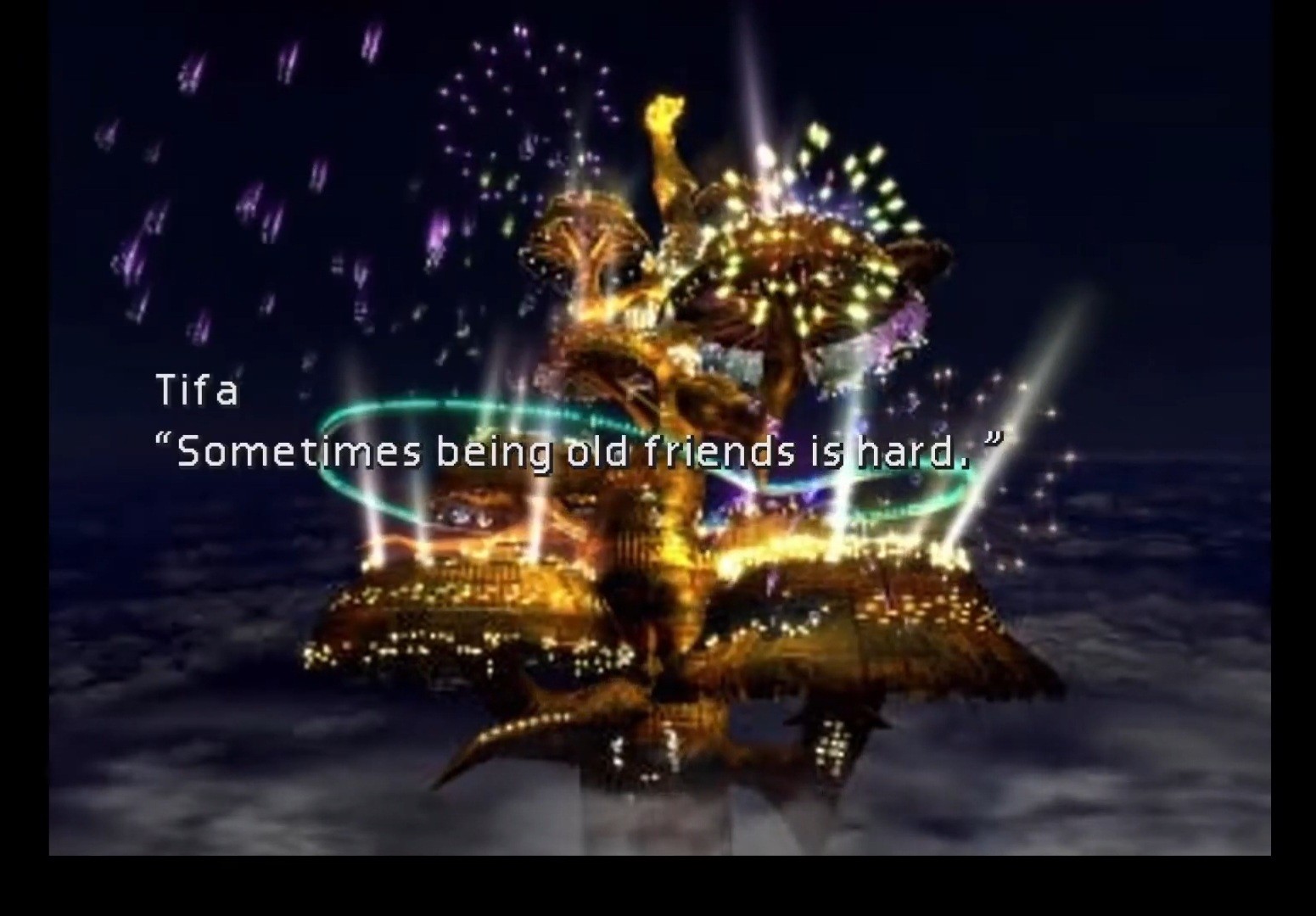
- Weapon – The kaiju “Weapons” get introduced about halfway through the game as a major obstacle… however, they hold very little narrative weight, ultimately coming across as superfluous and pointless. They have very little to do with the main conflict, and don’t really have any reason to oppose our heroes either. Also, if they are so powerful and specifically created to defend the planet, why are they not the ones dealing with Sephiroth…? That said, I can’t hate them, because they feature in two of the most hype moments in the entire game (four if you decide that you want to tackle the extremely challenging Emerald and Ruby Weapon battles).
*On the plus side, if you play with mods then you can mitigate this issue!
Hate
- Three Party Limit – Past Final Fantasy games allowed you to have a maximum of four characters in your party, which was already sadly restrictive, but FF7‘s three character limit is heart-breaking. I really wanted to spend more time with Barret, Yuffie, and Vincent, but once my “main” party was decided upon, I couldn’t justify the time it would take to swap around Materia and equipment. In addition, it would leave my mains missing out on their XP gains, since there is no XP sharing.
- However, what if I told you that your three character party is actually… a two character party? See, FF7 always has one “mandatory” character you cannot swap, meaning that you’re actually only controlling a two character party.
- Random Encounters – Yeah, this is a general Final Fantasy/JRPG complaint, but it’s one that really sticks. It’s incredibly annoying to get constantly interrupted by enemies when you’re trying to get somewhere. It’s not like most of these encounters are all that threatening either, they’re just annoying speedbumps to give you something to do and slowly increase your stats, Materia level, and limit breaks. I didn’t find random encounters all that annoying in FF6, but here it was a much more pronounced annoyance.
- Endgame Content is Tedious – Look, it’s cool that FF7 has optional end-game challenges that you can choose to engage with. However, the work asked of you and the rewards that they provide aren’t really worth it. This might be a controversial “Hate”, but I went from excited to try out this additional content, to dreading it when I realized what it would entail, and then hating it when I actually tried engaging with it.
- First of all, chocobo breeding: if you choose to take up chocobo breeding, you’re expected to spend hours playing proto-Pokémon: hunting and capturing chocobos, hoping that their stats are good enough, racing with them, and then breeding special-coloured offspring until you eventually get a gold chocobo. You also need to do lots of random battles in between steps (so that they have time to mature and breed), and the chocobo races alone take a while to complete… Still, your reward for this is pretty cool: Knights of Round, the strongest summon in the game. It will allow you to bitch-slap Sephiroth in record time, but that’s not particularly satisfying… no, what Knights of Round are here for is…
- Emerald and Ruby Weapon, the two strongest super-bosses in the entire game. They are ridiculously overpowered, so unless you’re spending a ton of time maximizing your stats and getting the absolute best equipment, you will not survive an encounter with either of these bosses. In other words, Knights of Round isn’t really such an amazing reward per se: it’s just something that’s mandatory to even attempt to take down one of these bosses.
- Then there’s the Ancient Forest, a puzzle-based area where the puzzle design is bullshit. You’re basically just playing “guess what the developer was thinking” without any sign-posting to nudge you in the right direction, and while constantly getting interrupted by annoying random battles. Worst of all? The rewards you get for completion just aren’t worth it. In my playthrough, I saved right before the Ancient Forest, completed the challenges, and then accidentally bumped into Ruby Weapon and got annihilated. I had to reload my game to a save before I had completed the Ancient Forest, but I decided that there was no way in hell I was replaying the entirety of this area again.
- FUCKING TONBERRIES – Look, if you’ve played a Final Fantasy game, you get it. We all hate these fucking bastards.
- Disappointing Sound Design – While FF7‘s presentation is top-notch, some of its coolest moments fall short due to the lack of any voice acting or absent sound effects. You’ll get lots of really cool moments in an FMV sequence, but then when the action happens, there’s no accompanying sound effects… it’s like watching a silent era film, it constantly takes me out of the experience.
I’m really glad that I decided to revisit Final Fantasy VII after all these years. I really wasn’t at a point in my life where I could appreciate it. While I do think I prefer FF6 overall, I can very much see why this game was so ground-breaking and widely-beloved. I doubt that the extended media will match this level of greatness, but I’m really curious to see how they expand the world of Final Fantasy VII…
If you liked this article…
I hate ads. You hate ads. In order to stop polluting my site with obtrusive and annoying ads, I’ve elected to turn them off on IC2S. That said, writing still takes time and effort. If you enjoyed what you read here today and want to give a token of appreciation, I’ve set up a tip jar. Feel free to donate if you feel compelled to and I hope you enjoyed the article! 🙂
About the Author
