
Welcome back to the Ace Combat Love/Hate series! Okay… as you probably realized, this isn’t really an Ace Combat game: it’s one of those “bonus” entries I like to do at the end of these series!
During the course of playing and writing about Ace Combat, I got a rough idea for a potential “That Time When” article about the near-death of the flight combat genre*. During my research, I came across a little game named “Combat Ace“. Like… was this an Asylum-level mockbuster meant to trick grandmothers the world over into buying that newfangled airplane game their grandson asked for? Considering that I was in the middle of playing all of the Ace Combat games, it seemed like a golden opportunity to find out. Was Combat Ace indeed a cheap attempt to fool uninformed rubes? Or was this a forgotten, legitimate diamond in the rough in its own right? Only one way to find out…
*At this point, I’m not sure if that article will ever come to fruition. However, even if I don’t cover it myself, it’s a topic that’s really worth looking into. As soon as Ace Combat took a strangehold on the genre in the mid-2000s, competitors died out shockingly fast. We went from several air combat games releasing per year to extended, multi-year droughts around the time the seventh console generation launched. If I do explore this further in future, I would be curious to see if this was due to Ace Combat‘s untouchable dominance, increasing development costs, bad games, legitimate shifts in audience tastes, or sheer corporate greed.
Love
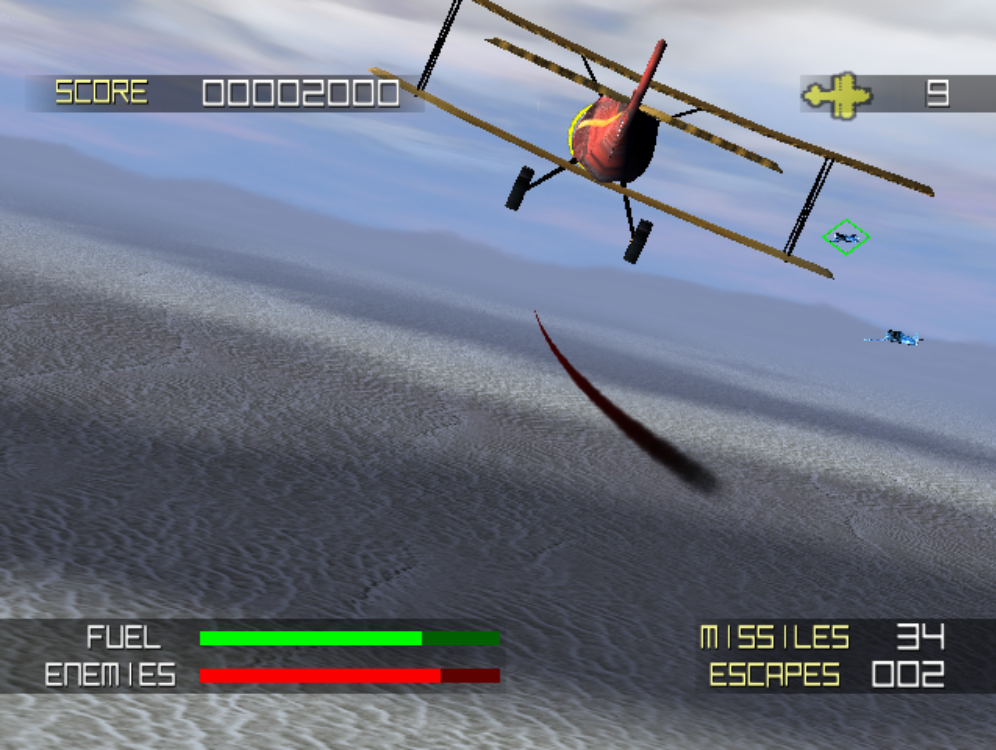
- The Core Gameplay is Pretty Fun – Combat Ace is operating with the basic, tried-and-true formula of the air combat rail shooter: dodge incoming fire and shoot down enemy planes. It looks and feels highly reminiscent to classic rail shooter Afterburner (or, to a much-lesser degree, Panzer Dragoon). It’s not doing anything even close to original, but the formula is so old and refined that it’s hard to really screw it up. When you’re playing Combat Ace and get into a groove, it can actually border on enjoyable at times. However, this comes with a huge caveat…
Hate
- EXTREME Repetition – I’m not exaggerating when I say that, if you’ve played thirty seconds of Combat Ace, you’ve seen everything the game has to offer. There’s so little gameplay and zero depth to its systems that I can comprehensively list off every single thing you’ll see in this game repeated ad-nauseum:
- Enemy fighters flying by the screen, firing shots at you that you need to dodge. You need to shoot down as many as possible to complete the level.
- Enemy bombers which fly up and fill nearly the entire screen. Once in position, they move up and down, and fire off lines of projectiles that you need to dodge. You either pump them full of bullets and missiles to destroy them, or they’ll flying away after harassing you for a few seconds.
- Kamikaze fighters which will come up from behind you, giving you a couple seconds to move out of the way before they ram you and explode. You need to fly to the left or right to avoid the splash damage (which will instantly kill you).
- Then there’s pickups, which show up randomly in the background or after blowing up an enemy plane. You can get bonus points to increase your score, extra fuel (which increases your fuel gauge; you instantly die if it hits zero), extra missiles (you can’t fire any missiles if your gauge hits zero), and extra lives (you get a game over if you die and have none left).
- Kill enough enemies (usually over the course of five-ish minutes) and you’ll move onto the next level… which is identical to all the other levels, except that the scrolling terrain will be a different colour. Keep going until you die or, by some ungodly miracle, you muster the patience to hit the end of level fifteen. That’s literally all there is to Combat Ace. While the base gameplay is kind of fun, it wears thin and becomes tedious within minutes.
- Limited “Escapes” – Why the hell is the ability to dodge a limited resource??? For some incomprehensible reason, you only get three dodges per life. It just doesn’t make sense. If you make dodging a limited resource, then you have to design your game around being able to avoid attacks through movement… which ultimately just makes dodging a pointless mechanic, because you don’t need it. Like… did the developers test this game with unrestricted dodging and found that it completely broke the game? No, wait, that’s impossible: that would have required somebody testing this game in an effort to make it play better…
- Clearly Made on the Cheap – Look, Combat Ace is one of those games that you start up and, within seconds, realize is literal shovelware: a low-quality game made for as little money as possible, which only needs to sell a handful of copies to turn a profit. The game was never meant to be good, only to exist, so as to leech away money from easily-duped customers.
- There are all sorts of insane stories about herculean game development efforts: for example, Doom for the 3DO being developed in less than three months, or E.T. the Extra-Terrestrial being made in only five weeks. These are, frankly, insane stories that make you kind of appreciate those games a bit more in retrospect. However, Combat Ace is one of those games where you start it up and immediately go “oh, this game was made in a couple months, wasn’t it?” There’s no depth, ambition, or artistry to it, it’s clearly been made in such a way as to get a minimum viable product out ASAP.
Look, there’s no sugar-coating this one: Combat Ace is fucking garbage that is obviously banking on Ace Combat‘s popularity to trick uninformed parents into buying literal garbage for their kids. I was actually kind of disappointed by this. Before playing, I was hoping that Combat Ace would at least have had some effort put into it. I had been planning on making this game the bonus Love/Hate entry for a couple months. You can imagine my disappointment when I realized that Combat Ace was so insubstantial that I could barely come up with any impressions at all… that is, until I started looking into how the hell the game ended up like this. Indulge me a bit as we break from my usual Love/Hate structure and peel back the curtains to get a look at the people who brought this game to life…

Phoenix Games
This whole rabbit hole started when I decided to find more info on Phoenix Games, the publisher whose sterling logo proudly (?) adorned the box art and splash screen. I had never heard of these guys before, but the 2000s were an era where we still had a lot of small publishers putting out weird games (such as Monte Cristo, who we covered in my article on adult console games in the 2000s). However, Phoenix Games weren’t just a run-of-the-mill “small European publisher”: they were notorious for releasing literal shovelware throughout the life of the PS1, PS2, Wii, and DS.
I can remember the excitement within the gaming community when the Wii released. Its unique control scheme could be used by developers to create completely new and fun experiences! Unfortunately, these dreams were quickly dashed, as Nintendo dropped their “Seal of Quality“, which had mandated a certain level of quality for games to be released on Nintendo hardware. This, combined with the Wii’s massive install base, and the cheaper development costs (compared to the other seventh generation consoles), meant that publishers began flooding shelves with cheap shovelware. As a result, the Wii stopped being taken seriously as a console for “core” gamers, so the only games you could find for it were either first-party Nintendo titles, or shovelware minigame collections. As you might expect, Phoenix Games were one of the companies fueling this flood of crap that we all hated so much.
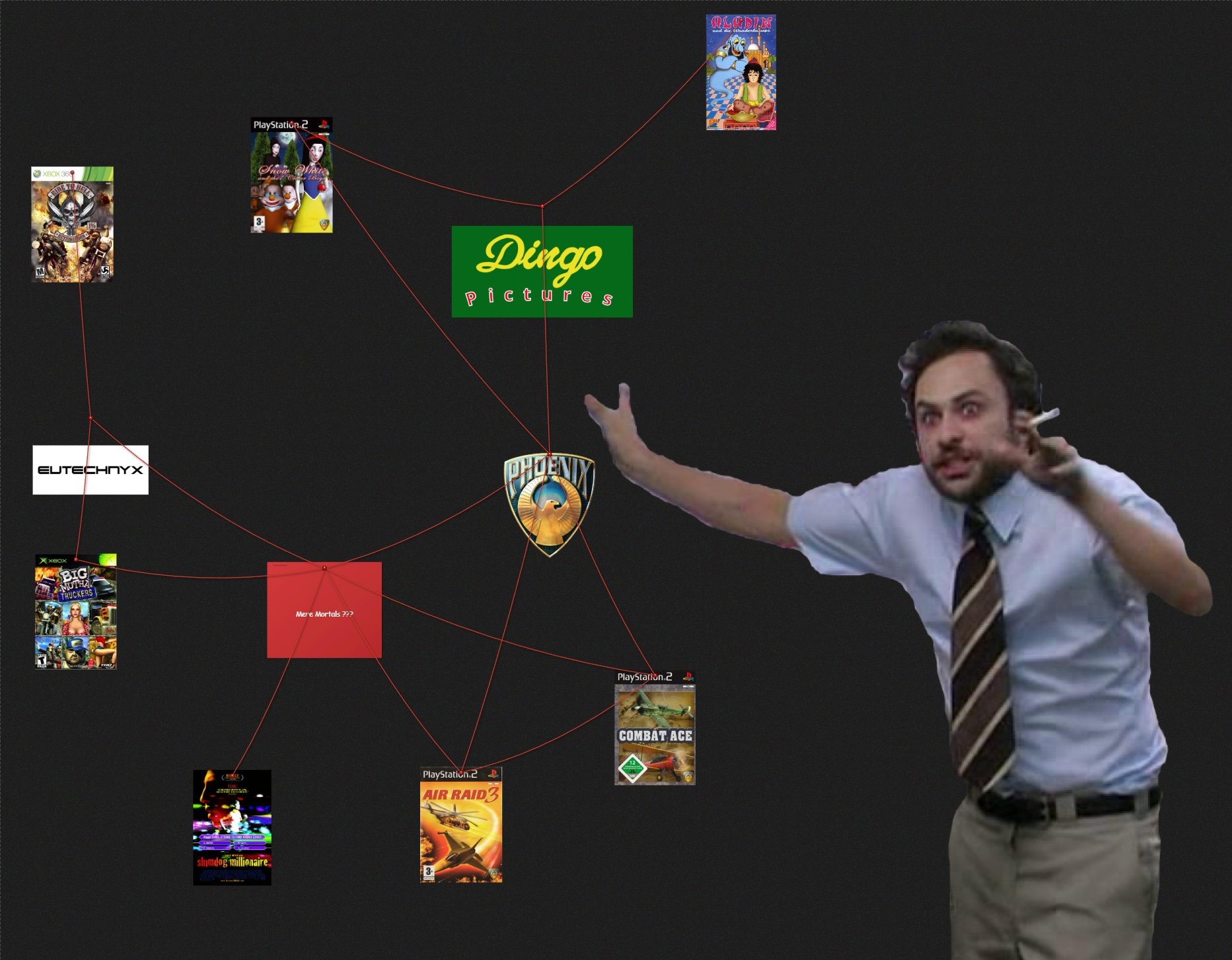
One of the most interesting things I found about Phoenix Games was their working relationship with Dingo Pictures. If you have never heard of them, they are a European animation studio that create knock-offs of famous animated films. Amongst their prestigious filmography are titles such as “The Dalmatians“, “Lion and the King“, “Prince for Egypt“, “Winkie the Little Bear“, and “…even more Dalmatians“. As part of their partnership, Phoenix Games would create adaptations of Dingo Pictures films and then pack the film in with it. I’m not sure if this would be considered cross-promotion, a “value add”, or just pure genius at work. I guess it’s just one more reason for grandma to go “wow, what a steal!” when she grabbed a Phoenix Games title off the shelf back in the mid-2000s.
Mere Mortals
This then brings us to Mere Mortals, the development team that Phoenix Games contracted to produce Combat Ace. They are a real enigma: you can find lists of the many games that they’ve developed, but there’s next to no first-hand information about them. Hell, I couldn’t even find out what their company logo looks like: their internet presence is that non-existent. As a result, all info I have about them has been cobbled together through second-hand accounts and speculation.
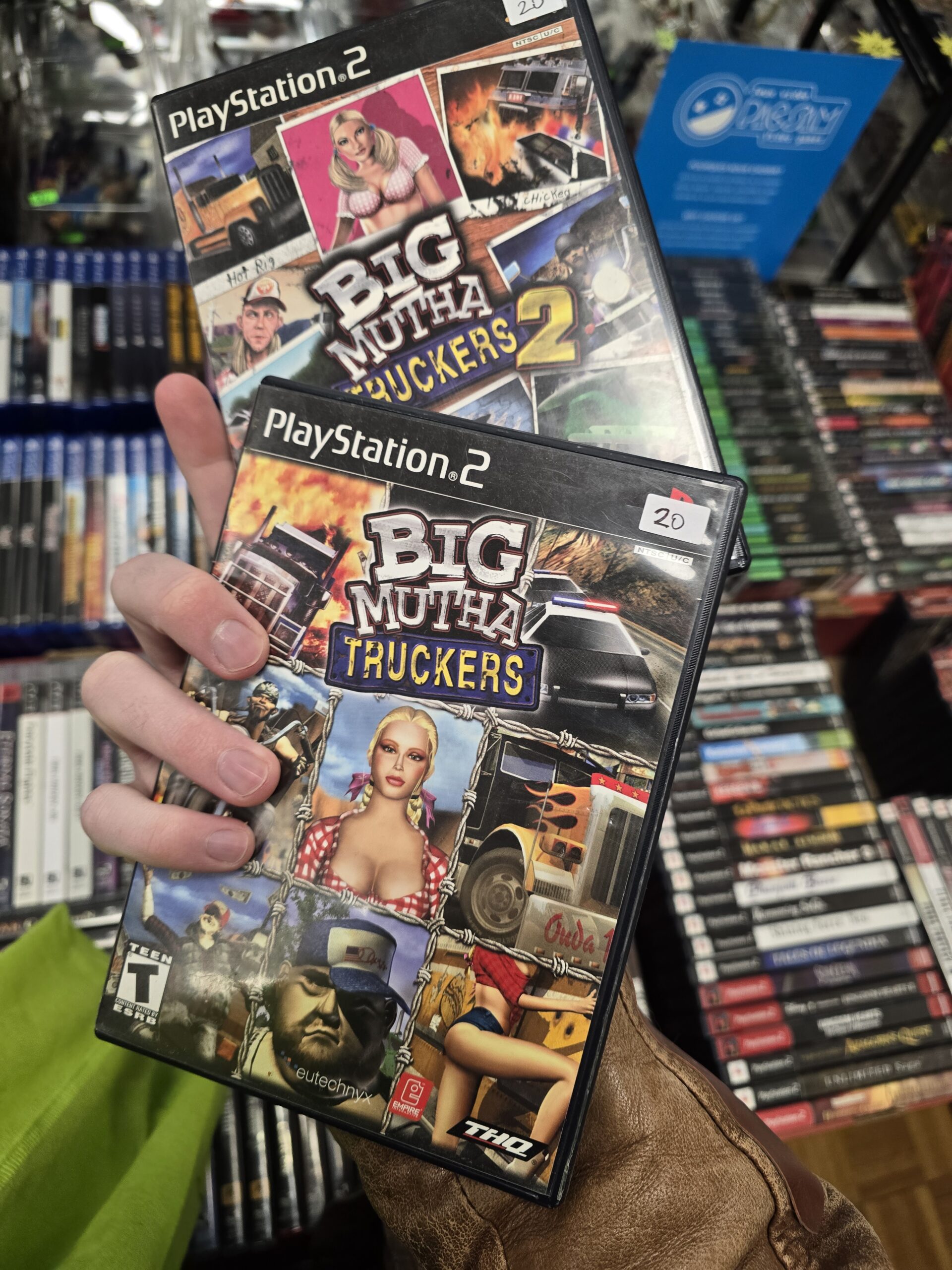
Mere Mortals appear to have been just as much of a support studio as they were an actual developer, as many of the games they worked on were primarily attributed to other studios. They have a couple games in their CV that you actually may have heard of: Big Mutha Truckers and Big Mutha Truckers 2: Truck Me Harder!. However, these were primarily attributed to Eutechnyx*, so I can only assume that they were providing support on these projects. This becomes even more confusing, because it appears that Mere Mortals and Eutechnyx were very closely associated in the company’s early days. They were both based out of Britain, they worked together on several titles in the early-to-mid 2000s, and I believe they may have even shared some staff too. Unfortunately, Mere Mortals weren’t providing development support on such notorious Eutechnyx titles such as Pimp My Ride or Ride to Hell: Retribution, but one can dream.
Within a couple years of their inception, Mere Mortals were thrown into the shovelware mines just to keep the lights on. Despite this, they also somehow caught the eye of Danny Boyle and worked on 28 Weeks Later, Slumdog Millionaire, and Sunshine!? I can’t find anything to actually corroborate this, other than Wikipedia and its uncited source, but if that’s true… why the hell were Mere Mortals stuck making shovelware??? You’d think that, if they’re rubbing shoulders with a major Hollywood director, they have some sort of presence in the industry…?
Combat Ace
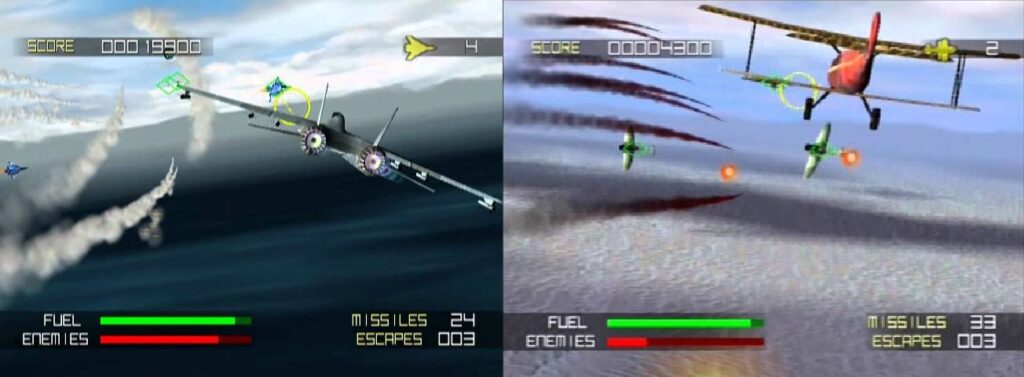
Phoenix Games liked to boast that their games were developed in only three-to-five months… which honestly sounds like a generous estimation for Combat Ace. The game was built using the exact same engine and code as Air Raid 3, a game Mere Mortals had released only three weeks earlier. It doesn’t take a detective to see that Combat Ace is very clearly a reskin of Air Raid 3, with only the most minimal of changes applied. The only substantial difference between the two games is that Air Raid 3 is a modern-day flight combat game, whereas Combat Ace swaps the assets around to make it into a “World War II shooter”… despite the fact that your plane still fires homing missiles. These developers just did not give a fuck.
Suffice to say, basically everything about Mere Mortals’ games (beyond “they exist”) has been lost to history. No one was actually expected to play or enjoy these games, so no one knows how many copies were sold or whether they were even profitable. However, I have a really hard time imagining that Combat Ace was any kind of success, because by 2010 Phoenix Games were bankrupt, and Mere Mortals exited the world of game development in the same year.
And that’s Combat Ace… sorry, kind of an unceremonious way to end this article, but I just found this little tour of the hidden underbelly of the 2000s gaming scene really fascinating. These kinds of publishers and developers were ubiquitous during the early years of gaming, back when the industry was still growing at an astonishing rate and opportunistic people could ride that growth to make a buck. And yet, so many of these small companies went almost completely unnoticed: you could be super-informed on games like I was and still never have heard the name “Phoenix Games” or Combat Aces, because their products were never really intended to appeal to… anyone. They just “exist”, taking up shelf space to dupe uninformed purchasers. When you think about it, it’s a really weird and desperate way to do business: you’re happily choosing to be a parasite sucking drops of blood from the monolithic gaming industry with no real ambition to create anything worthwhile.
If you liked this article…
I hate ads. You hate ads. In order to stop polluting my site with obtrusive and annoying ads, I’ve elected to turn them off on IC2S. That said, writing still takes time and effort. If you enjoyed what you read here today and want to give a token of appreciation, I’ve set up a tip jar. Feel free to donate if you feel compelled to and I hope you enjoyed the article! 🙂
About the Author
