
It’s time for a new Love/Hate series here on ICS2! This time around, we’ll be looking at the Final Fantasy franchise! The release schedule for this franchise will be different than most of my other Love/Hate series on IC2S: these are long-ass games and there are sixteen mainline entries, plus sequels, spin-offs, and supplementary media, so I am definitely not playing every single game in the franchise from start to finish and then releasing articles for them all at once. Hell, at this point, I’m not even certain how many Final Fantasy games I’ll be playing before I call it a day (as of the writing of this sentence, I’ve played three, and I plan on playing at least three more in the near future). Also, I’m casting a wide net for this Love/Hate series: if its name is “Final Fantasy“, then I’m considering it eligible for this list – so not just mainline entries, I’m also gonna allow direct sequels, movies, spin-offs, etc. Whatever I end up feeling like playing is fair game.
Also, just a warning before we get any further: THIS ARTICLE CONTAINS SPOILERS!!!

I didn’t really play JRPGs growing up, but I was aware of the reputation and legacy of the Final Fantasy franchise, so I always was somewhat interested in it. I did eventually play Final Fantasy VII on my PSP, but I didn’t really jive with the JRPG flavour, so I didn’t really get into the rest of the franchise…
…that is, until this year, when the Final Fantasy Magic: The Gathering set came out. I was already excited about the idea when it was announced last year, but the set’s release really unleashed a lot of built-up interest I’d accumulated over the years. I decided that I wanted to check out one of the “classic” entries for my first foray: I wanted to try Final Fantasy VI.
I had heard that this particular entry was one of the best in the entire franchise. Moreover, when I was a kid in the late 90s, I remember visiting a friend and watching this game’s legendary, captivating opening sequence, and I had heard that the game had some monumental twists and turns. It just sounded incredibly intriguing, so I needed to check it out. Would it become a good introduction to the series? Read on to find out…
A note on versions before we get into this, I played the Pixel Remaster of Final Fantasy VI on my Steam Deck. There are a lot of minor changes that make die-hard fans grumble about it, but it’s fairly faithful and easily accessible. I kept accessibility options to a minimum, as I wanted this to be a “true to the intended experience” first playthrough. From what I understand, you also can’t really go wrong with a ROM of the SNES original (just look out for some nasty bugs!), the PS1 anthology version, or the PSP version with some additional content.
Love
- The Narrative – Final Fantasy VI has a very interesting and unique confluence of ideas which make its narrative one of the best in the franchise. It’s a very narrative-driven game, and this can be broken down into several strengths:
- First of all, the narrative doesn’t really revolve around one, singular “main” character. There’s an old saying that the everyone in Final Fantasy VI gets to be the main character, and while that’s kind of an exaggeration, the huge cast of characters all get their own big moments to shine and make an impression on you. As a result of this structure, the game will frequently cause you to lose, gain, or entirely swap party members. In addition, there are also several moments where you get to alternate between two or three entire parties of characters at a time. When playing RPGs, I often lament that I get a “main” party and then feel disincentivized from ever using anyone else, which means I never get to see their storylines, personality or development play out. However, Final Fantasy VI‘s more equitable narrative structure means that you get lots of time to get to know and appreciate everybody in the cast.
- Secondly, the game is really well-paced. Like many Final Fantasy games, it follows a pseudo-episodic structure, where you have to head to a location, complete some sort of unique task, get some direction about your next task, and then repeat the cycle. These missions rarely overstay their welcome, always have some sort of interesting narrative development attached to them, and there’s a fair amount of variety between them all, so even if one mission isn’t vibing for you, you’ll be off on the next adventure before long.
- Thirdly, Final Fantasy VI has some huge narrative developments. If you didn’t take my earlier spoiler warning seriously, this is your last warning to turn around. Got it? Okay:
- First of all, the opera sequence is spectacular, it’s insane that they were able to make this work so effectively on the SNES! It’s such a great, swashbuckling sequence in its own right, with some extra depth added by how we can feel the emotions of the characters involved, but the presentation makes this an all-timer Final Fantasy set-piece. I don’t think that Final Fantasy VI needs a remake, but the temptation of seeing sequences like this brought to life in HD makes the prospect incredibly tempting.
- Then there’s the phantom train sequence, which is a pretty fun set-piece in its own right, but it ends with an incredibly tragic scene for Cyan, who has to see his murdered wife and child off to the afterlife. I find Cyan to be one of the less-interesting characters in the game, but this moment alone makes me feel so badly for him and makes him a memorable party member.
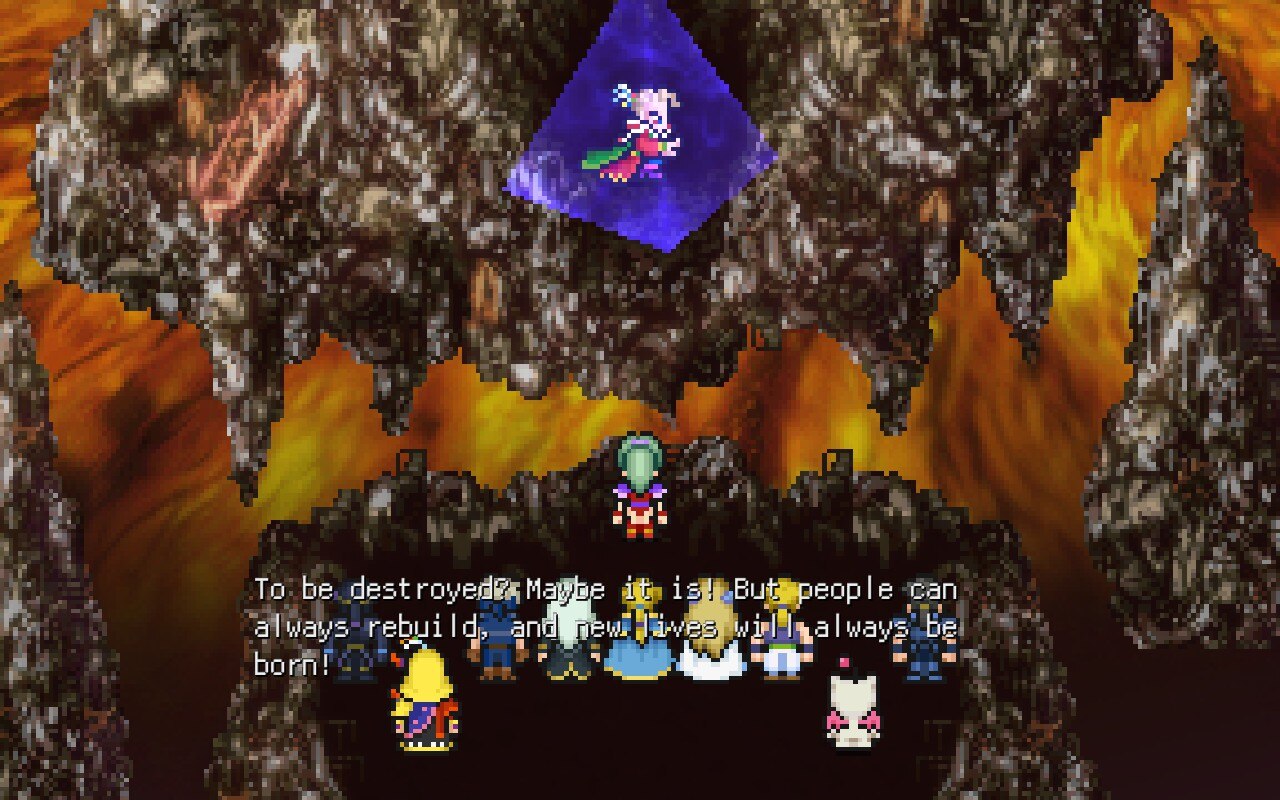
- Then there’s the big twist: the bad guy wins and destroys the world. Right when it feels like the game’s wrapping up, the Emperor is betrayed by his advisor, Kefka, an absolute bastard who has been harassing you for the entire game. He murders the Emperor and uses the power of the Warring Triad to break the world, reshaping it into the “world of ruin”, ascends to malevolent godhood, and scatters the party to the winds. It’s a shocking twist which single-handedly elevates Final Fantasy VI from “good” to “incredible”, as the consequences of this development end up driving the next dozen hours of the game. There’s a profound sense of sadness and loss, which the game captures well with Celes and Cid ending up on a deserted island. This typically ends with Cid getting sick and dying, and Celes becoming so distraught about the end of the world that she tries to end her own life. However, she is able to find hope for a better future, and you slowly get your party back together to face Kefka and end his reign of madness. After witnessing the destruction of the world and regaining the will to fight, it’s extremely cathartic to showdown with Kefka one last time and see how all of your characters have grown and developed over their journey. As Terra says: “Life will go on! There will always be people, and dreams!”, which is just so great: no matter how dark the world gets or how evil people can be, you can find hope and fight back for a better future. I love this game and this ending is a big reason why.
- In spite of all this… Final Fantasy VI is a pretty silly game. Its serious moments are balanced out with some pretty breezy narrative developments and slapstick shenanigans, but this just makes the dark parts hit harder.
- Characters (Part 1) – While I generally like most of the characters in Final Fantasy VI, the cream of the crop has to go to Terra, Celes, and Shadow:
- For Terra, she’s the closest to a “main” character that we get, being our first playable character and central to some of the big narrative developments (that said, she also gets sidelined for an extended period of time for two large chunks of the narrative, so you can’t really call her the “main” character). She’s half-human, half-esper (basically a demi-god), which allows her to use magic innately (which is unusual in this setting, you usually need technology to harness magical abilities). At the start of the game, she has been mind-controlled by the Empire and used as an enforcer, but she is broken free from their control and is left with little understanding of who she is or what her abilities are. She ends up fighting back against the Empire with a group of rebels known as the Returners. Over time, she learns the secrets of her heritage, but still struggles to understand who she is as a person. When Kefka destroys the world, she becomes extremely depressed and loses the will to continue fighting. However, she becomes a protector to orphans and children living in the ruins of Kefka’s world, and slowly comes to realize that she loves these children, that there’s still hope and people worth fighting for, and gains the determination to bring down Kefka once and for all. It’s a very solid character arc, and I really found myself rooting for Terra throughout the game.
- Then there’s Celes, who is low-key the second “main” character we get here. She was a general for the Empire, but she was arrested and tortured for defying orders she felt were immoral. Locke rescues her and the two slowly fall in love over the course of the story. Celes is the central character of the aforementioned opera sequence, where she has to impersonate a famous opera singer in order to lure an infamous rogue and gain access to his airship. Celes’ awakening into the world of ruin also sets the tone for the game’s final act, with her sorrow over Cid and the state of the world being utterly heart-breaking… however, her discovery that Locke may still be alive is the hope that drives the party’s reunion and ultimate defiance of Kefka’s malevolence. It is, again, a great character arc that really makes you love Celes. She especially has a very well-defined character and personality, so seeing that get challenged on multiple occasions is extremely satisfying.
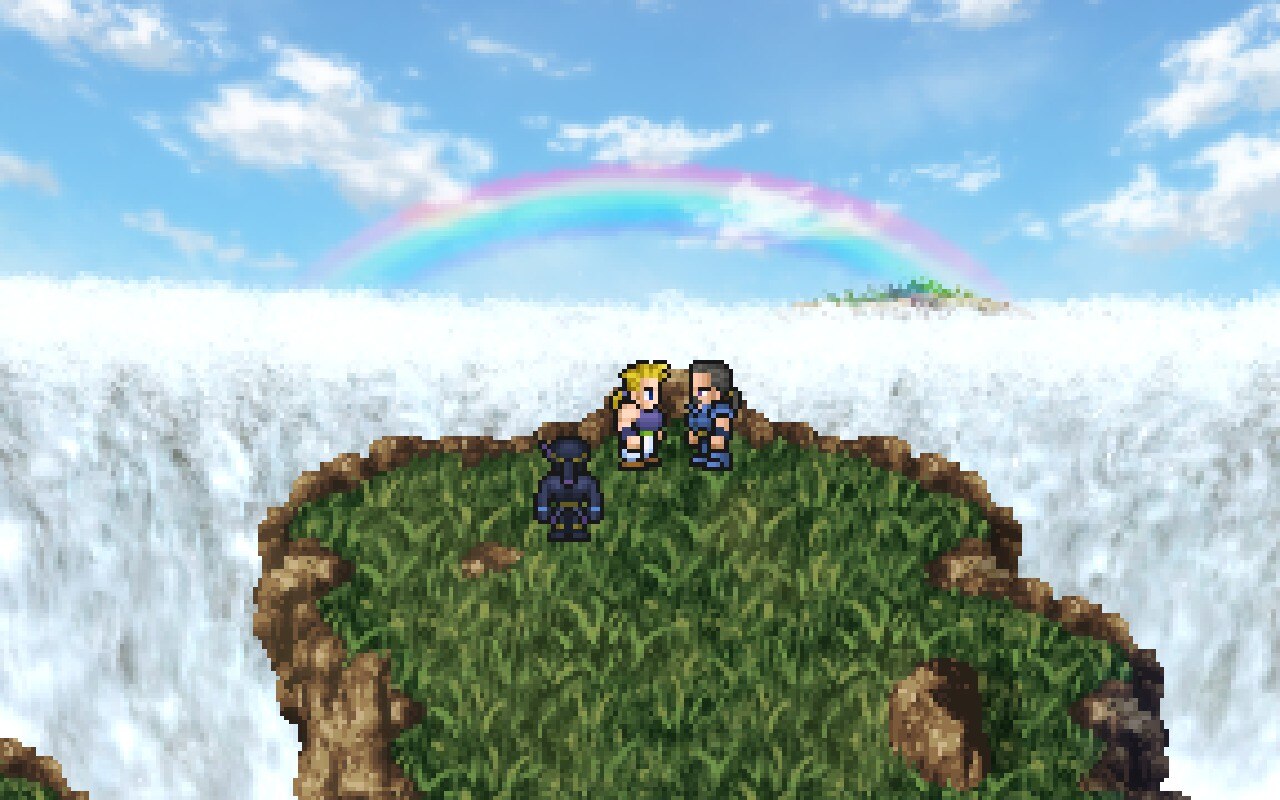
- Finally, there’s Shadow. He’s your typical aloof, moody, dispassionate, mysterious rogue, spending a good chunk of the game providing you with temporary assistance. You don’t learn a whole lot about him directly, and you can entirely miss getting him as a permanent party member if you’re not careful, but as the game goes along, you can piece his interesting and tragic backstory together. Shadow was a thief who, when a heist went bad, left his friend to die. He tried to retire and settle down with a family, but he couldn’t forgive himself for what he’d done, so he abandoned them and lives a life as a cold-blooded, wandering mercenary with his dog, Interceptor. It’s heavily implied that fellow party member Relm is his lost daughter, and the fact that he cannot open up to her or show her affection just makes his character even sadder. This all comes to a head in the finale: when Kefka is defeated, the entire party works together to escape his crumbling castle… except for Shadow. He quietly wanders off, telling Interceptor to go and be with the others, while he stays behind to finally atone for his guilt. As far as he’s concerned, the new, rebuilt world is not one for someone like him… it’s an incredibly tragic and heart-breaking end for this character, and I really wish that he could have found some peace, but his ending as-is is one of the saddest for me in all of gaming.
- Kefka is a Bastard – Okay, I could maybe have folded Kefka into the “characters” section, but this evil monster kind of deserves his own spot on the list, because he’s just that diabolical. I had heard that Kefka was one of the most evil characters in the entire franchise, but I was always skeptical: he’s a literal clown, how intimidating can he be? Well, my friend, let me assure you that Kefka lives up to his reputation. Early on, he indeed is acting like a fool and gets dunked on by the entire party, so you aren’t really supposed to take him too seriously. But, within a couple hours, the guy is out here gleefully poisoning the water supply of an entire castle and its inhabitants, killing Cyan’s wife and child in the process. He is just so over-the-top evil that it’s brilliant: he murders all who defy him (including his fellow generals), genocides the espers to take their power for himself, betrays the Emperor to usurp him, destroys the entire world, and then nukes entire cities on a whim. There are debates about who the ultimate Final Fantasy villain is, and while Sephiroth is the popular fan favourite, Kefka is so close to matching him that it’s an accomplishment in itself.
- Esper System – Final Fantasy games love their unique magic/class mechanics, and Final Fantasy VI‘s is pretty interesting. Around the end of the first act, you gain access to magicite, crystalized shards of magic which are created when an esper dies. You can acquire dozens of different magicite across the course of the game and they can be equipped by characters to provide several benefits. First of all, they provide stat bonuses when a character levels up (which is notable, since characters’ base stats cannot normally be increased otherwise). Secondly, they allow characters to passively learn magical spells over time, based on the spells known by that esper. Thirdly, they allow you to summon the esper contained within to provide a devastating, one-per-battle super attack. It’s an intuitive, unintrusive, and interesting system, allowing you to customize your characters’ abilities as you fit and provide them with bonuses, even if you don’t intend on using any of the spells or abilities they otherwise grant.
- Side-quests and Endgame Content – Final Fantasy VI has an impressive amount of optional content for you to explore, especially in the world of ruin portion of the game (which has a much more open-ended structure than the first two acts). The game is already expansive enough, but when you factor in all the optional content, it’s insane that this game fit onto a tiny 3MB cartridge!!!
- Graphics – I am an absolute sucker for SNES/GBA-style pixel art, and Final Fantasy VI has some of the most appealing graphics of the 16-bit systems. Like, I get that I played the game with the Pixel Remaster version, but the actual game when it was released did not look too far off from this. While it can’t match the cinematic presentation of the PS1 entries and onward, there’s an undeniable charm to this game’s graphics and the things that they were able to achieve with these limitations are at times astounding.
Mixed
- The Characters (Part 2) – Again, I like most of the characters in Final Fantasy VI, but there are a couple which I think fall short of their potential…
- First of all, there’s Edgar, the King of Figaro. He’s introduced within the first hour of the game, a charming, womanizing nobleman who rules a technologically innovative kingdom and uses gadgets in battle. He becomes an absolute mainstay of the party, with his auto-crossbow and chainsaw being extremely useful in every battle you’ll get into. That said… his character doesn’t really get a whole lot of development. He reconciles with his brother, Sabin, he has a lot of weight on his shoulders having to step up and rule his kingdom after the passing of his father… and, uh, that’s about it. He feels like he has a lot of potential, but he just doesn’t do much, which kind of sucks considering how important he was to my paythrough team.
- Secondly, and perhaps more egregiously, there’s Locke. He’s the second character you meet in the game, and it’s heavily implied that he’s going to be A Big Deal™. He’s a
thieftreasure hunter with a tragic backstory: he loved a woman named Rachel who got badly injured when she went treasure hunting with him. When her father found out, Locke was no longer allowed to see her. He tried to find a way to help her, but when he came back, Rachel and her father had been killed in a raid by the Empire. Locke would then spend years trying to find a way to bring her back to life, and part of his storyline revolves around trying to find a way to accomplish this. However, Locke’s A-plot through the game revolves around he and Celes falling in love. He’s conflicted about this due to what happened last time he fell in love, plus his lingering feelings for Rachel. He’s just… kind of bland. He gets some interesting moments of his own, but he isn’t all that impactful to the main plot, nor does he really transcend his archetype of the roguish scoundrel.
Hate
- ATB – I just do not like ATB. This complaint isn’t exclusive to Final Fantasy VI (ATB was introduced in Final Fantasy IV), but it really illustrates why I hate this system so much. In theory, ATB is supposed to make battles faster, more exciting, and more “realistic”, but I find that it just makes combat annoying:
- First of all, it forces you to rush through your move selections as fast as possible, which removes the element of strategy (such as Shadow’s throw command – I’m not wading through a long list of items to find the perfect one to throw at an enemy when I can just use the attack command), or causes you to make mistakes (especially for characters with attack input gimmicks, like Sabin, Cyan, or Setzer).
- Secondly, you’re more likely to miss important information in battle. In particular, if you’re you rushing through your commands, it’s very easy to miss that an enemy has a damage type immunity, or if they have been inflicted with a status condition (as the game does not tell you if they do or provide you with any visual indication).
- Finally, all of this just conditions you to do the same actions every time your character’s turn rolls around. You don’t really have the time to think about what cool things you characters could do, you need to act now or the enemies are going to get their turn first. It makes combat feel like a chore, rather than something you’re actively enjoying.
- The Characters (Part 3) – There’s only one character I actively dislike in Final Fantasy VI, and that’s Gau. He’s not even that badly-written a character: he’s a feral child who the party can take in and he’s got a couple potentially-impactful character moments… but what lets him down for me is his gimmick. Gau doesn’t get to perform standard attacks, and cannot be equipped with most items to give him any sort of boosts. Instead he can learn the attacks of enemies, which is pretty cool conceptually, but the method to do so is ridiculously convoluted. In order to do so, Gau has to fuck off in the middle of a battle, leaving your party for a couple battles before popping into the middle of the battle on the enemy side of the screen to say “hi”. If you accidentally hit him when this happens, he gets mad and runs off, forcing you to re-encounter him (or he can even die and be gone for the rest of the game if you’re really unlucky). His abilities are very random, being dependent on which enemies you encounter during random battles while he fucks off, and he cannot be controlled in battle if you do choose to use him, instead using random attacks of the enemies you encountered when he was gone. Oh, and did I mention that Gau can only learn enemy attacks in one small area of the world map? While you can make Gau really strong if you dedicate time and effort to him… fuck that. I could not stand using Gau in battle, so he was always on the bench for me unless I absolutely had to use him. I disliked Gau so much that, when I was doing my endgame side-quests, I intentionally didn’t bother to have him reunite with his long-lost father, despite it probably taking me only like a couple minutes of time to do so if I had wanted. I hated playing Gau so much, that I actively wanted to leave his life worse-off when I was done with the game.
- The Magitek Factory – The one sequence I actively disliked in this game, and the one mission where it definitely felt like the game was dragging, was the Magitek Factory. I didn’t mind the random battles in Final Fantasy VI too much (aside from forcing me to engage with the ATB battle system more often), but the Magitek Factory makes them get really annoying. This is because this area is quite spread out, so getting to any destination is going to cause you to get into at least three battles before you reach your destination, if not more… and you’d better hope that you got where you wanted to go, or you’re going to have to turn around and reorient yourself, getting into more battles along the way. There are lots of little dead-ends and optional off-shoots here across a few different floors, so this gets old real fast. At least the Pixel Remaster lets you turn of random battles, so if/when I ever replay the game, I will probably do that, because I was getting very annoyed very fast.
Final Fantasy VI took a little while to connect for me, but after a few hours I was really drawn into its characters and world. It’s an extremely impressive game for the SNES era and its narrative is shockingly well-realized and genuinely affecting. I had pretty high hopes for this game, and it managed to meet or exceed them all, cementing off this desire to play/replay the Final Fantasy games I’ve been interested in for years. A lot of people say that Final Fantasy VI is the pinnacle of the series, and I would not be surprised if it stands at the top of my personal series’ tier list years from now.
If you liked this article…
I hate ads. You hate ads. In order to stop polluting my site with obtrusive and annoying ads, I’ve elected to turn them off on IC2S. That said, writing still takes time and effort. If you enjoyed what you read here today and want to give a token of appreciation, I’ve set up a tip jar. Feel free to donate if you feel compelled to and I hope you enjoyed the article! 🙂
About the Author
