
Welcome back to the Ace Combat Love/Hate series! We’ve finally reached the (as-of-yet) most recent entry in the franchise, Ace Combat 7: Skies Unknown. After Ace Combat 04, this was the only Ace Combat game I had played prior to starting this Love/Hate series. I remember thinking that it was pretty good overall, but I had never finished it. As a recall, I got really annoyed at the game because the missions all had very restrictive time limits that gave you barely any margin for error. I think that this is because I played the game on Hard mode, but I never could be certain. Well, for this playthrough I played on Normal mode (same as every other game in this franchise that we’ve covered so far). Would this solve my big frustration from my first attempted playthrough? Read on to find out…
So I happen to have this game on both PS4 and PC. For this playthrough, I went with the PC version at maxed settings. There are VR missions for this game as well, exclusive to the PS4 version. I really wanted to try these out, but unfortunately I don’t know anyone with a PSVR and I’m not willing to shell out a couple hundred bucks to get a used one.


Love
- Mission Variety – Ace Combat 7 has by far the most varied missions in the entire franchise. It takes all of the mission structures we’ve seen from previous games (dogfights, air-to-ground missions, superweapon battles, escort, area defense, canyon runs, and more besides), mixes them in some really interesting ways, and adds plenty of new ideas to boot. Even though some of these missions can get annoying (I’m looking at you sandstorm tanker search level), you’ll be off doing something creative and new quickly enough.
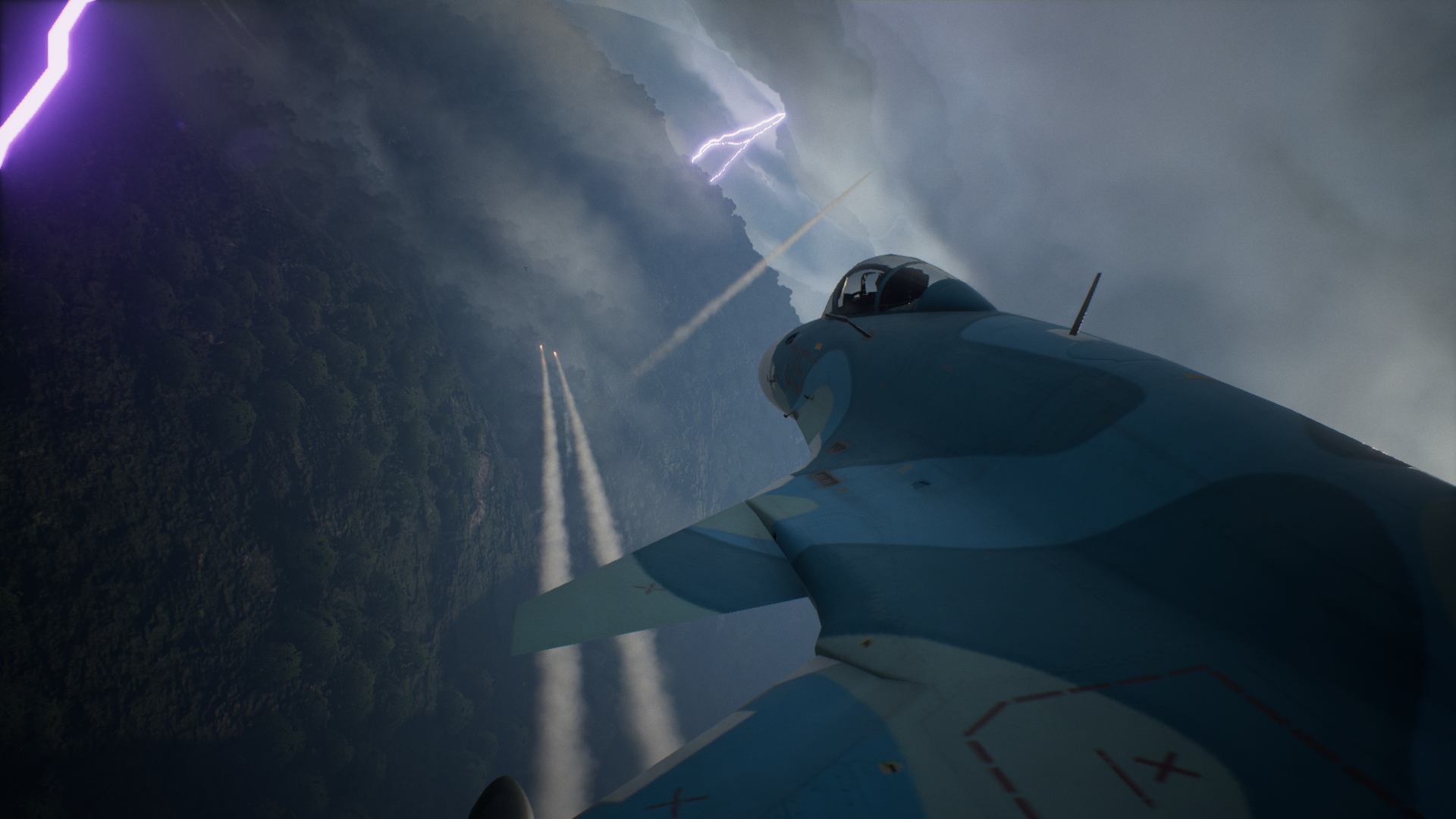
- My favourite missions are probably “First Contact” and “Fleet Destruction”. “First Contact” manages to be one of the most epic missions in the entire franchise thanks to its atmosphere and constant escalation. You go from blowing up enemy radar sites within mountainous terrain, to battling drones in a raging thunderstorm, to taking on a deadly enemy ace and pushing yourself to your absolute limits. Meanwhile, “Fleet Destruction” is a classic “blow shit up” mission, with tons of enemy targets to engage. The floating platforms are what really make this work so well: you can blow up enemy units individually, but the most efficient approach is to try to blow up the entire structure in one go, which involves some precise, skilled, low-altitude flying to pull off. This level also has by far the most restrictive time limit, so you really have to push yourself to maximize your score.
- Part of the reason why this game’s missions are so much more varied now is thanks to the addition of weather conditions, which can be mixed with the various mission archetypes to produce near-endless combinations. Most notably, clouds are an actual hazard now. Not only do they obscure your vision (especially if you’re in cockpit view, which causes your entire canopy to be covered in rain droplets), but staying inside the clouds for too long causes ice to build up on your plane, lowering your plane’s mobility. Clouds also interrupt your missile lock-on, so a cloudy mission can become a legitimate annoyance. There’s also thunderstorms, which bring all the issues of clouds, but with an added bonus of random lighting strikes to your airplane, causing your HUD to glitch out and for you to lose the ability to lock-on to a target at random for about half a minute. I didn’t mind this though, because bolts of lightning look amazing and it’s badass as fuck to be fighting in a goddamn thunderstorm!
- The Story (SPOILERS!!!) – Perhaps the most surprising improvement Ace Combat 7 brings to the table is a much stronger emphasis on story: in fact, I’d say that Skies Unknown is easily my second-favourite story in the entire franchise:
- First of all, the actual writing and performances in Ace Combat 7 are quite solid. While most prior entries struggled with overwrought dialogue, bad voice acting, generic plotting, or all of the above, Ace Combat 7‘s dialogue feels natural (aside from some cutscenes in the latter-half), and the performances are all quite good. It doesn’t feel like an afterthought that was strung together after all the levels were designed, it feels like they actually considered the narrative to be an important piece of the puzzle during development.
- Most of all though, the narrative itself is much more interesting – while the overarching storyline is not about to win any awards, it’s easily the most unique entry in the franchise thanks to some major narrative developments which translate to exciting new gameplay shifts. In particular, getting court-martialed early on and sent to a penal squadron is a really cool concept (even if the idea of giving criminals and murderers armed fighter jets is insane), and flips the power fantasy of these games on their head. In the late-game, we also get to see the devastating effects of large-scale information warfare. It genuinely shakes the entire game up and presents some really intriguing possibilities at a time when it felt like the game was getting back to the familiar formula. Considering that these games often make you overpowered early on and you just steamroll your way through the enemy, having the script get flipped and for you to suddenly be on the backfoot even into the late-game levels is quite an accomplishment. The stronger emphasis on story and its integration with the gameplay is easily one of the standout improvements of Ace Combat 7.
- Also, Ace Combat 7 really pays off all the world-building that had been done for Strangereal over the past couple decades. While the Ace Combat games were (mostly) taking place in the same setting, there was rarely any crossover: they were effectively stand-alone stories, requiring no knowledge of prior games to enjoy. While Ace Combat 7‘s story is enjoyable if it’s the only entry you’ve played, it has several references and callbacks to prior titles, which can make the game extremely exciting for fans of these games. I geeked out hard when the game told me that we were going back to Stonehenge and were going to use it to blow up the enemy superweapon! Probably best of all, these callbacks do not feel ham-fisted: most of them are reasonably subtle and feel justified within the narrative (plus the game is not afraid to piss some fans off, as some of the returning figures get dispatched rather non-ceremoniously).
- Return to Form – After the last several Ace Combat entries tried to reinvent the franchise’s formula, only to dumb down the core gameplay in the process, it’s nice to see Ace Combat 7 return to the classic mechanics perfected during the PS2 era. The game clearly draws inspiration from the “holy trinity”, for its game feel, story structure, and mission design, which feel like refinements of the best aspects of Ace Combat 04, 5, and Zero. Most of the new gameplay mechanics introduced from 6-onwards have been dropped as well. While I would have liked to see a refinement of Ace Combat 6‘s operations, I think going back to what they know works was ultimately a good thing.
Mixed
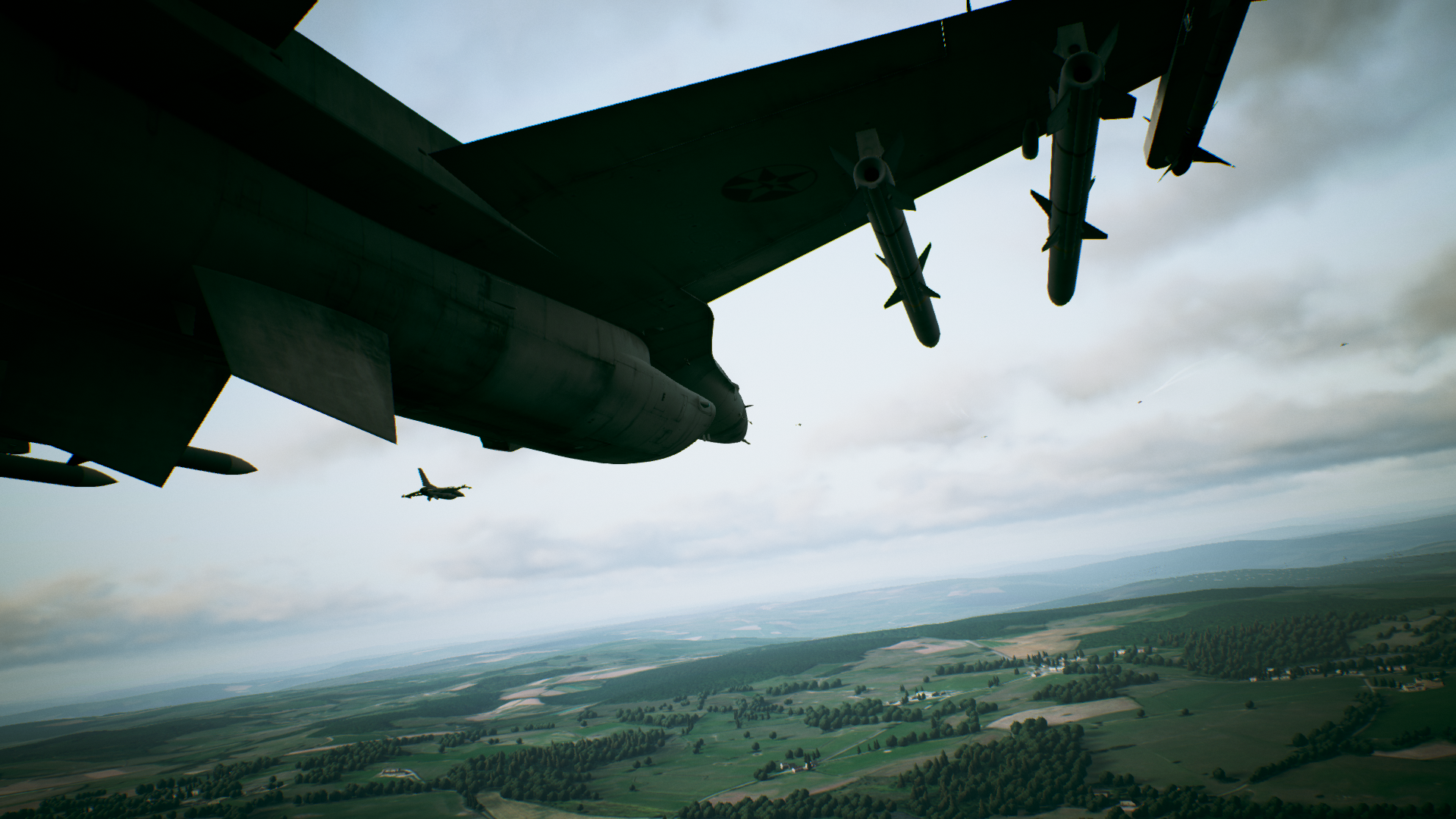
- Aircraft Tree – One of the biggest innovations of Ace Combat 7 is its new progression system, the “aircraft tree”. This is basically a tech tree system which allows you to unlock new planes, weapons, and parts through currency earned in-game. While the system is really cool, I feel like it needs a bit more refinement. For one thing, all purchases in the aircraft tree are non-refundable, so you if you purchase something and then decide that you don’t like it, sucks to be you. Branches on the tree also rarely intersect, so you need to plan your route out from the start and then commit to it. Also, it’s probably worth saying that this system means that you don’t get nearly as much aircraft variety in a single playthrough as you would in most other Ace Combat games. Unless you’re buying all the cheapest aircraft available, you’re probably going to be flying the same two or three aircraft for nearly your entire playthrough. Granted, this does somewhat incentivize follow-up playthroughs where you carry over all your unlocks to try out new aircraft and upgrades. Despite my gripes, this system is a pretty great idea in concept, but with a bit more refinement this could have easily been a “Love”.


Hate
- Wind Currents – While I do think that most of the new weather/area hazards Ace Combat 7 introduces really help to shake the gameplay up, I really don’t like the way wind has been implemented. Wind seems like a reasonable thing to incorporate into a flight combat game, but it ends up being a massive pain in the ass. You’ll be flying along when suddenly, with zero warning or way to avoid it, you lose control of your aircraft and get pushed around in all directions. This is bad enough when it happens in open skies, but when it happens close to the ground it can literally be mission-ending. They’re also completely invisible, so you can’t avoid them – they’re purely designed to be a fun-sucking annoyance you have to react to.
- Cheating AI – It’s really annoying to me that, after all these years, Project Aces’ design philosophy for “hype moments” is still to just make the enemy AI cheat like a fucking bastard. As awesome as it is to battle an enemy ace or a superweapon, when the actual fight plays out and it turns out that they can do things that break the normal rules of the game… it just sucks, man. In particular, Milhay’s the main enemy ace you’ll showdown against, but he moves so fast and can turn so sharply, that you basically only get to land a hit on him when the game tells you that you can. You can end up wasting a ton of ammunition trying to figure out when the game is going to let you actually hit (which can be a serious problem, because these fights tend to come as the second-half of a longer mission, so you’re already low on missiles and possibly HP too). Probably most annoyingly of all though is the Arsenal Bird showdowns, as this superweapon can fire tons of missiles which track you endlessly, unless you deploy your flare countermeasures (of which, you have a very limited number available). You can get around this by destroying all of the missile launchers, which feels borderline-mandatory if you want to survive this fight, because they are very difficult to dodge normally while also focusing on taking the Bird down.
If we take a good, honest look at this franchise’s evolution, Ace Combat 6-onwards faltered because they were trying to reinvent the series’ formula and failed. Ace Combat 7 succeeds in large part because it falls back to what worked in the PS2 titles, and ends up being one of the best entries in the franchise for it. While I really enjoyed Ace Combat 7, it doesn’t really do a whole lot new, which is why I have comparatively little to say about it. That’s not a bad thing by any means, but it is a really strong indicator that Project Aces really had nailed the Ace Combat formula early on and trying to improve on that is arguably a fool’s errand.
Also, I’m happy to report that the timer was not an issue for me this time! I am not sure if that’s because I played on Normal mode vs Hard mode in my initial playthrough, or if I’m just more used to how these games played vs my initial playthrough where I hadn’t played an Ace Combat game in more than a decade. Whatever the case, I’d recommend playing on Normal unless you’ve beaten the game and/or are looking for a more serious challenge.
If you liked this article…
I hate ads. You hate ads. In order to stop polluting my site with obtrusive and annoying ads, I’ve elected to turn them off on IC2S. That said, writing still takes time and effort. If you enjoyed what you read here today and want to give a token of appreciation, I’ve set up a tip jar. Feel free to donate if you feel compelled to and I hope you enjoyed the article! 🙂
About the Author
