
Welcome back to the Ace Combat Love/Hate series! In this entry, we’ll be going over Ace Combat 3: Electrosphere, the final series entry released on PS1. This was also the last game released in the franchise before I got on board, so I’ve always been curious to see how good it was in comparison to Ace Combat 04. I’ve heard glowing praise for it over the years, so I was definitely excited to finally get the chance to try the game out. Would it live up to my expectations? Read on to find out…
Before we get into my thoughts properly, I need to go over something that makes Ace Combat 3 stand out from the rest of the franchise: the Japanese and international versions of the game are vastly different experiences. The reasons for this discrepancy haven’t been officially stated, but it’s speculated that Ace Combat 2 sold below expectations, so Namco decided to cut costs on the sequel by skimping on localization. As a result, they cut out most of the story, characters, cutscenes, and voice acting, excised sixteen missions, and removed multiple gameplay features, which led to a much more linear, stripped-down experience for international markets. As a result, I’m going to handle this Love/Hate similarly to how I handled the differences between Ninja Gaiden 3 and Razor’s Edge: commentary specific to the Japanese version will have the (JPN) tag, commentary specific to the international version will have the (INTL) tag, and general commentary that applies across both versions will be tagged (both).
Love
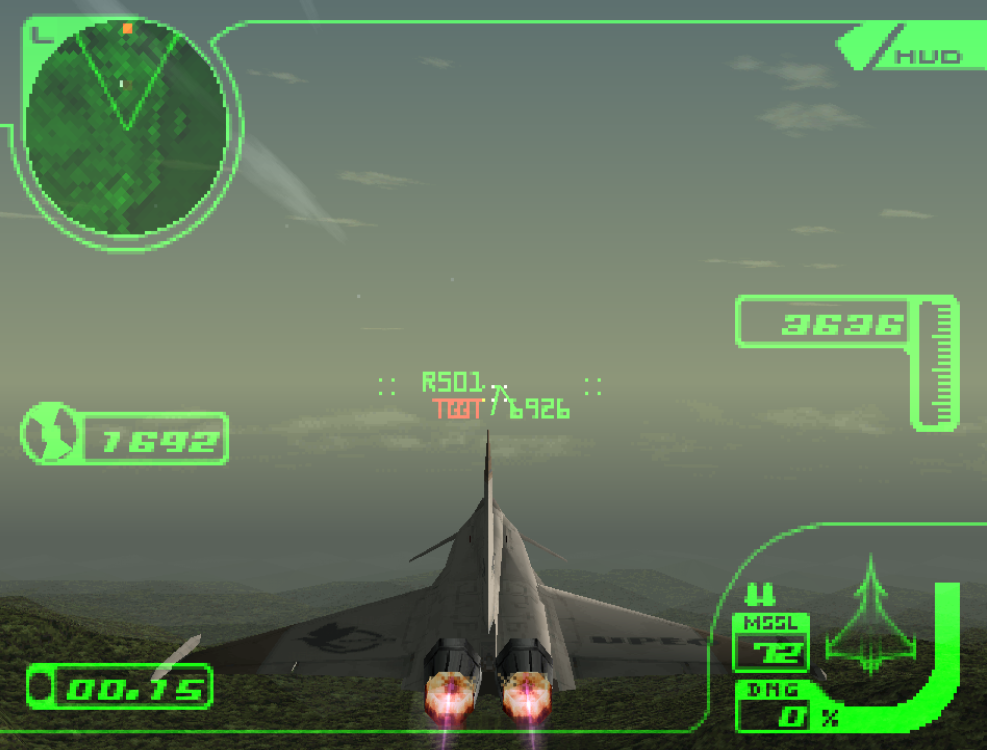
- Camera Controls (both) – My God, they finally added the ability to use the right analog stick to look around your plane, allowing you to get a better view of your surroundings without having to physically maneuver your airplane around. This is good enough on its own, but the real coup Electrosphere pulls off is that you can now hold down triangle to center the camera on your chosen target. This allows you to see how they’re moving in relation to you, allowing you to easily maneuver and get your nose lined up with them. It’s literally a game-changing refinement that I use constantly in every single mission, and I’m so glad to finally see it introduced to the franchise!
- Branching Paths (JPN) – Easily the most celebrated aspect of the Japanese version of Electrosphere is the game’s branching narrative pathways. At fairly regular intervals, a character will ask you to choose between two options on how to proceed, which results in some major shifts to how the narrative plays out: your faction allegiance can change, characters can die, and other characters can become your enemies going forward. Suffice to say, choosing one route over the other locks off multiple missions from your current playthrough, incentivizing at least four replays if you want to see everything the game has to offer. This also affects what planes you have access to in your missions, as each faction has a limited arsenal of aircraft available to them. It’s a cool feature and surprisingly impactful on the way your playthrough will unfold.
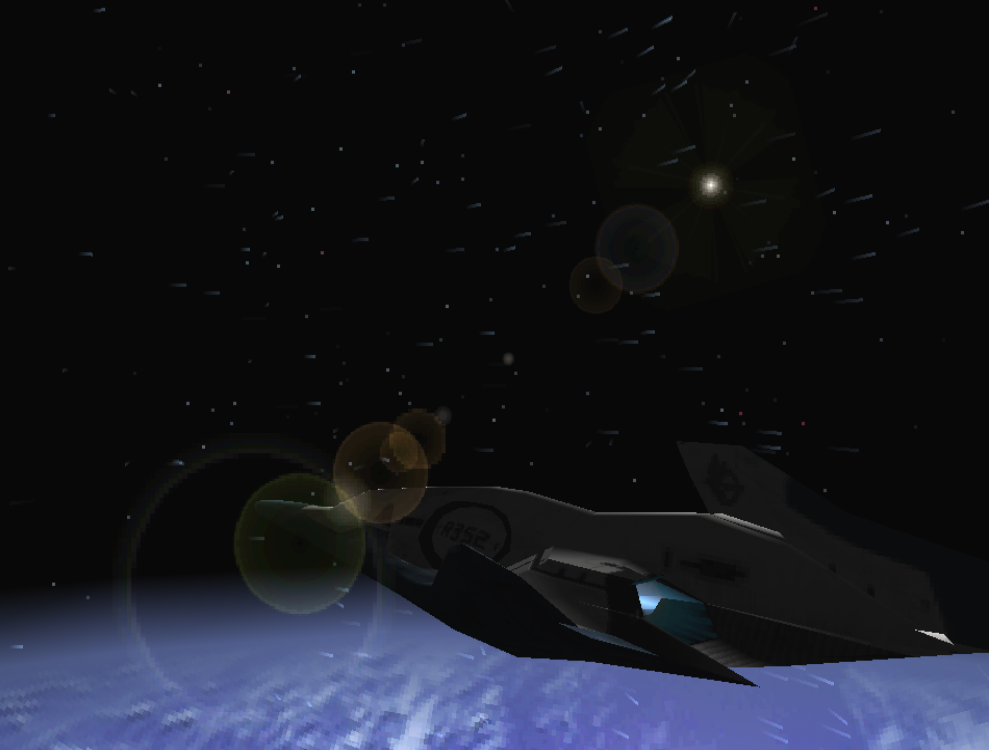
- Space Missions (both) – In keeping with its shift to a sci-fi setting, Ace Combat 3 introduces some high-altitude and space-based missions. While these missions aren’t very substantial by themselves, they do shake up the gameplay in an interesting manner and bring with them some really unique and cool visuals that makes them quite memorable.
Mixed
- It’s Quiet… Too Quiet (INTL) – Look, I know that I complained that there was too much radio chatter in Air Combat, but the international version of Electrosphere has gone way too far in the other direction, to the point where your missions are eerily silent. You’ll occasionally get an audio cue, but it’s only in specific circumstances (stall warnings, destroying an enemy, ground proximity warning, taking damage, etc). When you’re playing the game, this feel like a really odd dedsign decision, but it’s entirely due to the cheap, butchered localization process, which removed 99% of the voice acting. The game still plays fine enough without it, so I can’t really say that I “hate” this, but it is noticeably strange.
- No More Money/Purchasable Planes (both) – In most Ace Combat games, you earn money for destroying enemy targets and completing missions, which you then get to spend on new aircraft. You also had the option to sell off your older aircraft in order to afford new ones, which was usually worthwhile, because newer/more expensive aircraft were always straight-up upgrades. However, Electrosphere does away with this entirely, instead giving you new planes as rewards for completing missions. I’m definitely mixed on this. For one thing, you aren’t really incentivized to deal with non-mission-critical targets if there’s no money tied to them, especially since some missions have consequences if you take too long to deal with the main target. This also means that your hangar is filled with a bunch of completely outclassed planes that you have to sift through every time you start a new mission. On the other hand, this isn’t an inherently bad system on its own merits, I just don’t really understand why they made this change in the first place.
- Also, weirdly enough, this ties into one of the few benefits to the international version of the game. In the Japanese version, your available planes are tied to the faction you are currently aligned with, whereas in the international version, you just unlock planes from all the different factions and can use them whenever you want. Obviously, there are narrative reasons for this in the Japanese version, but sometimes you just want to use your favourite plane, y’know?
- Weapon Options (both) – Some planes come with alternate weapon options, which is a nice new feature! However, this comes with some notable drawbacks. It’s hard to tell what the actual differences are between weapon options without using them, because all you get is a bar which shows the weapon’s relative stats. For example, the short ranged missiles can be fired faster than standard missiles, but they have a much shorter range in comparison… how short, exactly? No idea, use them and you’ll find out. Or how about the MIRV missiles, which fires multiple rockets, but they do less damage each… how does this actually translate in-game? Hell if I know, but it was ultimately costing me more shots to shoot down planes when I tried them, so I just stopped using them. The only options that are actually worth considering are the machine gun options, since the trade-off in fire rate and damage actually makes sense and there’s some legitimate pros and cons that you can wrap your head around. It would be nice if there was some actual balance to these “options” so that they didn’t just feel like no-brainers or like you’re handicapping yourself to try to get some variety.
- Sci-Fi Setting (both) – One of the big ways that Electrosphere differentiates itself from its predecessors is that it takes place in a futuristic, cyberpunk setting. Instead of warring nations, we’ve got two mega-corps with their own militaries battling it out, and most of the game’s aircraft are entirely fictional.
- In the international version, this is surface-level stuff since the story, characters, and voice acting have been mostly stripped out. As a result, it feels arbitrary and less compelling – I wanna play with my real planes, not a bunch of fictional aircraft!
- In the Japanese version, you can really tell that they were heavily inspired by the 1995 Ghost in the Shell movie, which would have released a couple years prior to the game’s development period. In fact, Production I.G (the studio which animated Ghost in the Shell) were hired to produce this game’s animated cutscenes. These cutscenes aren’t particularly impressive or ambitious, but it’s cool and definitely a huge step up from the virtually-nonexistent story presentation of the previous two games. With the stronger emphasis on story, it justifies the shift to a sci-fi setting, which is enough for me to keep this point in the “Mixed” category rather than “Hate”. However, that said…
- The Story (JPN) – The Japanese version of Electrosphere heavily emphasizes story, so it kills me that it is just not very good. Like I said earlier, it’s heavily inspired by Ghost in the Shell, with some light philosophizing about existentialism and disassociation/dehumanization while experiencing the world detached through the Internet. The game just doesn’t do a whole lot with it, introducing some characters who will ramble at you in a long-winded, dull, generically-anime manner (ie, explaining something to you, and then saying “in other words…”, only to explain the exact same thing to you again with slightly different wording…).
- Unfortunately, this really kills the weight of the game’s choice system. None of the characters are particularly compelling, and there’s no cause for you to latch onto in order to justify making decisions for anything other than purely mechanical purposes. For example, you begin the game playing as a pilot for the UPEO (basically this game’s UN faction). You train with a pilot for one of the mega-corps for a couple missions and then he suddenly asks you to defect to join him. The game does absolutely nothing to justify why you would think “yeah, I’ll upend my entire life to follow this guy I barely know!”, so of course I declined and he acts as if he’s personally offended by my decision. Like, I dunno man, maybe learn how to hustle instead of being such a bitch? More egregiously, there’s a later level where, out of nowhere, you’re ordered to kill your boss and a friend that you had just been defending/escorting. These orders are clearly suspect, so of course I refused to follow-through with them, but one of my companions says “wow, how dare you refuse to follow orders!” and cuts off all contact with me (despite me committing insubordination at their behest earlier in the game). Oh, and then there’s a point where you’re asked to join a coup, but are told “I don’t have time to explain!”, so you have to either decide to join this person you barely know, or stay with your current faction. I decided to join them but, hilariously enough, the story then immediately has you betray the coup and go rogue anyway. The implementation of these choices just doesn’t make any sense and really dulls the potential impact that such a robust branching path system could, and should, have had.
- I also just don’t really like how “personal” the game’s scope is. Previous Ace Combat games had a “macro” level scope, where you were just a cog within a larger war effort. I really liked this, it felt realistic and it was cool seeing how your efforts slowly turn the tide. Here, you’ve got individual pilots going off and doing their own thing, deciding the fate of millions with their mercurial squabbling. It’s excessively melodramatic and ends up making this story feel very cartoonish in spite of its grander ambitions.
- It also needs to be said that this emphasis on story comes at the detriment of everything else. Because the game needs to account for so many branching pathways, and because they legitimately want these routes to be different, the developers have to program 2.5x as many missions as there were in prior Ace Combat games. As a result, missions are notably less-fun than prior games were. This is also probably why the weapon options feel half-baked, since they would have spent the entirety of development on default weapon loadouts and then added the others later as extra variety.
Hate
- Engagement Distances Are Off (both) – If you’ve played any other Ace Combat game, then Electrosphere feels “off” the moment you boot it up. It took me a little while to really come to grips with what was wrong, but I think I know the core of the problem: combat has been made much more close-range than previous games, but the scales are completely out of whack, resulting in gameplay that feels sluggish and slow. Part of the reason I didn’t realize this sooner was because Ace Combat 3 no longer gives you the option to display distances in imperial or metric as preferred. Instead, it opts for a hybrid system where feet are used for distances and everything else is in metric. As a result, it feels totally normal when your missiles start locking on at 1500ft, giving you plenty of time to land a shot… until you realize that that’s actually less than 500m, which would have been a very close-ranged engagement in previous Ace Combat titles. Hell, I was literally just complaining about Ace Combat 2‘s 900m lock-on range, so this should be a catastrophic change… but, no, it feels like you have a “normal” amount of time to get a shot off, so something is off: either the speed the game tells you you’re going isn’t accurate, or the distances are not to scale.
- Check out the video below, which I captured during my playthrough on my Retroid Pocket 4 Pro, for a demonstration of this in action. In the video, the game tells me that I’m 1668ft from the target and that I’m going around 1,000km/hr, decelerating to just over 700km/hr by the time I reach the target in just under seven seconds. However, if my math is correct, my actual in-game speed would have to be closer to 260km/hr given how long it takes me to cover that distance. I can only conclude that the game is just straight-up lying to you about your speed, the distances, or both. To be fair, these large numbers and distances are fairly arbitrary within the framework of the game – if Namco wanted to, they could just make up fictional units of measurement and it wouldn’t make a huge difference to how the game plays. However, when speed and distances are not lining up as expected based on what the game is telling you, it makes Ace Combat 3 feel palpably slower than its predecessors and makes it harder to judge whether you have time to line up a shot or not.
- Poor Controls (both) – Building off of the previous point, planes feel incredibly sluggish in Electrosphere compared to other Ace Combat games. Some planes in these games have noticeable, baked-in delay and acceleration between making a turn and actually having it execute, while other planes just seem like they take forever to complete a turn. This is especially pronounced in the early game, when you only have a few aircraft to choose from. There are some planes that feel like you’re constantly wrestling with the controls, like the MiG-33 and the Remora. Making matters worse, the distance required to complete a turn with some of these planes is insane. The most egregious offender is the high-altitude Blackbird fighter, which requires 5,000ft of clearance in order to make a 180° turn!!! It feels awful when there’s a target below you that you want to take out, but you have to fly vertically a few thousand feet first to be able to even attempt to do so safely (and God help you if you miss the target on the strafing run and have to do it again).
- Granted, this definitely felt worse from start-to-finish in the international version compared to the Japanese version, where it is somewhat mitigated once you unlock better planes (and aren’t forced to use the Blackbird or Remora). It’s still frequent enough though that I really can’t consider this a version-exclusive issue.
- The Story (INTL) – With no cutscenes and limited voice acting, the “narrative” of the international version of Electrosphere is extremely basic and unsatisfying. You’ve basically got two militarized mega-corps getting into a pissing match, and you’re part of a peacekeeping organization trying to get them to de-escalate… by flying in and single-handedly bitch-slapping them both into submission again and again. There’s a bit more to it than that, but the narrative setup in this version of the game just pisses me off: it feels like you’re parenting a couple whiny children across thirty-six drawn-out missions, which gets exhausting before long. For as simple as their narratives were, at least Air Combat and Ace Combat 2 felt like you were making forward progress with every mission completed; in this version of Electrosphere you’re just herding cats for four hours.
- Cheating AI (both) – Dogfights in Electrosphere can get really tedious at times, because enemy planes will often straight-up cheat:
- First of all, your missiles just don’t work sometimes for no discernable reason. I’ve had multiple occasions where I am perfectly lined up about 400ft behind an enemy plane, I fire off four missiles, maintain my lock-on… and they all just miss the target for no discernable reason. It’d be one thing if I was too close to the target or they were taking evasive maneuvers, but the missiles refuse to accept the lock-on, just because. Seriously, I don’t think there’s any other reason for it, the game just decides to give you the middle finger for artificial difficulty sometimes.
- More egregiously, I can’t count the number of times I passed an enemy plane and then a second or two later, they’ve turned around and are on my tail. If the game was playing fairly, this should be impossible: it takes you several seconds to complete a 180° turn, and the arc on these turns is quite wide, so this is just straight-up cheating on the game’s part. This becomes ridiculously painful in levels where you get stuck with the aforementioned Blackbird, which can take upwards of ten seconds to complete a turn. As a result, by the time you complete a turn to try to line up with an enemy, they have probably turned around and are on your tail now, making these dogfights very tedious and drawn out. However, in spite of that…
- Difficulty (both) – In spite of what I just said, Electrosphere is a ridiculously easy game, to the point of inducing boredom. Unless otherwise noted, in all of my Ace Combat playthroughs, played on the “normal” difficulty setting, but this was the first time that it left me bored to tears. Enemies may maneuver in such a way that you struggle to hit them, but eventually they will decide to fly in a straight line for no other reason than to let you kill them. Meanwhile, you’ll rarely get shot at, even by enemy gun emplacements and SAM batteries. Hell, the only times I ever died in the game were due to the sluggish turns causing me to crash into terrain, cementing my opinion that the controls are the biggest threat in Electrosphere.
- Actually, that’s not entirely true – right at the end of my playthrough of the Japanese version, I died to the final boss once because it was incredibly cheap: this enemy plane flies and maneuvers faster than you can, and fires off lasers that you cannot dodge, meaning you have to just constantly fly in a zig-zag pattern or low to the ground to avoid taking damage. Even then, I can’t possibly consider this game difficult at all unless you’re going for S-ranks on missions (which, considering they removed any financial incentives, I honestly couldn’t give less of a shit about).
- Pacing (INTL) – The first two Ace Combat games were fairly short affairs, with only around twenty missions to play through over the course of a couple hours. Electrosphere is clearly intending to be a longer experience, with the international version opting to feature thirty-six missions from the various pathways in the Japanese release, which it then lays out as a single, sequential campaign. Unfortunately, without a story to connect them, these missions quickly grow stale. Canyon run missions meant to be split up over multiple playthroughs become tedious when you’re on your third one, and even standard missions don’t feel very fleshed out when you’re babysitting corporate squabbling for the twentieth time with zero progress made. Worst of all is the final series of missions, which force you to dogfight “boss” planes, which are immune to all but a head-on missile strike… and then when you finally defeat them after upwards of ten minutes of clashing, you have to fight them again, identically, in the next mission. Oh, and then you have to do it again after that. I was already really underwhelmed by this point and having to go through this tedious crap absolutely soured me on this game. At least the Japanese version of the game has the good grace to make each of its routes fairly short and manageable affairs.
I was really disappointed by Ace Combat 3: Electrosphere. After the arcadey fun of the first two games, I was expecting more of the same here, but what I got was just kind of boring. To their credit, Namco weren’t willing to rest on their laurels and put out an experience that was legitimately transformative, but man did they bungle the landing. It’s easily the worst-playing Ace Combat game I’ve experienced thus far, to the point where I had to put down the international version for more than a month mid-playthrough because I was having such a miserable time with it. When I finally came back to complete it and start the Japanese version, it was more for obligation than any actual fun. While the Japanese version is definitely superior in every way, it’s still fundamentally the same flawed game at its core. If you’re curious, that’s definitely the version that’s worth checking out, but it is not the “hidden classic” that its fans would have you believe.
If you liked this article…
I hate ads. You hate ads. In order to stop polluting my site with obtrusive and annoying ads, I’ve elected to turn them off on IC2S. That said, writing still takes time and effort. If you enjoyed what you read here today and want to give a token of appreciation, I’ve set up a tip jar. Feel free to donate if you feel compelled to and I hope you enjoyed the article! 🙂
About the Author
