
Welcome back to the Final Fantasy Love/Hate series! This time we’re skipping ahead a bit and checking out Final Fantasy X! While Final Fantasy VIII and IX both sound interesting, they’re not really games that I’m in a rush to play. Someday, hopefully. However, I do have interest in checking out some of the more “modern” Final Fantasy entries, and Final Fantasy X is often considered the first game of that era. It’s also the last entry in the franchise to be widely considered among fans as a stone-cold classic, so I think it would probably make sense to check it out before diving into some of its more controversial successors. Does Final Fantasy X hold up well in retrospect? Read on to find out…
There are a bunch of different versions of this game with various minor differences between them. I played the HD Remaster of Final Fantasy X on my Steam Deck without any mods. While this version is largely the same as the original, I kind of wish that I emulated the PS2 version instead, because the character models’ faces are noticeably “off” in the HD remaster. Considering how many cutscenes there are in this game, this is a legitimate annoyance, and if I wasn’t already ten hours in when I found out, I probably would have just happily restarted the game on my Retroid Pocket 4 Pro. That said, it’s not a major issue, so you’re going to get a fundamentally similar experience however you choose to play.

Love
- Battle System – Oh my God, a true, turn-based battle system!?!! FUCK YES! You heard that right, FFX ditches the ATB system and goes back to a more traditional, turn-based system. However, there are a few twists which actually improve upon this archetype to make FFX one of the best battle systems in the franchise:
- First of all, turns are not “set”: you can actually see the turn order and actively manipulate your turn and the turns of your enemies in a few ways. Your character’s speed influences how often they act, so having faster characters in your party is advantageous to be able to act first. In addition, you actions in combat will influence how long it will take before you act again, so sometimes you’ll do a “minor” action and then get another turn only a couple moves later to do something more impactful. Similarly, if you do a really strong, devastating move, these will often come with the drawback of delaying your next turn. There are also multiple moves you can use which will delay an enemy’s next turn, giving yourself more opportunities to incapacitate them first. It’s a very simple, but very satisfying system.
- Secondly, you can swap characters in and out of battle freely. This makes manipulating turn orders even more important, since you can swap in the character you need, or swap out a character who’s disadvantaged/critically wounded. It also makes a dedicated healer more useful, since you aren’t forced to use one of your three party slots for them – you can just swap them in when they’re needed. I absolutely love how easy character swapping is in this game: my biggest issue with so many RPGs is that switching party members is often cumbersome and, eventually, detrimental since the characters you aren’t using are noticeably weaker and swapping to them leaves your “main” party under-leveled. However, in Final Fantasy X, you are actively incentivized to swap party members all the time in every battle, as they get full XP if they participated. While this can slow battles down as you make sure everyone does something, I think it’s more than a worthwhile trade-off (and you’re not disadvantaging yourself too much if some party members miss out on XP sometimes).
- Thirdly, battles in Final Fantasy X can be hard. Enemies have a lot of HP, strong defenses, and require careful strategy and party management to defeat efficiently. Even standard enemies will often hard-counter at least one of your characters, but be vulnerable to another character’s abilities, and most enemy formations will have a variety of different enemy combinations, so it makes every battle an fun little puzzle to solve.
- That said, there is one noticeable drawback to FFX‘s combat system, and that is that it is very slow compared to other Final Fantasy games. Since you can manipulate the turn order, you cannot queue up characters’ actions and have to watch them play out their actions before anyone else can act. In addition, enemies can have a ton of HP to burn through, and swapping through all your party members to maximize XP only exacerbates this issue further. Furthermore, attacks that hit multiple enemies are very rare, so you can’t just quickly wipe out enemies in a random encounter and move on, meaning every battle feels somewhat drawn out. Considering that this is still in the “Love” section, this clearly isn’t much of an issue for me, but it’s worth noting that the battle system isn’t entirely perfect.
- Sphere Grid – Final Fantasy games have got to have their unique character progression mechanics, and Final Fantasy X‘s is the sphere grid, an expansive web of upgrades that replaces a traditional leveling system. As you level up, you get to move your characters around the sphere grid, moving to the next available node and fitting in spheres to unlock new abilities and stat upgrades. Leveling is quick enough that nearly every battle will end in a trip to the sphere grid to power up one or more characters, and it’s extremely satisfying to plan out a build-path ahead of time and slowly watch that plan play out over time. That said, there are a couple minor drawbacks that come with this system (not that that they really diminish it, but again they’re worth noting):
- For one thing, the grid is far more linear that it might appear at first glance – it’s arranged like it’s a web, but it’s actually more like a bunch of spirals with the occasional branch, so characters aren’t quite as customizable as you might like.
- In addition, as you get further and further into the game, you start gaining the ability to cross over into other characters’ sections of the grid. This is cool for specializing/diversifying characters’ abilities, but also starts to homogenize them over time and makes some characters become less-useful when the things that make them special are getting spread out around the party. Lulu in particular can really struggle with this, as Yuna can become a god-tier healer, and then use some black mage spheres to become an offensive mage as well (in addition to being able to call in summons), rendering Lulu kind of redundant in the latter-half of the game. Kimahri also really suffers for not having much of a defined route – he gains access to other characters’ grids very early on, so you get to decide whether to specialize him as a melee or magic user, but he’ll never be as strong as the more dedicated characters are.
- Fashion Sense – Full credit here to character designer Tetsuya Nomura, the man has a very unique and distinctive sense of style (to the point where Final Fantasy X very much resembles his later work on Kingdom Hearts). The character designs are very over-the-top, with all sorts of weird hairdos, and strange, garish incongruent fashion choices. However, this really works for me here for a few reasons:
- Firstly, these designs are so weird that they genuinely feel like you’re stepping into a well-considered fantasy world. This isn’t like Final Fantasy VII, where everyone looks kind of normal and familiar, here you never know what you’re going to come across next… and that’s just kind of neat.
- Secondly, there’s clearly been a lot of effort put into differentiating the various peoples and cultures of Spira through their fashion sense. This article here gives a nice overview of the various cultures you come across and how well-differentiated and considered their fashions are.
- Thirdly, the characters’ fashion often provides a visual short-hand to their personalities. In particular, Yuna’s traditional and formal dress reflects her devotion to the path of the summoner, Auron’s half-worn coat shows his role as someone who is wise and precise in battle, Lulu’s dark clothing shows her status as a black mage and a woman in mourning, and Rikku’s outfit is fitting for her cheerful and playful personality.
- Charming Writing and Voice Acting – You can tell that Squaresoft were really trying to make Final Fantasy X a cinematic and emotional journey, and the game leans hard on this to make its impact… so the stilted, awkward writing and historically-bad voice acting should absolutely torpedo it, in theory. However, Final Fantasy X manages to succeed in spite of, and because of all this: it’s got that PS2 charm to it, where the writing and dialogue aren’t that great, but you just go with it and enjoy the journey. It’s just good enough that you can still get immersed in Yuna’s pilgrimage, the goofy moments keep the game fun, and there’s enough good writing that shines through that the emotional moments still have weight, especially towards the latter-half when you’ve gotten really invested in the narrative and characters. It’s an interesting case in how sometimes higher-fidelity and production values don’t necessarily matter: sure, a modern version of Final Fantasy X would be executed far better, but it could never have the same soul that is inherent to the time in which it was originally made.
- Sin – Perhaps the most interesting aspect of Final Fantasy X‘s narrative is its primary antagonist, Sin. JRPG villains are generally some really powerful, evil guy who you need to go beat up to save the day. Sin twists this formula and is all the more effective for it. Sin is an existential calamity rather than a traditional antagonist. It devastates settlements, killing swathes whenever it emerges and limiting the progress of society. You can defeat Sin, and it has been defeated many times in the past, but it will always come back within a few years’ time. In addition, defeating Sin requires a heavy sacrifice, which casts a pallor of inevitable dread over the latter-half of the game as the characters come closer and closer to their destination. However, they are resolved in their task, because defeating Sin will allow the rest of the world to live in peace and safety for a time. Sin is so mysterious and all the more effective for it throughout Final Fantasy X, and it is the driving force behind a lot of the deeper themes that this game delves into, making it easily one of the best Final Fantasy villains.
- Blitzball – Look, I didn’t even play all that much blitzball during my playthrough, but it’s so impressive that they’ve built a fun, full-fledged, turn-based sports RPG on top of the rest of the game. That’s not getting into the team recruitment aspect, where you get to recruit new teammates throughout the game world and earn new blitzball-exclusive skills as you play to create the ultimate team. It’s like my much-beloved Monkey Soccer, but even more well-developed, while being entirely optional if you just want to focus on the main storyline. Man, why can’t we get more games like this no adays?
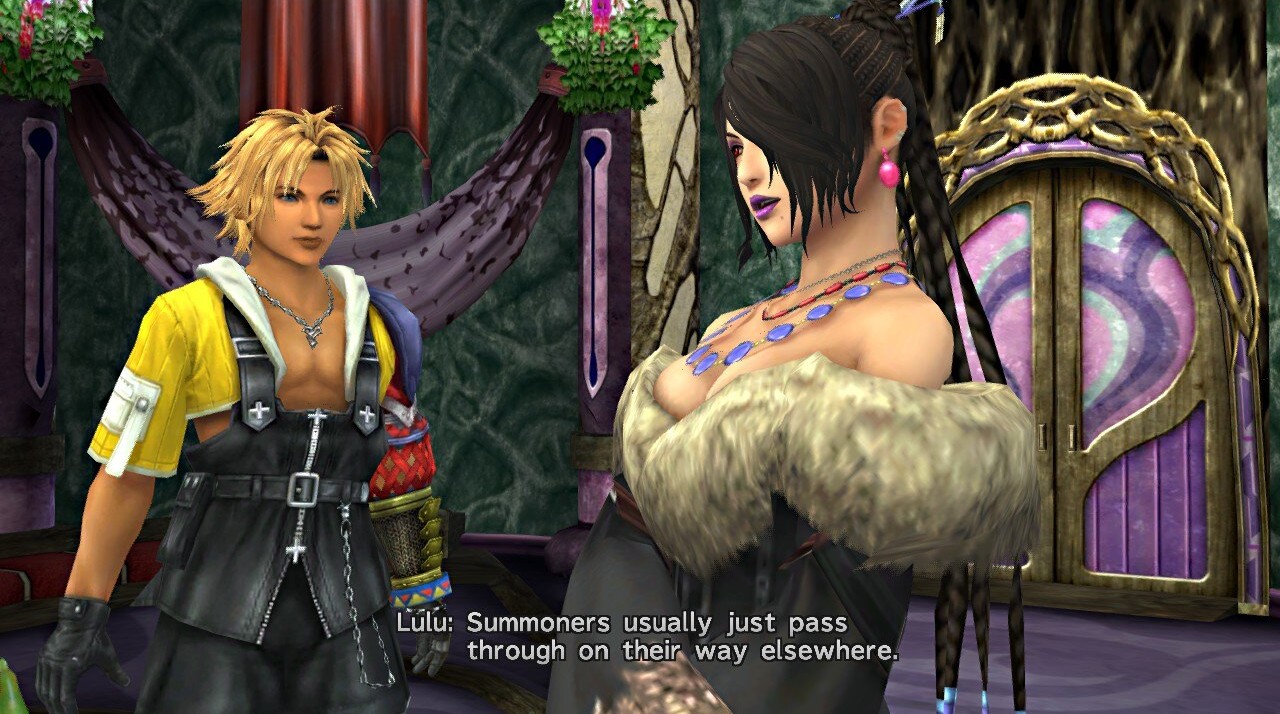
- Lulu – I’m down so bad for Lulu… I need to get a Lulu costume for my wife…
Mixed
- Graphics – When it came out, Final Fantasy X would have been a remarkably-good looking game. Hell, it still looks better than Pokémon games being released twenty-four years later (which shouldn’t be too surprising considering it cost more to make than any Pokémon game has, not even accounting for twenty-four years of inflation, holy fucking shit Game Freak). However, that said, there are some really rough edges that are glaring to even the most forgiving eyes. Most notably, NPCs often have very blocky features and low-res textures, which stick out like a sore thumb considering how many cutscenes this game has. In fact, I was playing this game while my seven-year-old son was watching and he was laughing and asking why the NPCs looked so weird. I can’t imagine the work that would have to be put in to bring all the NPCs up to snuff, but man does it look bad and make many of the cutscenes even goofier as a result.
- Wakka – I mostly-like the characters in Final Fantasy X: not enough to earn them a spot in “Love”, but they’re all good enough that I wouldn’t drop them down to “Mixed” either… except for Wakka. He’s a pretty chill guy, and one of the more unique Final Fantasy companions as a result. He’s basically the captain of a fantasy soccer team, and fights enemies by throwing his fantasy soccer ball at them. He’s also incredibly useful in battle, being the one character who can use ranged physical attacks against enemies (without having to use limited consumable items), plus he’s strong and fast to boot. However, he’s also racist as fuck. Like, I don’t mean that his portrayal is racist (his character clearly inspired by Māori culture, which is actually really cool), I mean that Wakka himself is a cartoonishly racist dick. He’s very cheery, but as soon as someone mentions the Al Bhed or forbidden technology, he flips on a dime and rants about them being evil and blames them for everything bad that befalls the group. Granted, his attitudes soften and change towards the latter-half of the game, and it’s clearly meant to be a big part of his character development… but he’s literally the only outright-racist character in the game. Like, Yuna and Lulu are from the same place he’s from, and they both have just as many reasons as he does to be racists, but they aren’t and seem outright embarrassed every time they have to listen to him make a bigoted statement. It just makes him kind of grating in the first half of the game, especially when Rikku joins the party and there’s this big tension about when he’s going to realize that she’s an Al Bhed.
- Also, his hairdo looks really dumb.
- Equipment System – Final Fantasy games usually put a lot of emphasis on your equipment, using it to scale your character’s stats to be more effective in combat and incentivizing you to seek out better-and-better items. FFX takes a… strange turn instead:
- First of all, equipment no longer has a direct effect on your stats. Your starting weapon does just as much damage as an endgame weapon. What differentiates items is that they get between one and four slots for “perks”. Sometimes these perks are pre-baked into the item, and later in the game you gain the ability to add perks to any open slots on the equipment in exchange for other items (with more helpful perks coming at much steeper costs, which really makes you consider whether it’s worth the trade-off). It’s kind of an interesting system, as you can specialize your equipment towards dealing with certain kinds of encounters, and you aren’t really incentivized to sell off your items as soon as they become obsolete, since they could come in handy again later. That said, it also makes equipment a whole lot less exciting and impactful, and the steep cost of customizing your items isn’t really worth it until you get late-game equipment.
- In addition, all equipment is hard-locked, with one dedicated weapon and armour type reserved per character. This means you cannot mix or match any items between characters, which is particularly annoying for armour pieces (which are only really useful for nullifying certain status effects and elemental damage; it would be nice to be able to swap these between characters instead of having to duplicate the effects across each party member).
- It’s also worth noting that customizing your equipment can cost a lot of items to do. For example, you need thirty echo screens to give yourself Silence Ward, which only gives you a chance of ignoring the Silence status effect… which isn’t too bad since you can just buy echo screens as needed, but for higher-tier perks, you will need to farm enemies by using the Steal command in combat. This is, as you can imagine, a tedious endeavour.
- Summons – Summons have always been a highlight of Final Fantasy, and in Final Fantasy X they are arguably cooler than ever, since they come in and become actual, controllable creatures! However, there’s a pretty big drawback to this system: when you call in a summon, the rest of your party leaves the battle until the summon leaves or is defeated. Considering that much of the battle system revolves around swapping characters in and out, this really limits the usefulness of summons. They’re basically there to be a way to provide a buffer for your party if you’re getting your ass kicked, pull them out in a boss battle to keep your party safe for as long as possible, or provide a hard-counter against a strong enemy that uses particular elemental attacks or is weak to a certain element (because most summons are based around one of the games’ elemental damage types). I just wish I could have used summons more often, because they really so seem cool, but swapping party members is so important in this game that shutting that off makes them incredibly niche.
Hate
- The Hypello – There are a few unconventional, non-human species inhabiting Spira. The Guado are pretty strange (especially due to their off-putting hair styles), but the absolute worst are the Hypello. They’re these weird-looking amphibious creatures… which is fine, until you hear them speak. I swear to God, these fucking things are Final Fantasy‘s Gungans, with goofy vocalizations and weird grammar to boot. They’re on-screen for literal minutes of this game’s forty-some hour runtime, but they were so off-putting that I was viscerally recoiling and cringing every time they opened their stupid mouths.
- Linearity – While there are linear elements to prior Final Fantasy games, even the linear sections feature a lot of optional exploration and their gameplay structure quickly opens up to become more and more free-form the further in you get. FFX, on the other hand, is almost entirely linear. Areas have few (if any) branching paths, the branches that do exist are very short and obvious, and there’s rarely anything worth looking for anyway. Meanwhile, moving through each area is literally just following a thin corridor for like 80% of the game, broken up only by some random battles. It’s easily the most disappointing aspect of the game’s design, and makes the world of Spira feel a whole lot smaller and less alive than it would if you could freely explore the world map like you could in every prior Final Fantasy game.
- Granted, there are occasionally exceptions to this, but they just serve to illustrate how linear most of the game is. Specifically, there’s a late-game area called the Calm Lands, which is a sprawling, wide-open field zone, more akin to the overworld maps from previous Final Fantasy games. It even has a couple optional, hidden areas and some hidden items in it. Why couldn’t we get a few more areas like this?
- Overdrives – Overdrives function like Final Fantasy VII‘s limit break system, where you can occasionally activate a powerful desperation attack to do extra damage. FFX‘s overdrives can potentially be even more useful than they were in FF7, because you can customize what causes the overdrive gauge to charge (eg, when allies take damage, when the character damages enemies, etc). However, there are a couple fundamental issues that make overdrives incredibly underwhelming, to the point where I just didn’t bother using them for nearly the entire game:
- For one thing, while overdrive attacks are stronger than a standard attack, they’re nowhere near as meaningful as FF7‘s limit breaks are. For example, right before writing this I was in a boss fight where Auron was hitting for ~1500 damage with standard attacks. I used his single-target overdrive attack and he hit the boss for a whopping… 2100 damage. A 33% difference isn’t nothing, but in a game with enemy health bars this large, it sure isn’t all that impactful compared to just using a status-inflicting or stat-debuffing skill.
- Every overdrive also has some sort of gimmick tied to it which directly determines how effective it is. For example, Tidus’ overdrive has an arrow moving fast along a bar and you have to press the button at an exact time to execute it, Auron’s makes him enter a string of button prompts, Wakka’s is a slot machine, etc. You have very little time to pull these off and can very easily be failed, causing the attack to be either very weak, or completely ineffective. As a result, they just straight-up cannot be relied upon in a pinch, which is exactly where you’re supposed to be utilizing a limit break system to begin with.
- Finally, some overdrives are just straight-up broken. Lulu’s overdrive asks you to rotate an analog stick as fast as possible to cast multiple spells at once, but it just doesn’t work (this is apparently an issue that persists across multiple versions of the game, and even on the PS2 you physically could not maximize your overdrive limit on even low-leveled spells). This is just one more reason why poor Lulu loses her luster in the latter-half of the game.
- Sexualizing Rikku – I gave PSM shit for featuring Rikku, a fifteen-year-old, in their swimsuit special… but it turns out that Squaresoft should bear the brunt of that blame, because Rikku is uncomfortably sexualized in this game at times. While not quite as blatant as Lulu (between her outfit and sexy victory pose), Rikku’s sexualization is literally in-your-face at times. In scenes revolving around Rikku, they love to stick her short-short booty square in the center of the camera. It’s far from the most egregious instance of sexualization in Japanese media, but still… why did you make Rikku fifteen years old, Square? You clearly think she’s hot. You clearly want the players to like her, hence her fun, bubbly personality and positioning her as a potential, secondary love interest for Tidus. Why was it so important that she be that young, Square? I just find this extremely questionable and uncomfortable… which sucks, because Rikku is a pretty cool character, she doesn’t deserve to get leered at by the camera like that.
Overall, I really did enjoy Final Fantasy X. It makes a lot of changes to the franchise’s formula, some of which are great (the battle system), some of which are questionable (equipment, summons), and some of which are for the worse (linearity). However, the game’s ambition to push the franchise forward and into more cinematic territory is admirable and the results are good enough that I’d say it largely succeeds at its goals. I don’t think it’s a classic, but it’s good, it’s interesting, and it’s unique, at that’s all it really needs to be, now isn’t it?
If you liked this article…
I hate ads. You hate ads. In order to stop polluting my site with obtrusive and annoying ads, I’ve elected to turn them off on IC2S. That said, writing still takes time and effort. If you enjoyed what you read here today and want to give a token of appreciation, I’ve set up a tip jar. Feel free to donate if you feel compelled to and I hope you enjoyed the article! 🙂
About the Author

I enjoyed reading this — especially the parts about social dynamics.