
While I was researching and writing my article about the PSM video game girl swimsuit issues, I was hit by waves of nostalgia. I loved video game magazines in my early-to-mid teens, so getting to pour through these old pages and reminisce made writing that article a total blast. By the time the last words of that article were written, I knew in my heart that I wasn’t done with video game magazines just yet. Luckily for me, I had a good place to focus on: the ads. Video game magazine ads were (and still are) notorious for being unhinged, obnoxious, edgy, violent, and especially for objectifying women. This got me wondering: when did these marketing tactics start? Were they always like this? How bad did they get? Were they ever as obnoxious as their reputation would suggest?
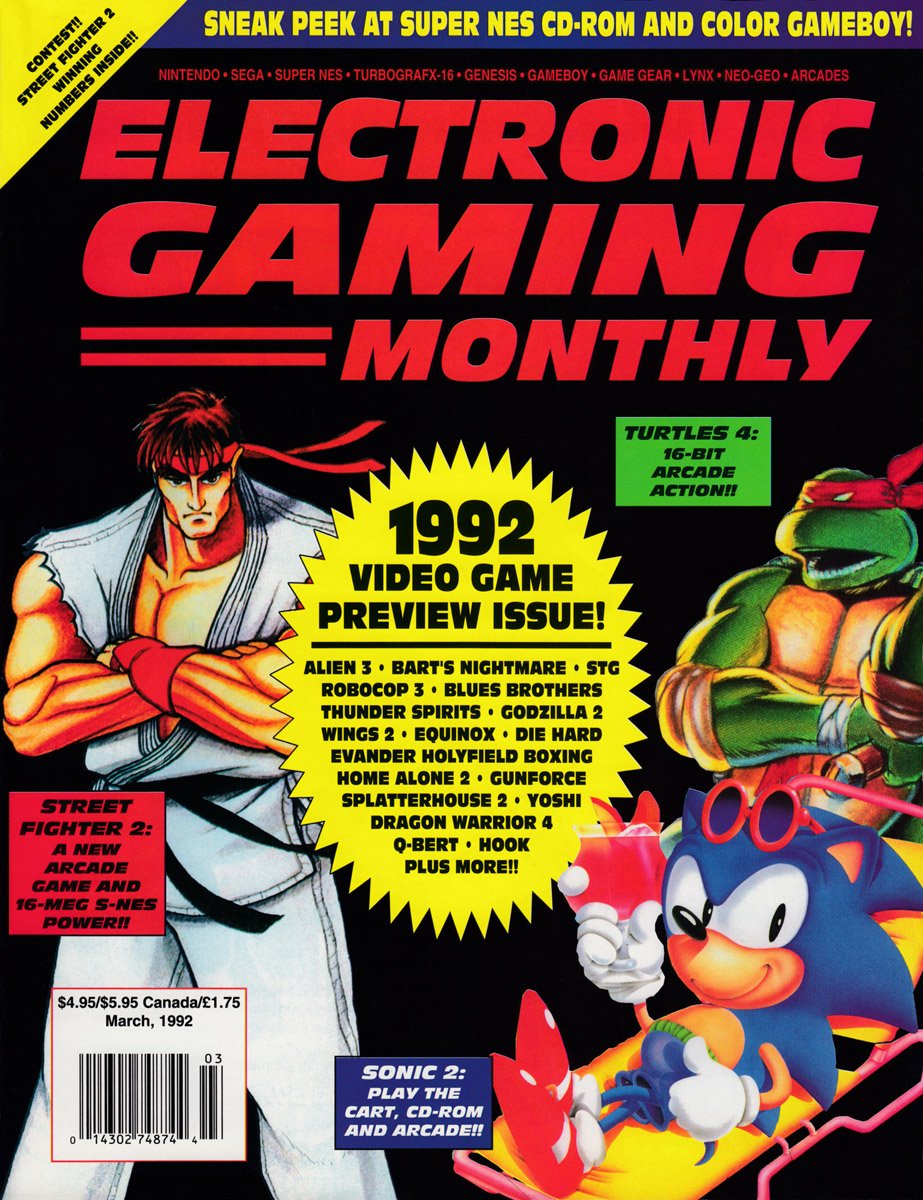
To find out, I went back to good ol’ Retromags and started with issue #1 of Electronic Gaming Monthly. This was always one of my favourite video game magazines, because they provided coverage for all of the major consoles. Despite being a PlayStation fanboy, this platform-agnosticism allowed me to stay in-tune with the wider culture of gaming. For the purposes of this article, it also means that I’ll get to see a more diverse assortment of advertisements that were being put out across all of the platforms.*
Originally, I was just planning on going through one hundred or so issues of EGM to get a picture of when the era of the “video game magazine ad” started, but the further I went, the more fascinating the whole deep-dive became. I ultimately went through all 264 issues of EGM** and, for my troubles, got to go on a journey through gaming history that was interesting, nostalgic, funny, infuriating, baffling, and even tragic. It’s a journey that I would love to take you through as well: I hope you enjoy it!
*To be safe, I did check some issues of other contemporary gaming magazines to see if they had any unique ads, but I did not find anything particularly notable or relevant. There are likely some more extreme ads that did not make the pages of EGM (for example, I never saw the notorious “John Romero’s about to make you his bitch” Daikatana ad). In addition, EGM only provide coverage for console games, so there are likely some interesting ads from the PC gaming space that I missed out on. However, EGM‘s longevity and popularity makes it a very good representative for the ads that were permeating through console gaming culture, so I think that this is still a reasonably-comprehensive look at the subject.
**Well, except for the one issue that never got officially released, because their parent company filed for bankruptcy before it could go to print.
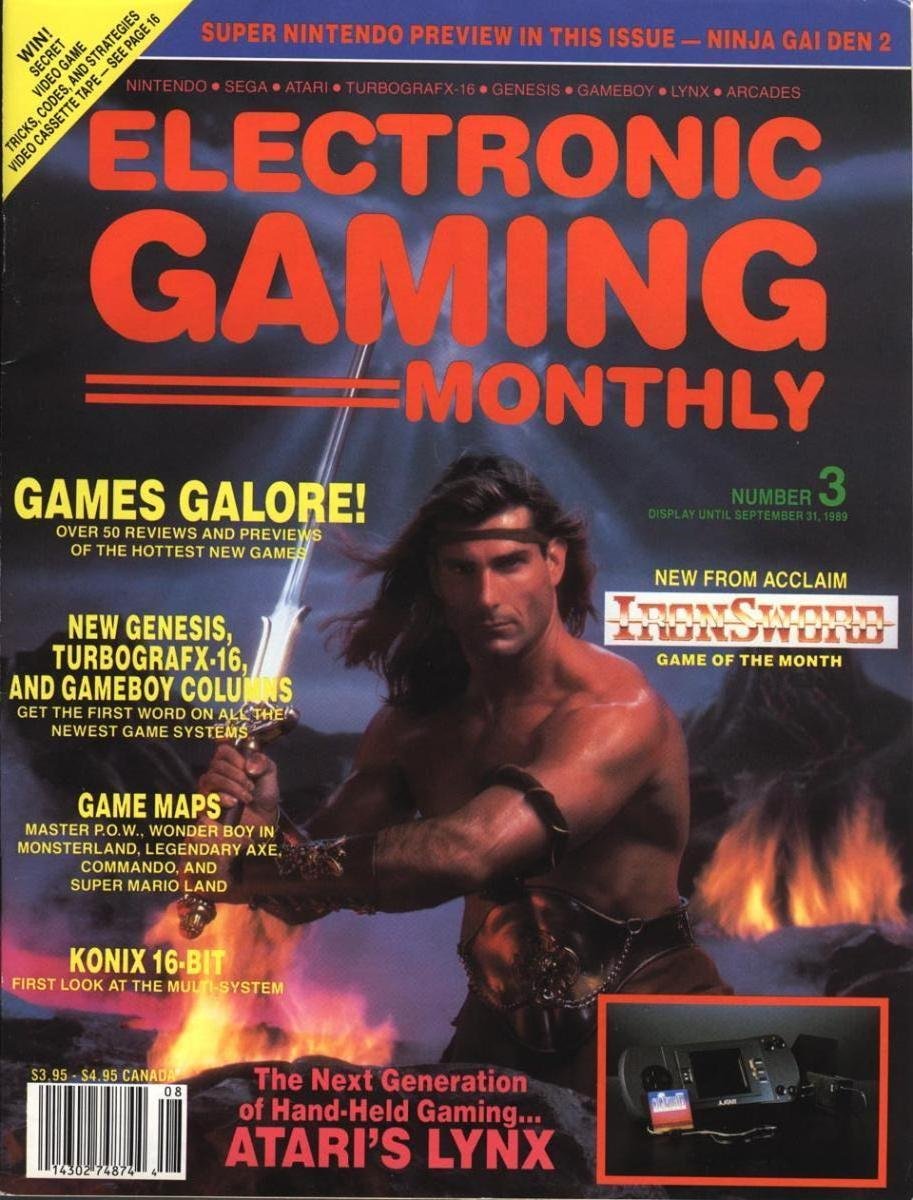
Humble Beginnings (1989 to mid-1990)
The best word to describe the early days of video game ads is “quaint”. The industry was chugging along with the NES and Sega Master System, and we would soon see the introductions of the TurboGrafx-16, Atari Lynx, Game Boy, and the earliest days of the Sega Genesis.
Ads in the early days of EGM are operating on an product marketing philosophy which is entirely alien to the battery of flashy, memorable, and superficial ads we’ve been served for the last three decades. You could get by with a plain, white page, some small images, and a wall of descriptive text in 1989.
Let me reiterate this so it sinks in: video game ads in 1989 were almost entirely text-based rather than image-based. There may be an eye-catching piece of art there, but that’s just supposed to lead your eyes to the giant walls of text telling you why you should buy the latest video game, console, or peripheral.
Given that this was the 8-bit era, ads rarely show any screenshots or in-game graphics. When they do, they are very small, de-emphasized within the ad, and often selected very carefully so that they’re not particularly representative of the actual gameplay. Instead, these ads’ key art will often contain a painting which tries to demonstrate the idea of what playing the game is like.
It’s also worth noting that the primary demographic for ads of this era is children (particularly young boys). Ads will portray children in them, reference homework or parents, cater to childhood fantasies, and avoid showing anything that may displease parents (this was, after all, in the wake of the Satanic Panic).
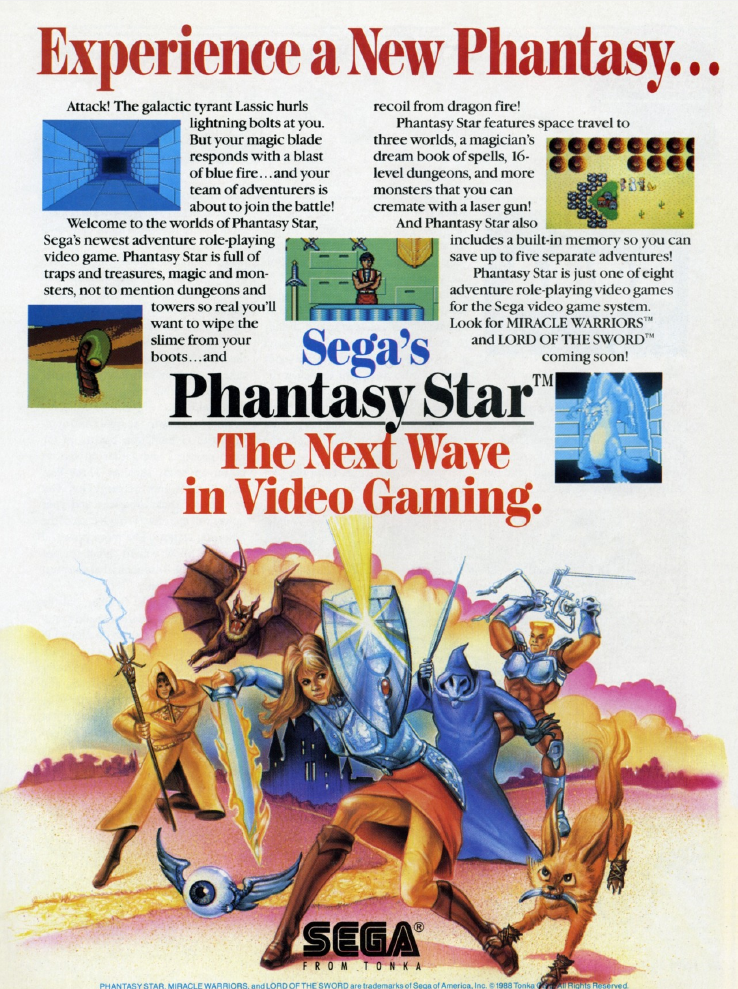
This ad for Phantasy Star (from the very first issue of EGM) exemplifies the blunt, “wall of text” market strategy. A full half of the page is occupied with several lines of text extolling the game’s virtues, crowding out the key art that’s supposed to sell you on its fantasy. You can also see that the included screenshots are tiny and not particularly indicative of the reality of playing through Phantasy Star.
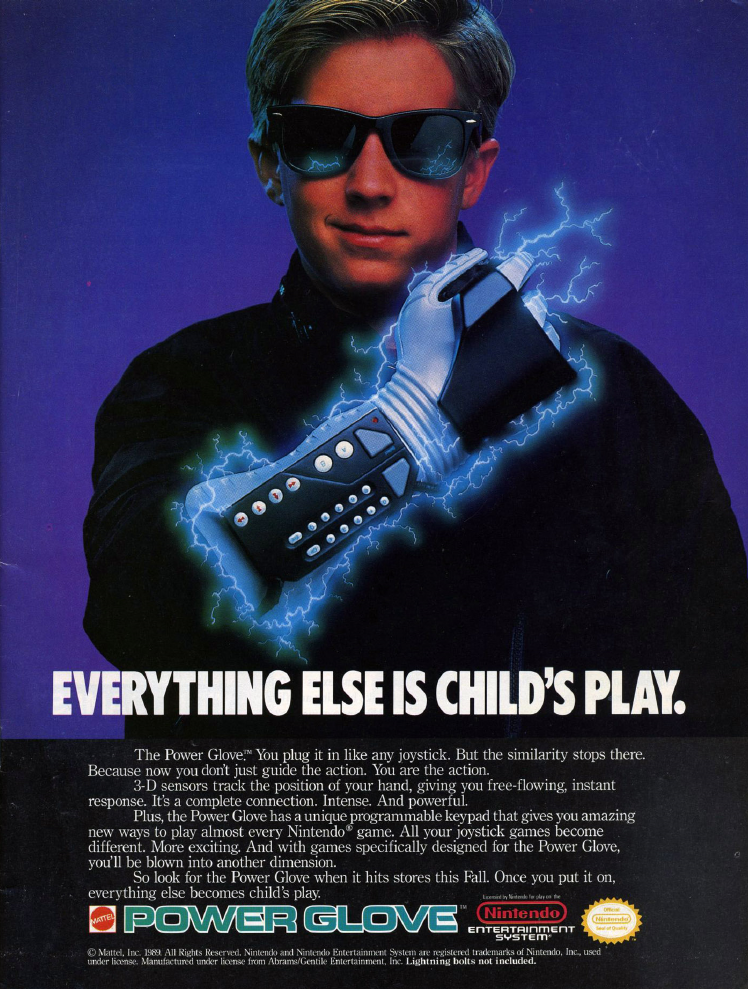
Peripherals were a huge market in the early days of video game advertising, and none are as notorious as the goddamn Power Glove. This ad from November 1989 tries to make the Power Glove (one of the most notoriously crap controllers of all-time) look like literal magic that will make you the coolest motherfucker in the fourth grade.
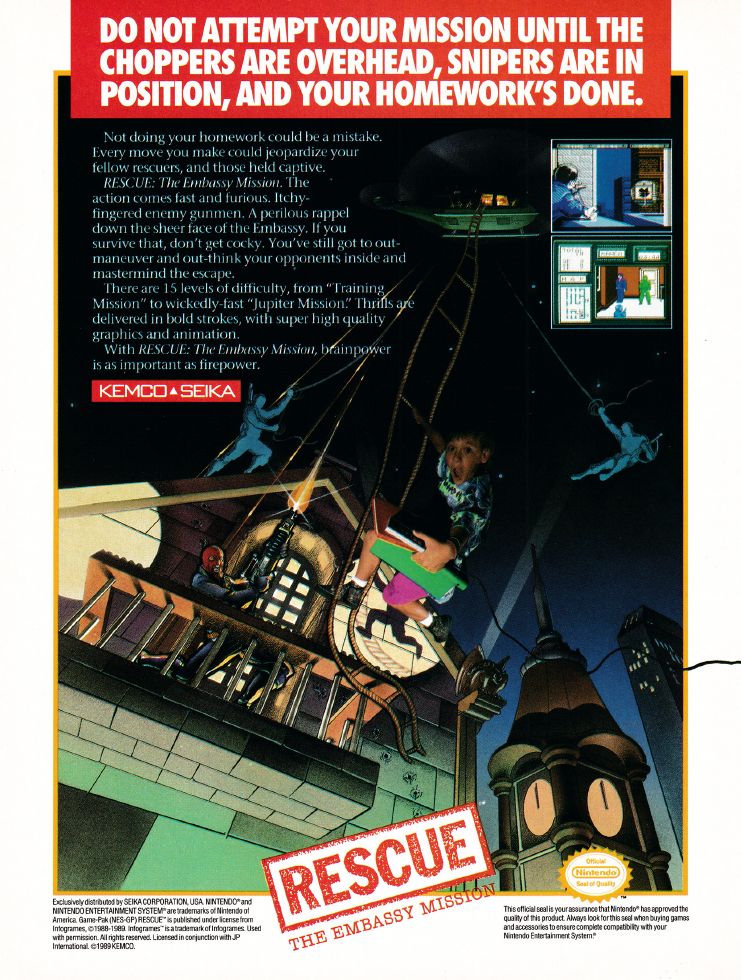
All of the negative stereotypes we have about video game magazine ads today stems from the fact that they were being marketed exclusively towards teenage boys. However, in this era, children took precedence, which means a lot of cartoonish hijinks. This ad for RESCUE: The Embassy Mission (EGM 007, Feb 1990) makes it look like a Saturday morning cartoon, despite the game itself basically being an 8-bit version of Rainbow Six. Honestly, I love the goofy contrast of the real-life, cut-and-paste kid against the background of bad guys and ninjas.
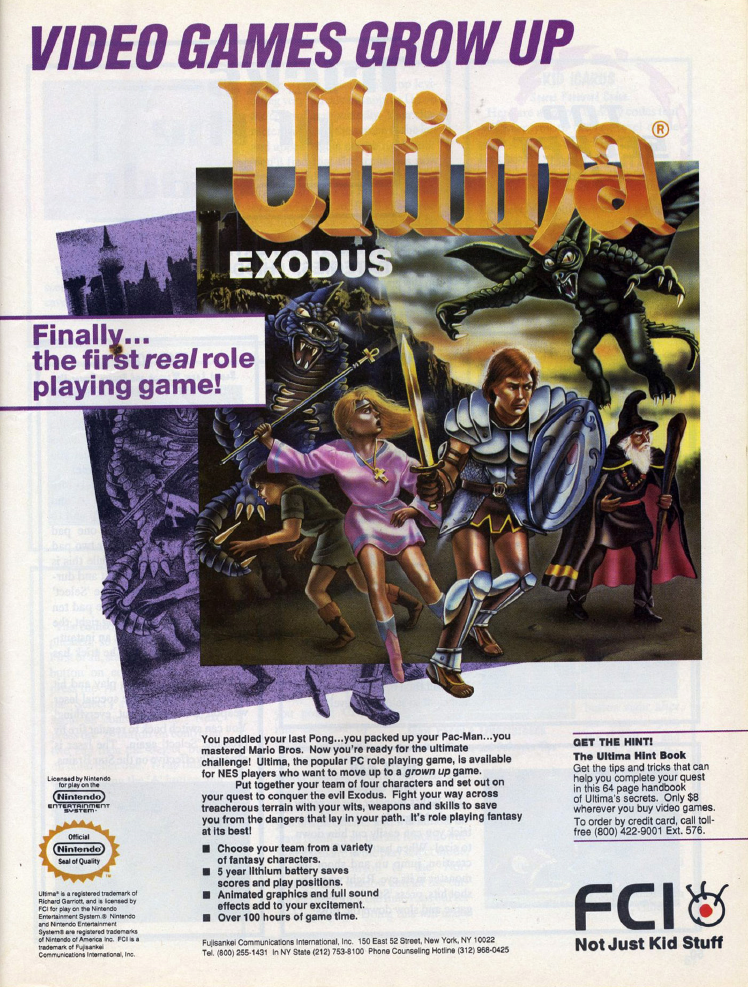
Despite the kid-focused marketing, there is also a clear insecurity within the industry about video games being labeled as something “for children”. This ad for Ultima: Exodus (EGM 002, July/August 1989) loudly and repeatedly claims that it’s “for NES players who want to move to a grown up game”… which is about the most childish way you could try to make that statement. Hell, publisher FCI’s entire marketing strategy revolves around this insecurity, since their tagline is literally “Not just kid stuff”.
Also worth noting: despite its attempts to be “grown up” and the pulpy artwork, there’s still a very conscious effort to make this ad appropriate for general audiences (ie, there’s no explicit violence and the female character is not sexualized at all).
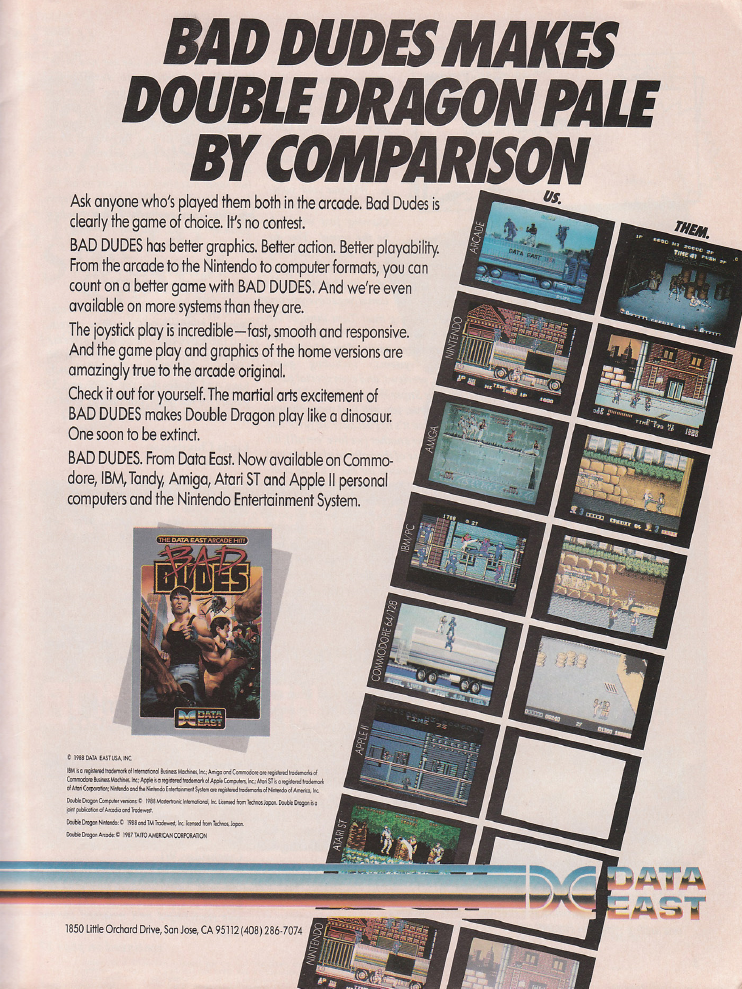
About the closest you’ll get to any sort of “edge” during this era are ads which directly compare one game or console to another. These are often come across as obnoxious, desperate, and unconvincing, insisting that their product is superior and their competition is uncool.
These ads are embarrassing in retrospect, because the game/console they’re putting down is always the one that won in the end (as demonstrated by this ad from Sept/Oct 1989 for Bad Dudes, a forgotten beat-’em-up which tries to go toe-to-toe with fucking Double Dragon). Despite that, this type of ad would lay the groundwork for some of the insane marketing tactics that we’d see in the coming years…
(In case you haven’t noticed yet, you can click on the images to see them in full-size.)
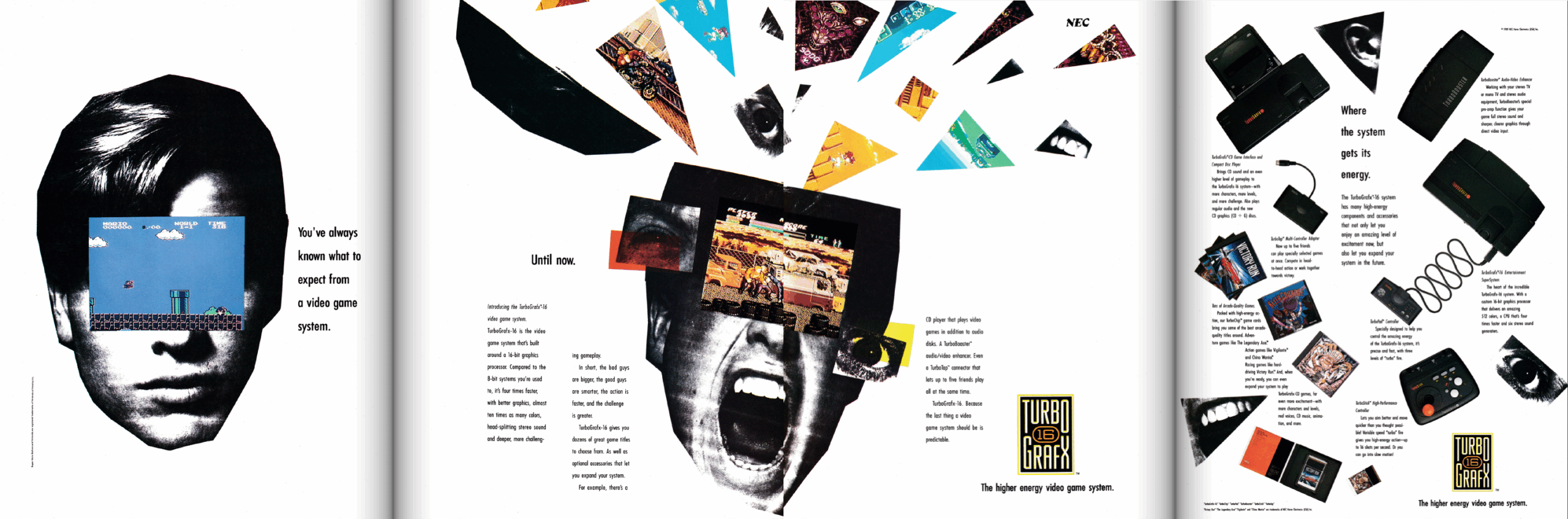
This ad for the TurboGrafx-16 (EGM 005, December 1989) demonstrates a few notable trends from the era:
1) It has the aforementioned embarrassing “popular console bad, new console good!” format.
2) This is one of the earliest gaming ads to utilize multi-page spreads, which make the ad impossible to ignore.
3) The timing of this ad is actually really important: the holiday season is the prime time for video game sales (and therefore marketing as well). October through January is when publishers and manufacturers pull out all the stops, coming up with their flashiest, most attention-grabbing ads possible, before returning to more of a status quo for the remainder of the year. You can therefore intuit that NEC were going all-out to try to make the TurboGrafx-16 a hit that holiday season.
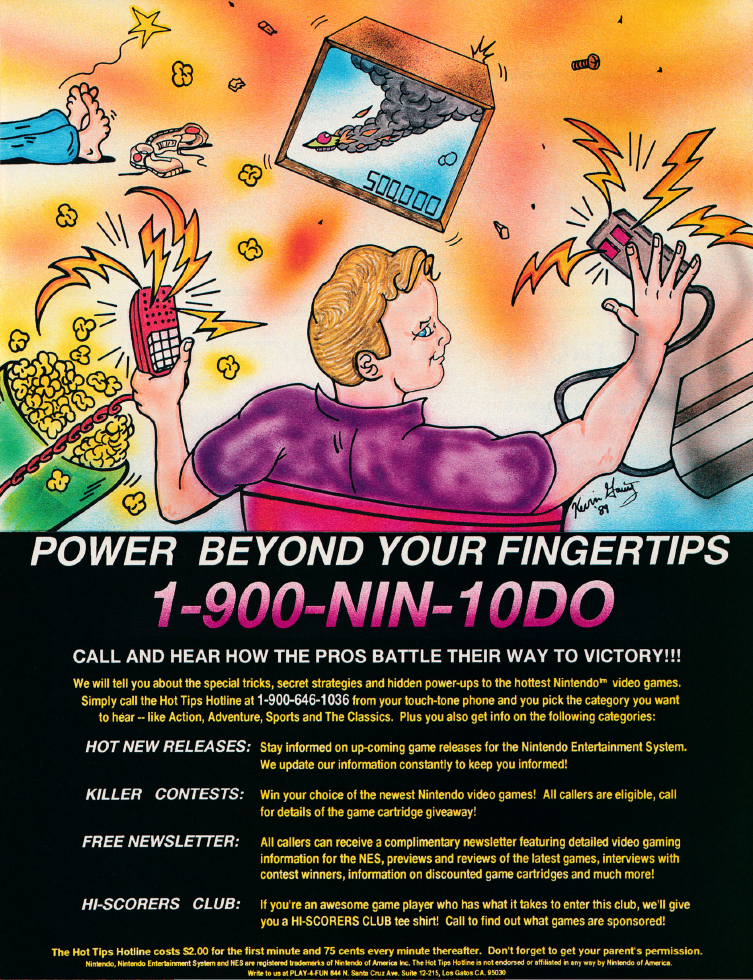
While there are some impressive ads out there in 1989 to mid-1990, this era of marketing had shockingly low standards. Like, look at this hint hotline ad from March 1990: it looks like it was illustrated by a middle-schooler!
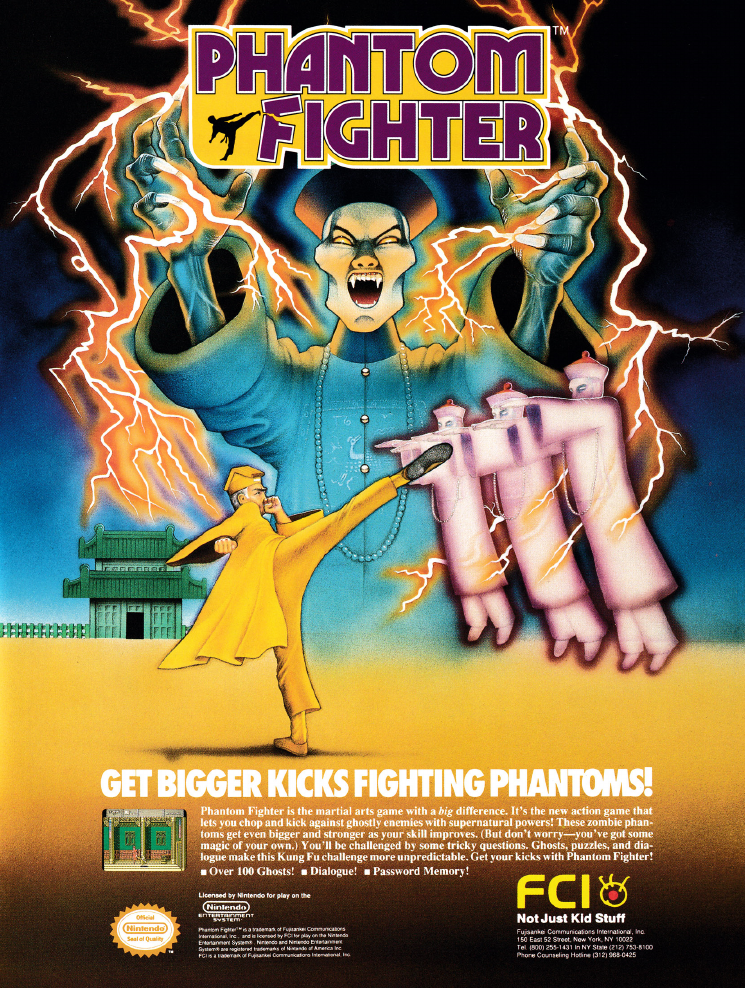
…or how about this baffling ad for Phantom Fighter from December 1989? What the fuck is this game even supposed to be???
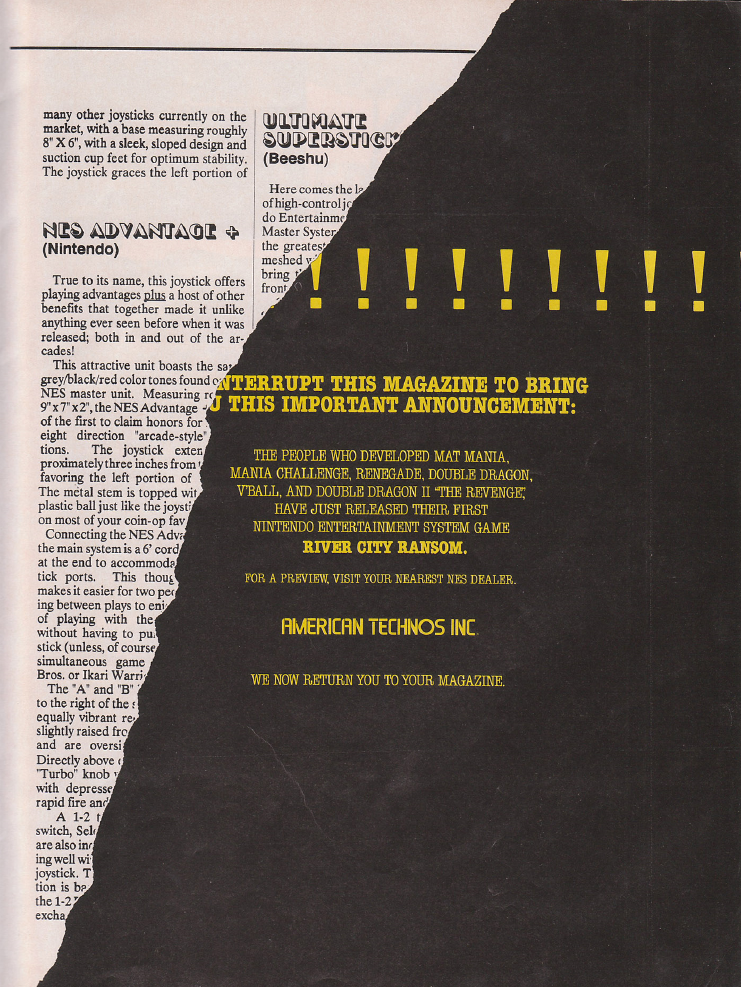
This ad for River City Ransom from Sept/Oct 1989 has to be one of the most clever game ads of its era: despite being entirely text-based, it’s eye-catching, breaks from convention, and plays with the print medium in brilliant fashion!
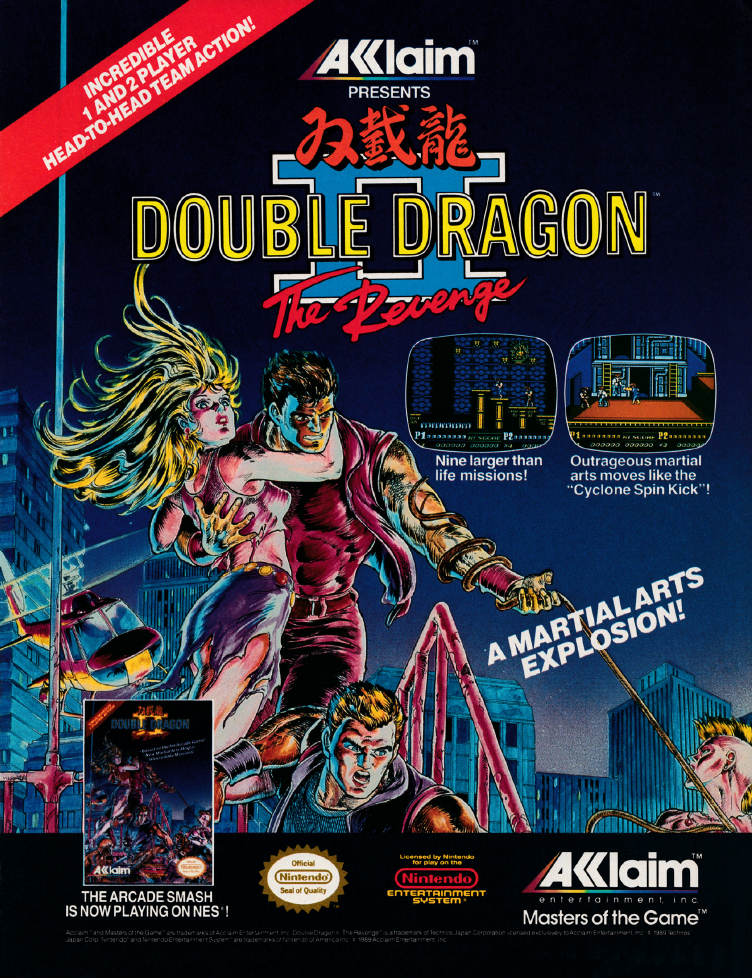
This ad for Double Dragon II: The Revenge from March 1990 is the closest we ever get to anything that might be considered “risqué” during the early days of the video game ad. Despite being fairly tame overall, this ad is still an outlier for this era (which, considering this is an Acclaim game, is funny in retrospect).
However, what makes this ad notable to me is that it nails a lot of the conventions which would define video game ads going forward: emphasis on the game title, one big, exciting piece of flashy key art, a couple screen shots, and a memorable tagline. Those are the building blocks that will carry us through this entire gaming history lesson.
Genesis Does… (mid-1990 to 1992)
The 16-bit console era, heralded by the Genesis and going into full gear with the release of the SNES, would bring with it major changes in video game advertising. What defines this era of video game ads comes down to one thing: marketing savvy. Advertisers were quickly learning that their text-based, informative ads were less compelling than selling a feeling or experience. Ads of this era will gradually come to prioritize one big, flashy, exciting piece of key art which is meant to convey what using the product feels like.
This also marked the birth of the console wars, which marketers leaned full-tilt into. Sega would become the undisputed masters of marketing during this era. Their competitors would blatantly ape their marketing strategies, but no one could match Sega, because their edgy attitude felt more genuine.
Of course, in spite of all this effort to push the boundaries, video game ads were still being directed almost entirely at children. This makes this era kind of charming, as all of the hardest edges have been sanded off, so it has the same sort of adorableness as a child trying to look cool and grown-up.
Overall, this was a transitionary period for video game ads. This was a time when the language of the video game ad was being established, and we can see a lot of the building blocks taking familiar shape throughout this year-and-a-half period.
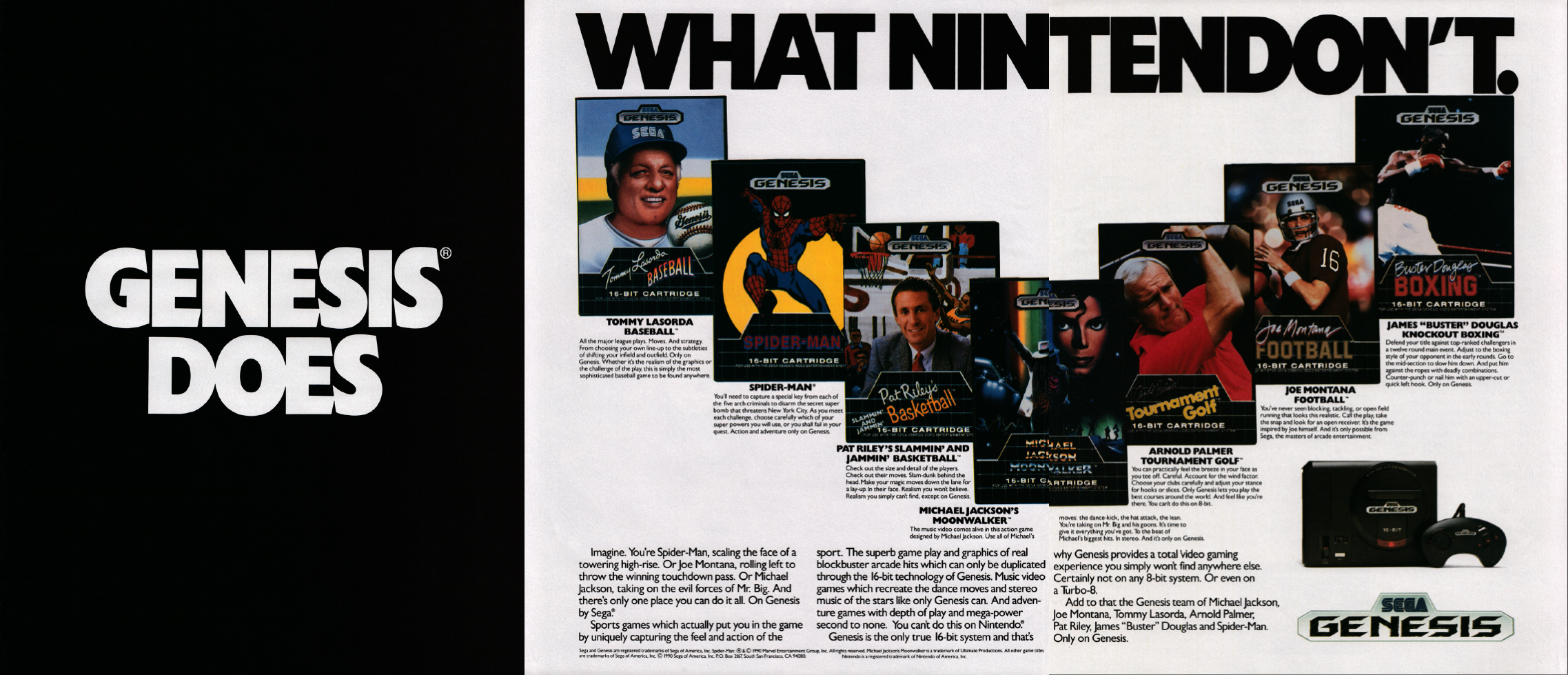
This legendary ad from August 1990 loudly proclaimed that a new era of video game marketing was upon us. At its core, this ad is still very text-heavy (it came out right at the start of this new era, after all). However, by laying it out as a multi-page spread, the whole thing come together to be bold, eye-catching, surprising, and memorable. We have already seen comparison ads like this in the past that failed, but Sega pulled it off because they actually did make themselves look cool.
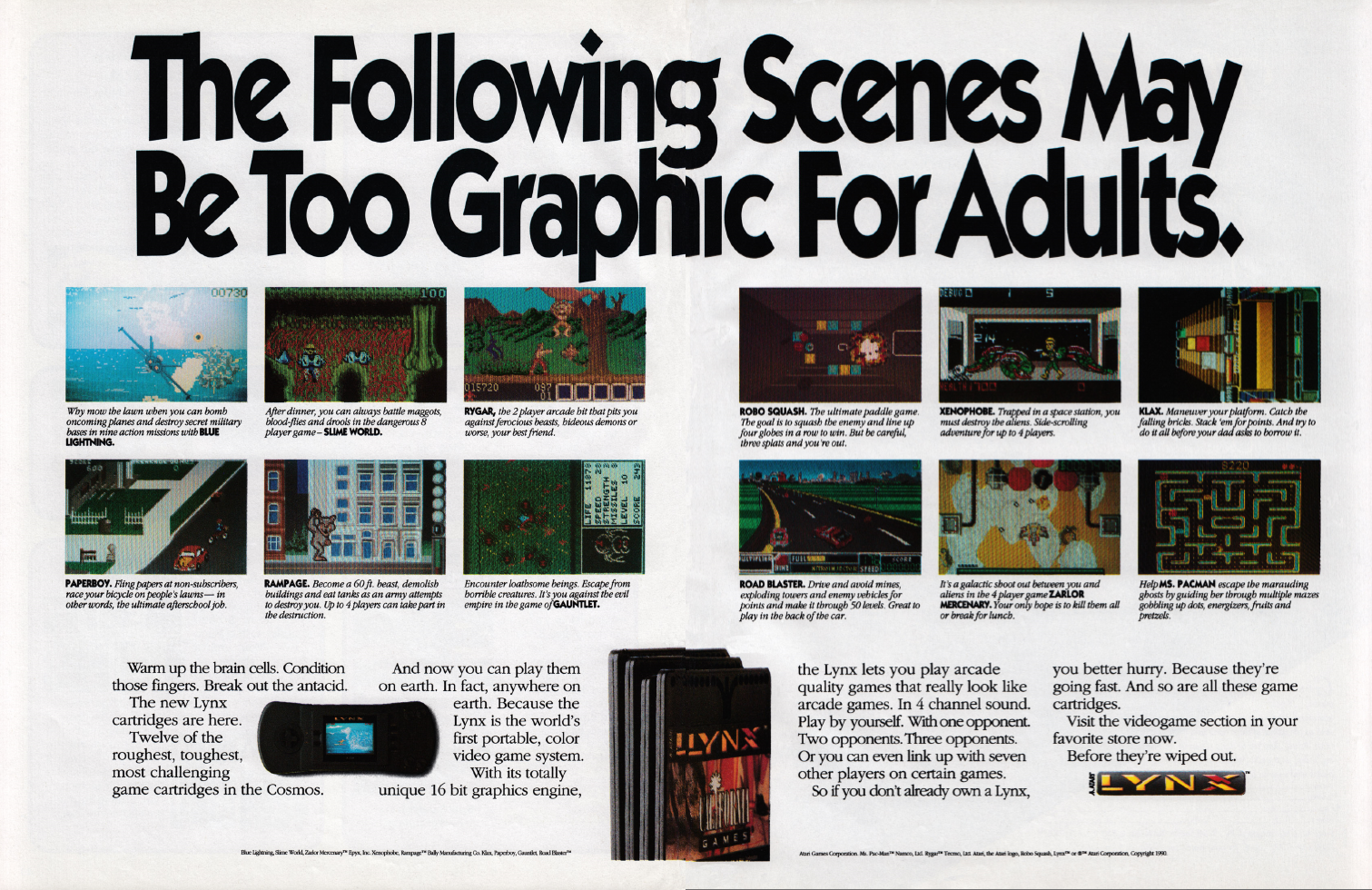
This spread for the Atari Lynx from December 1990 is aping the sort of attitude Sega’s Genesis ads had, albeit less-successfully.
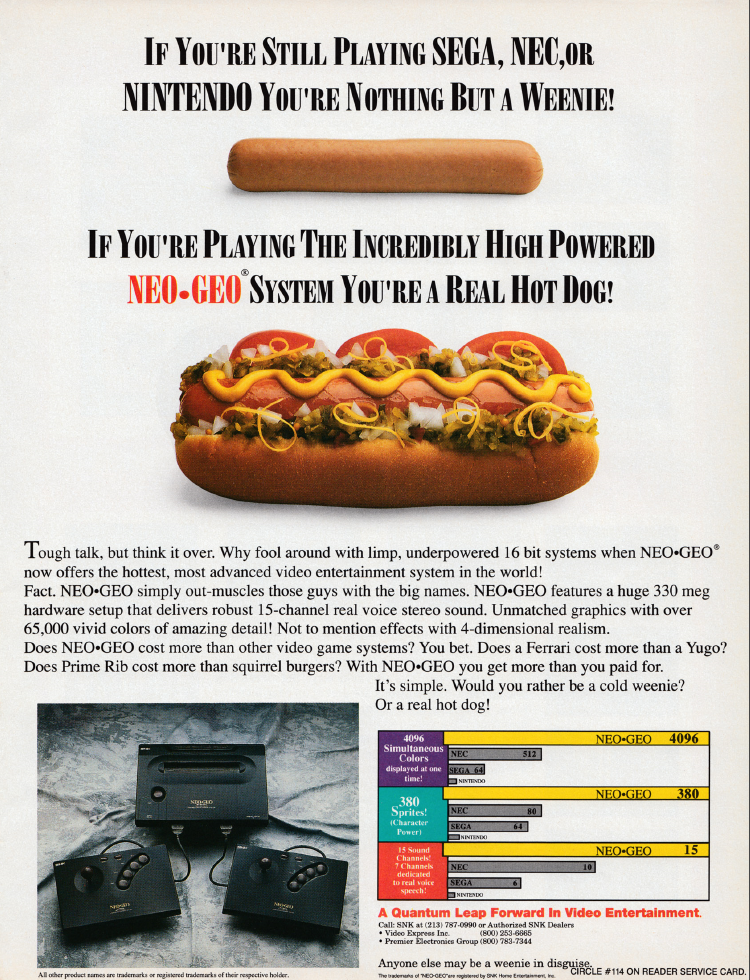
This ad for the SNK Neo-Geo from January 1991 is particularly interesting for a couple reasons.
First of all, it’s early-90s as fuck.
Secondly, it’s one of the first ads to really hammer home the idea that computing power is king (a trend which many failed consoles would lean on throughout the early 90s). Make no mistake: the Neo-Geo was a cutting-edge console that blew its competition out of the water with its arcade-quality performance. There was just one big, glaring issue… it cost $649 and the games for it could be as much as $300 each (compared to less than $200 for the Genesis and SNES, and $50-80 for their games).
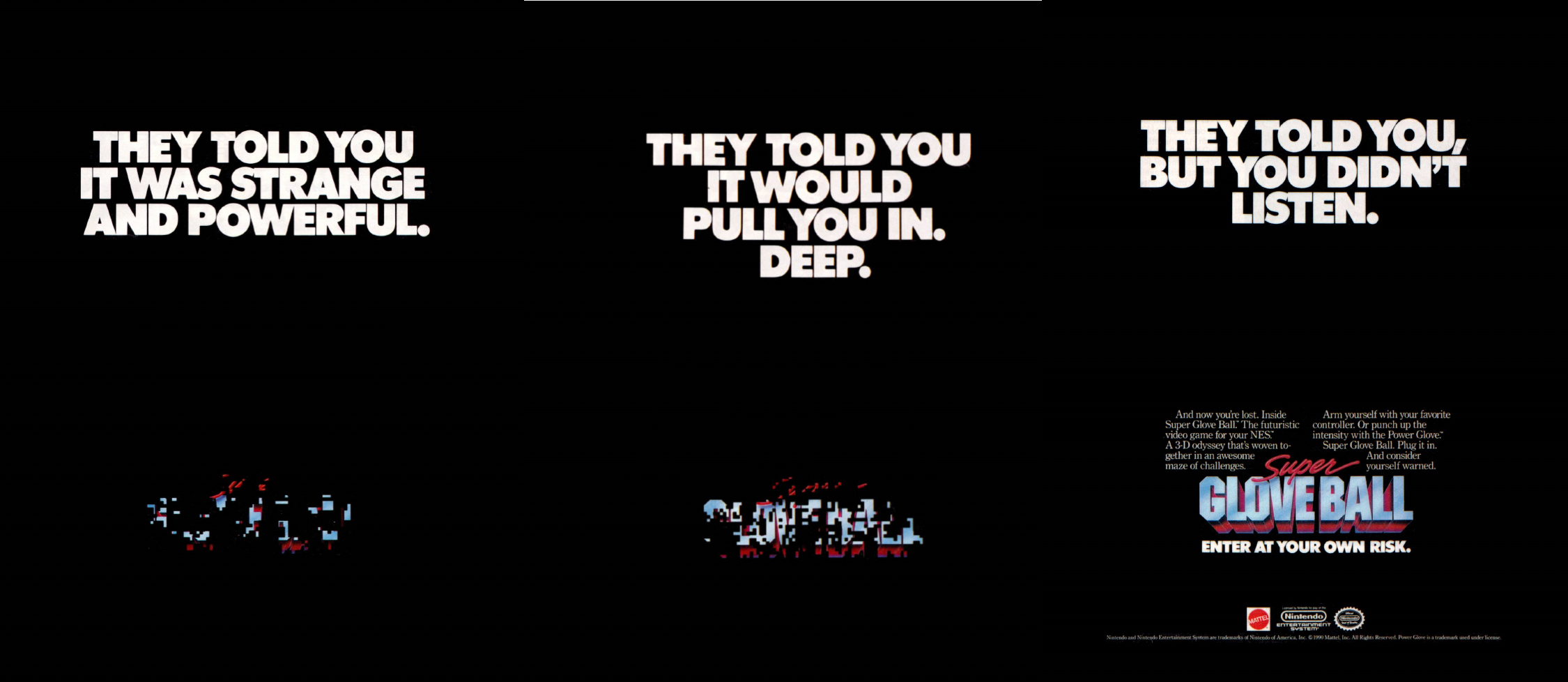
Lastly, for our series of “everyone was aping Sega’s marketing department”, we have this blatant rip-off which was done for Nintendo’s Super Glove Ball in September 1990. This is a pretty wild example of how loosely marketers would base their ads on the “experience” of playing a game. This is what Super Glove Ball looks and plays like… it’s not exactly a revolutionary experience, especially since you’re supposed to use the goddamn Power Glove to play it.
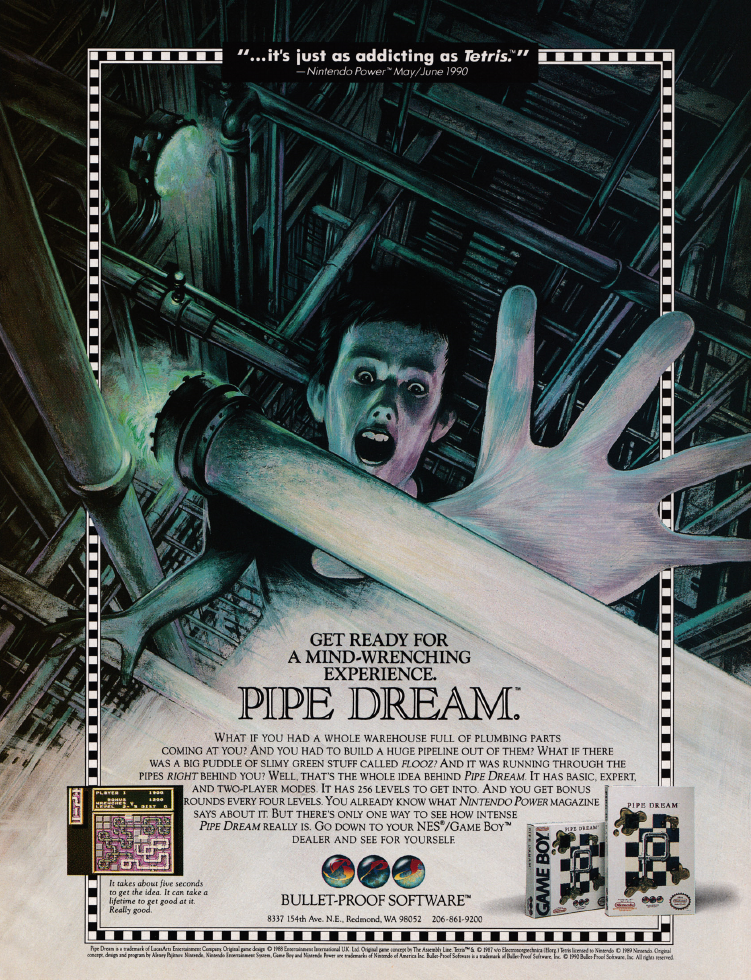
On a similar note, check out this ad for Pipe Dream from December 1990. Wow, this game looks exhilarating, I can’t wait to play it!
…guys, it’s fucking Pipe Dream (which, if you are unfamiliar, is the basis of the hacking mini-game from Bioshock that everyone despises). I like Pipe Dream, and even I’d say that there are very few games less exciting than it. I’m sure some kid got suckered in by this ad, thinking it was some sort of action/platformer, only to find that they had bought a puzzle game.
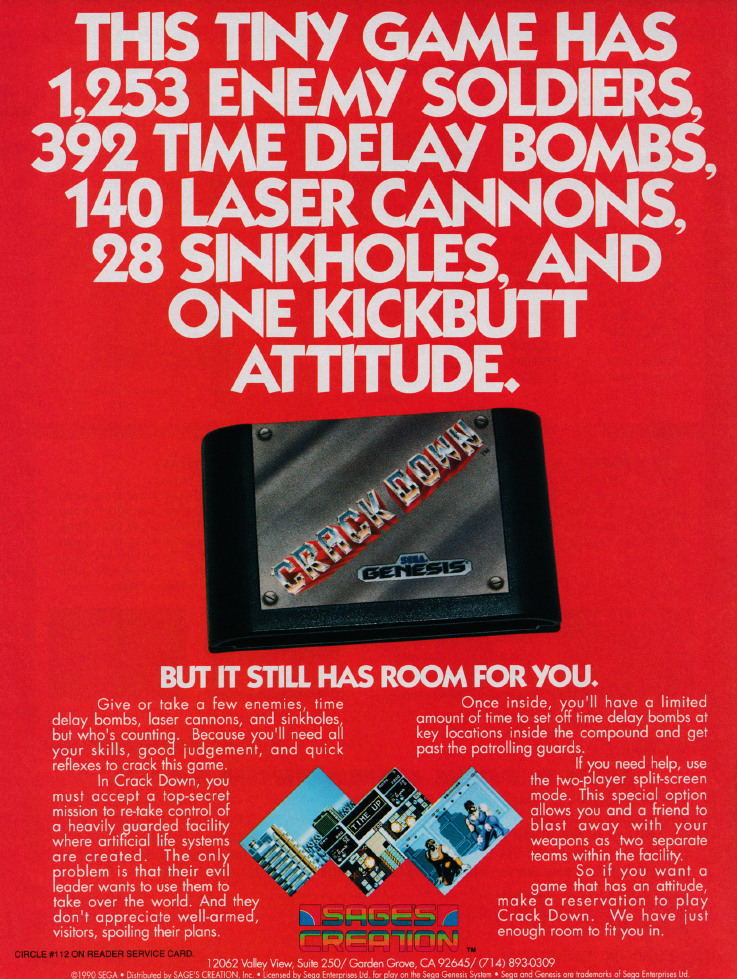
In spite of the increasing amount of attitude and marketing savvy, it’s still worth keeping in mind that these ads were still being marketed towards children, as this ad for Crack Down from February 1991 demonstrates. Your big selling point is that this game has “kickbutt attitude”? Okay, junior.
I feel like this is worth reiterating, because it also explains why disparaging the competition was such a common tactic in these ads: they’re literally trying to convince insecure and easily-influenced children that the things they love make them uncool.
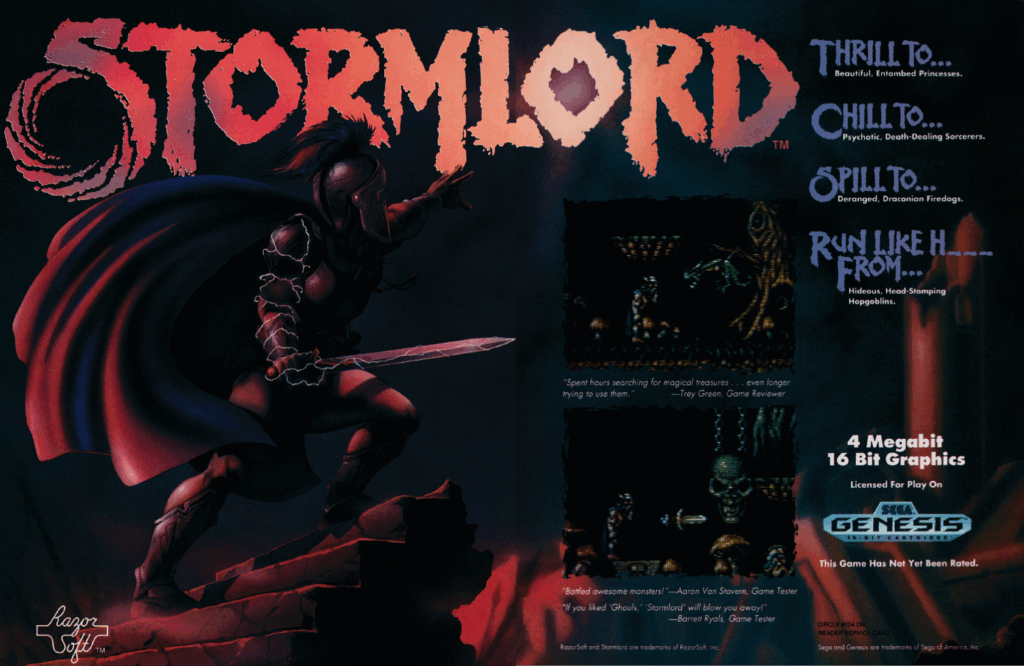
This ad for Stormlord from February 1991 is really cool-looking and well-designed, further refining the language of the video game ad from where it was only a couple years prior… but, man, for such a cool ad, they can’t even say “hell”? Again, in case it wasn’t clear already, these ads and publications were aimed squarely at children, so they couldn’t have any real edge without drawing the ire of concerned parents.
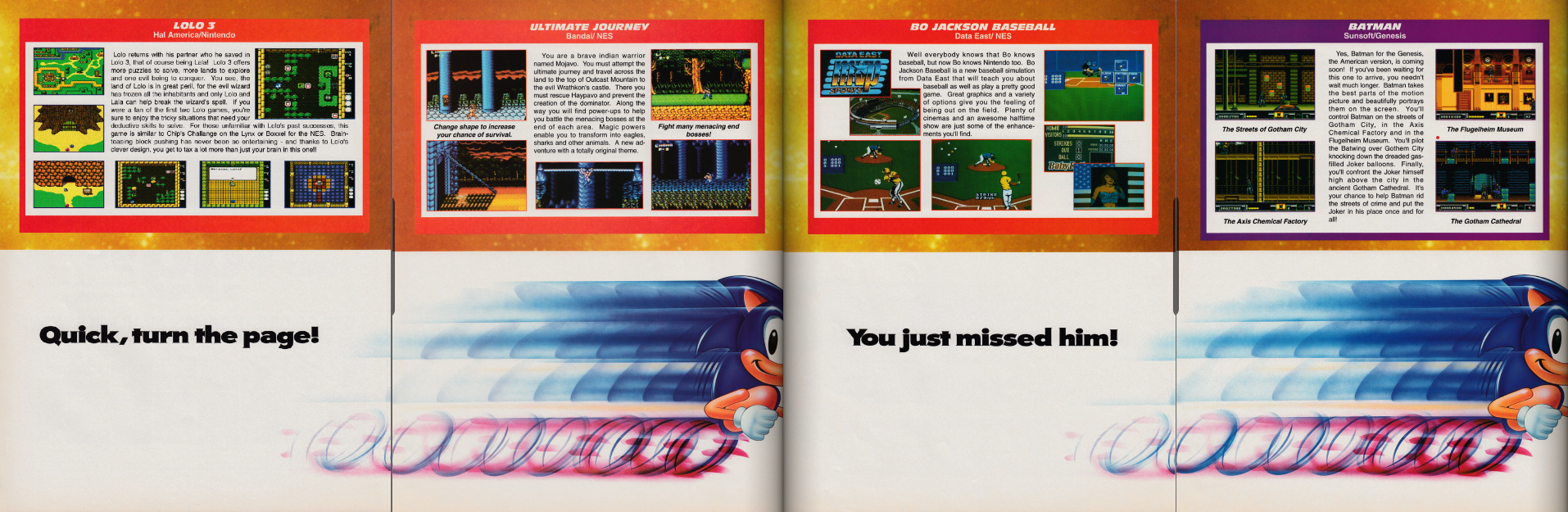
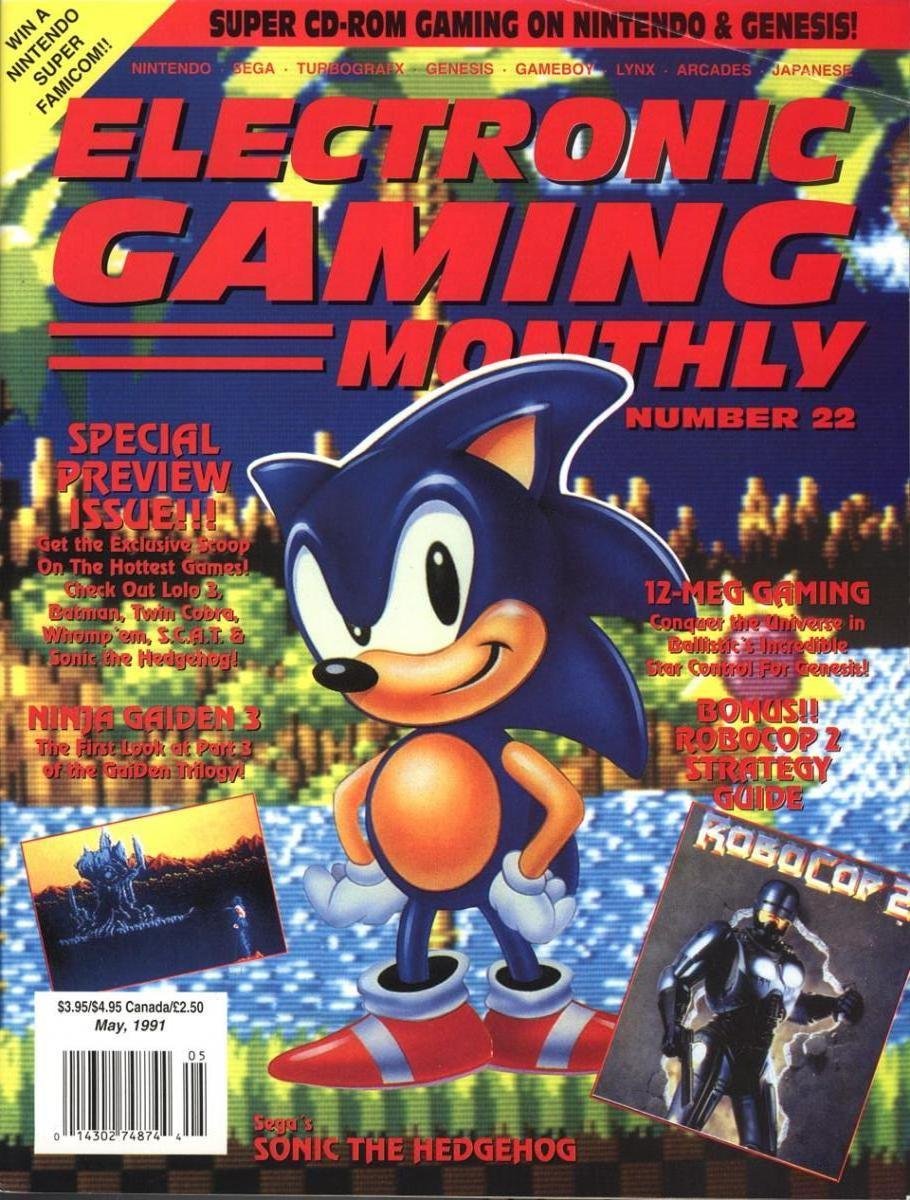
Here’s another ingenious marketing campaign from Sega to promote the debut of Sonic the Hedgehog in May 1991. The big thing that set Sonic apart from Mario was speed, so how better to get that across in print media than this unforgettable, eye-catching, multi-page spread? Seriously, if I was old enough to be into gaming magazines in 1990, I would have absolutely wanted a Genesis over an NES/SNES.
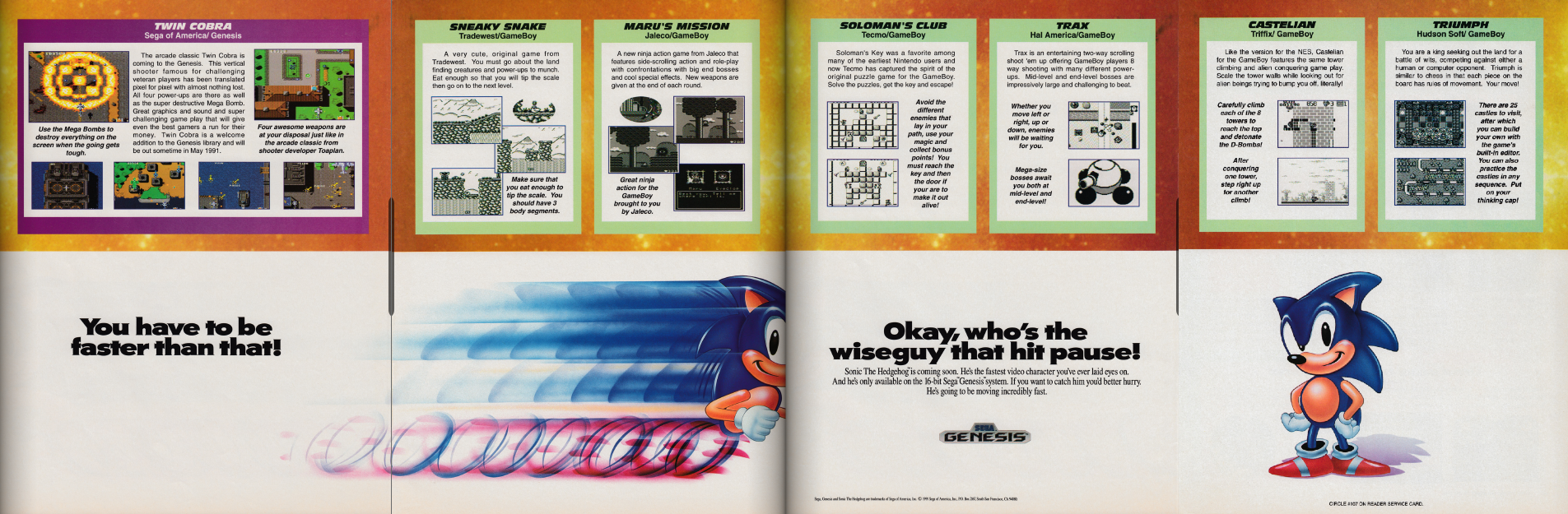

I quite like this ad for Al Unser Jr.’s Turbo Racing from July 1990. Whereas a lot of the ads we’ve looked at in this era will sell you on a feeling or experience that’s not representative of the actual game, Turbo Racing is giving you just enough imagination to fill in the gaps between the fantasy and the actual game. The emphasis on the tagline and de-emphasis on text is also notable, as this further refined and helped set the standards for what a typical “video game ad” looks like.
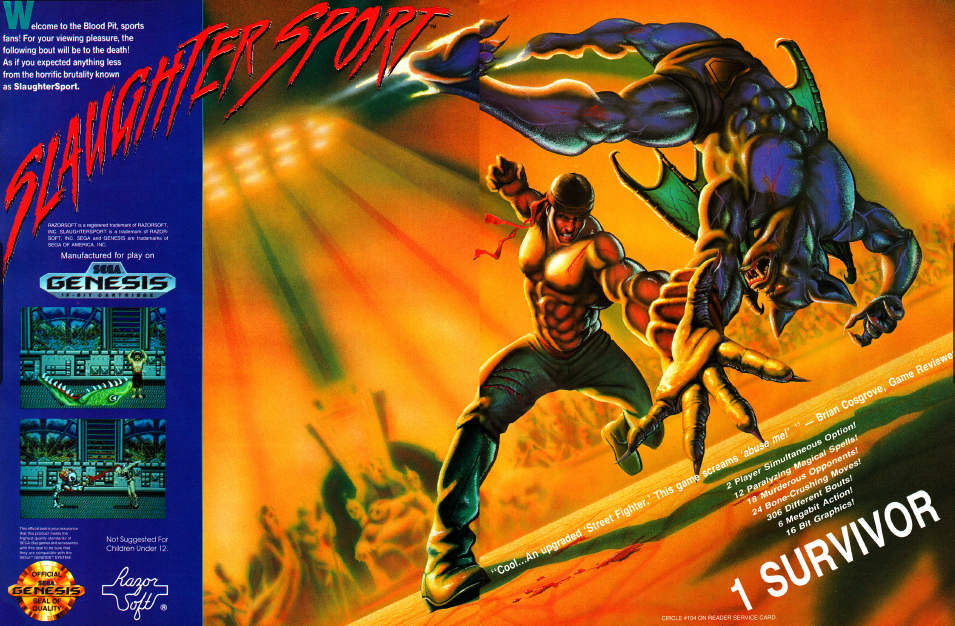
Finally, we have this ad for Slaughter Sport* (EGM 026, September 1991). This ad shows just how far the “language” of video game magazine ads had gotten by the end of this era. Perhaps most notably, this is a more teen/adult-oriented ad, with a very edgy tone and an increasing amount of violence portrayed on the page.
*I can’t move onto the next era of gaming without mentioning that this game was originally titled Tongue of the Fatman. This game has a fucking insane legacy, and is considered one of the worst games ever made! I love seeing crazy and notorious games like this in the pages of EGM!
The Standardization of the Video Game Ad (1992 to mid-1993)
After a couple years of refinement, video game marketing departments had finally developed a basic, unified “language” for the video game ad, which they would all adopt going forward:
- An eye-catching key art which conveys the game’s feel and tone. This will generally feature the protagonist(s) front-and-center showing off the main gameplay feature(s).
- A catchy tagline.
- Screenshots showing off the game’s graphics.
- The title in large, unmissable font.
From here, a marketing arms-race ensued. Now that video game ads were starting to look the same, advertisers had to find ways to stand out. This generally manifested with obnoxious ads that try to make the reader feel inadequate, or which feature rude humour, or both. However, what sets this era apart from the one that would follow is that advertisers were still aiming their products squarely at children; as a result, the deluge of snark and attitude was not pushing the boundaries too far yet.

Take a look at this ad (from EGM 033, April 1992)! Design-wise, this looks like something I’d see when I was reading EGM in 2005: it’s incredibly impressive how early the language of the video game ad became established!
Of course, I’d be remiss if I failed to mention that this is a video game acting as a sequel to the goddamn Gulf War, playing into the (at the time) popular fantasy of “finishing the job”. It, uh, was a different time.
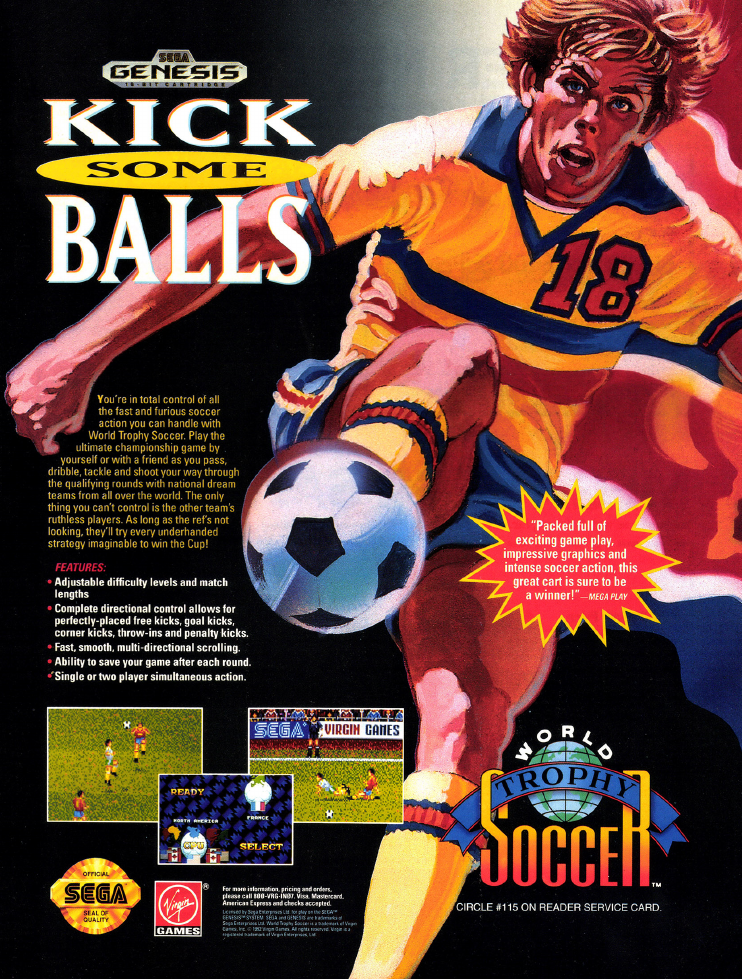
For this ad for World Trophy Soccer (EGM 038, Sept 1992), it’s pretty obvious to see how Virgin Games’ ad team decided to stand out: with the relatively rude “kick some balls” tagline. It’s silly, but memorable; the sort of innocent rebellion that really defines this era.
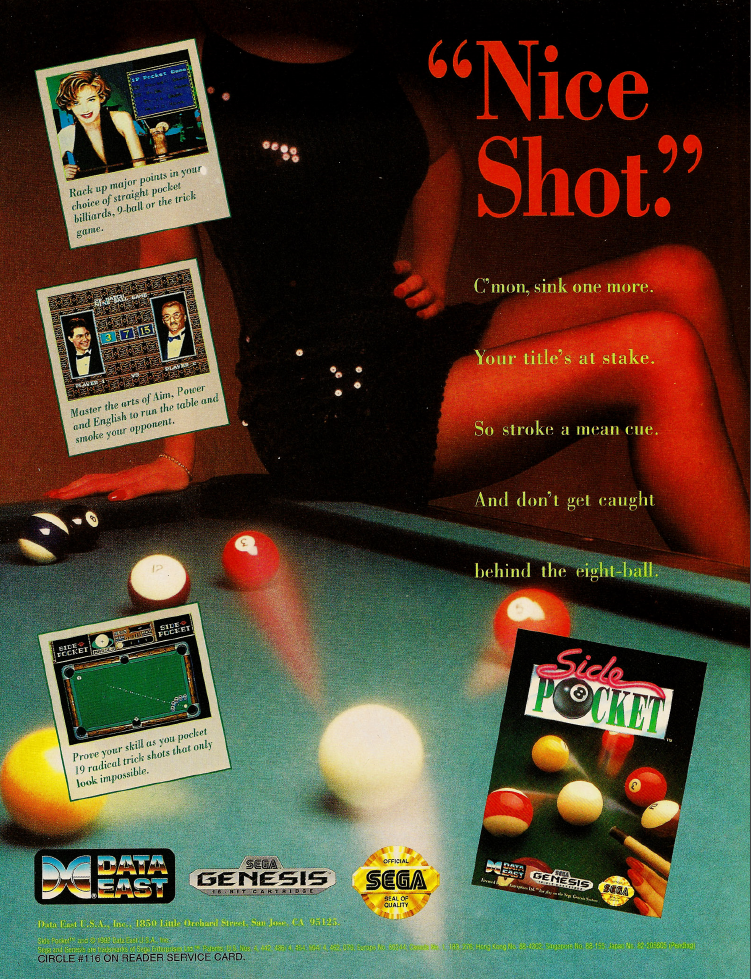
This ad for the Side Pocket (EGM 037, August 1992) is notable for being one of the earliest video game ads to take a more risqué approach, marketing towards a hornier demographic in an effort to stand out. Of course, this is still extremely tame stuff, but the inference and the fantasy it’s selling is unmistakable.
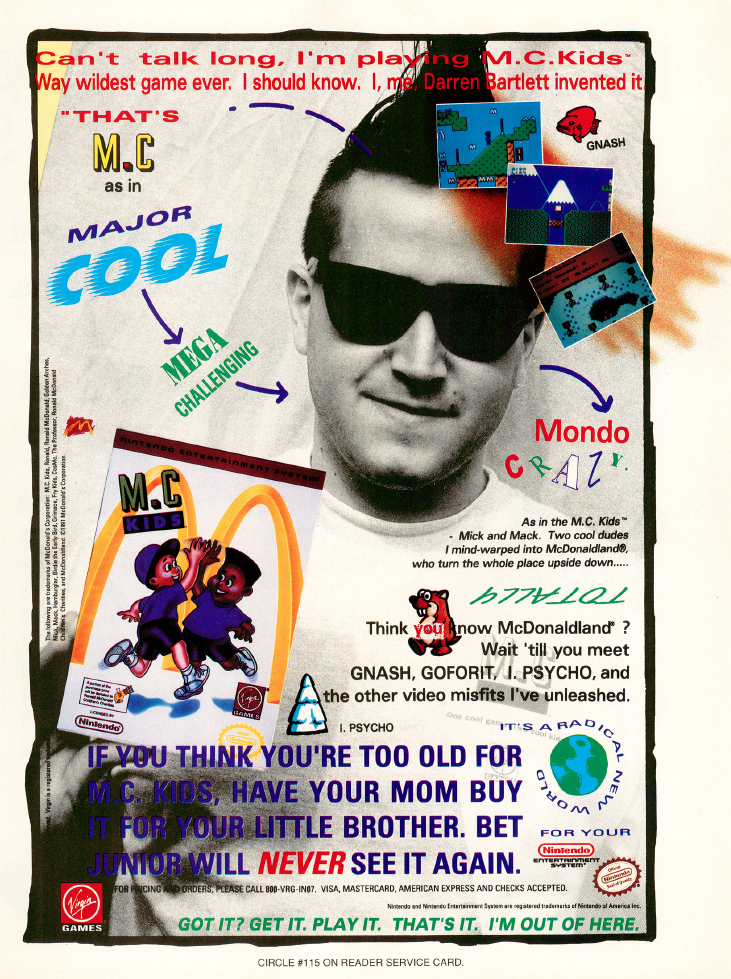
Of course, just because the language has been established, doesn’t mean that you’re Shakespeare. This ad for M.C. Kids (EGM 033, April 1992) is embarrassing and fascinating in so many ways. First of all, it’s for a fucking McDonald’s kid club game. I cannot think of anything that would be less-cool to someone over the age of eight. However, by trying so fucking hard to be cool, this ad manages only to make M.C. Kids look all the more uncool. One of the more notable advertising failures of this era for me.
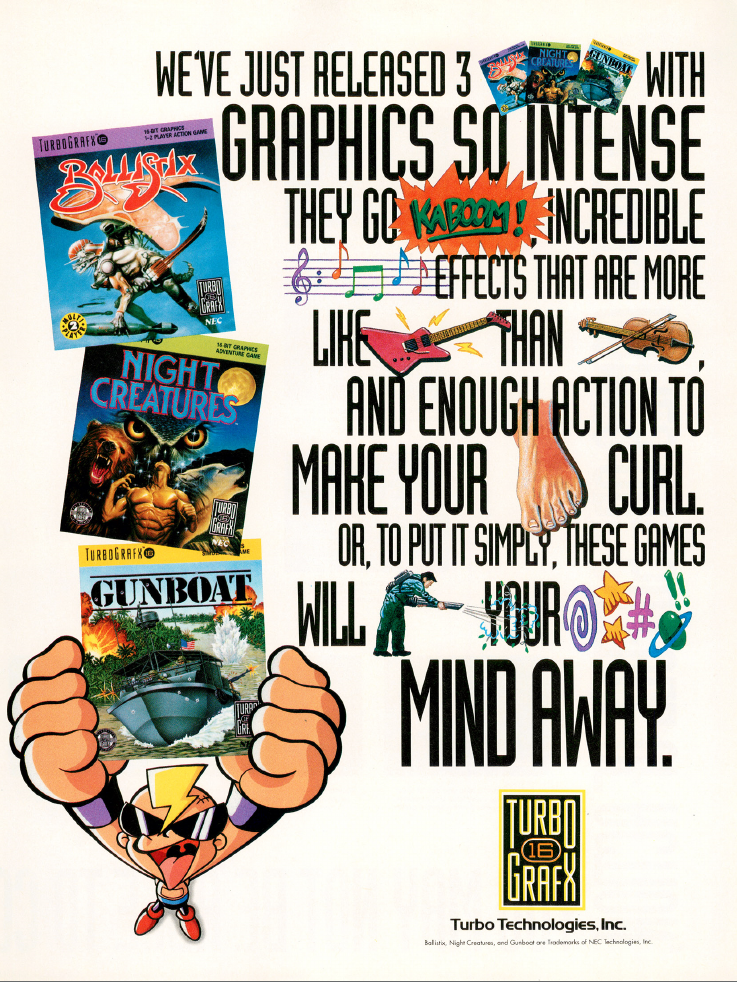
Sega’s edgy attitude continued into 1992, and their competitors followed suit. This TurboGrafx-16 ad from May 1992 is clearly aping Sega’s style, but its unique spin makes it look more childish… whether that was their intent or not, I can’t really say, but NEC would give up on the console when this marketing blitz failed to ignite any interest in it.
Sega were still had the edgiest, most provocative, and most attention-grabbing advertising team of the day. However, since their competition were all putting on attitudes of their own, that just meant Sega had to take things one step further to stay on top. Take this ad from December 1992, for example, where they call their competitors (and the people who own their systems by extension) a bunch of loser nerds.
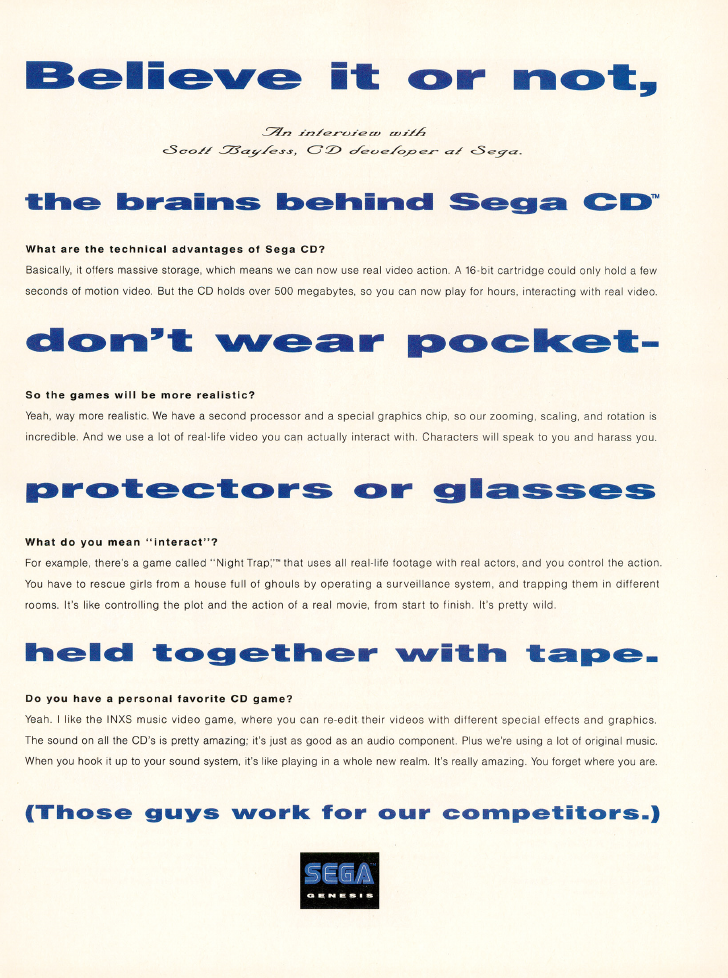
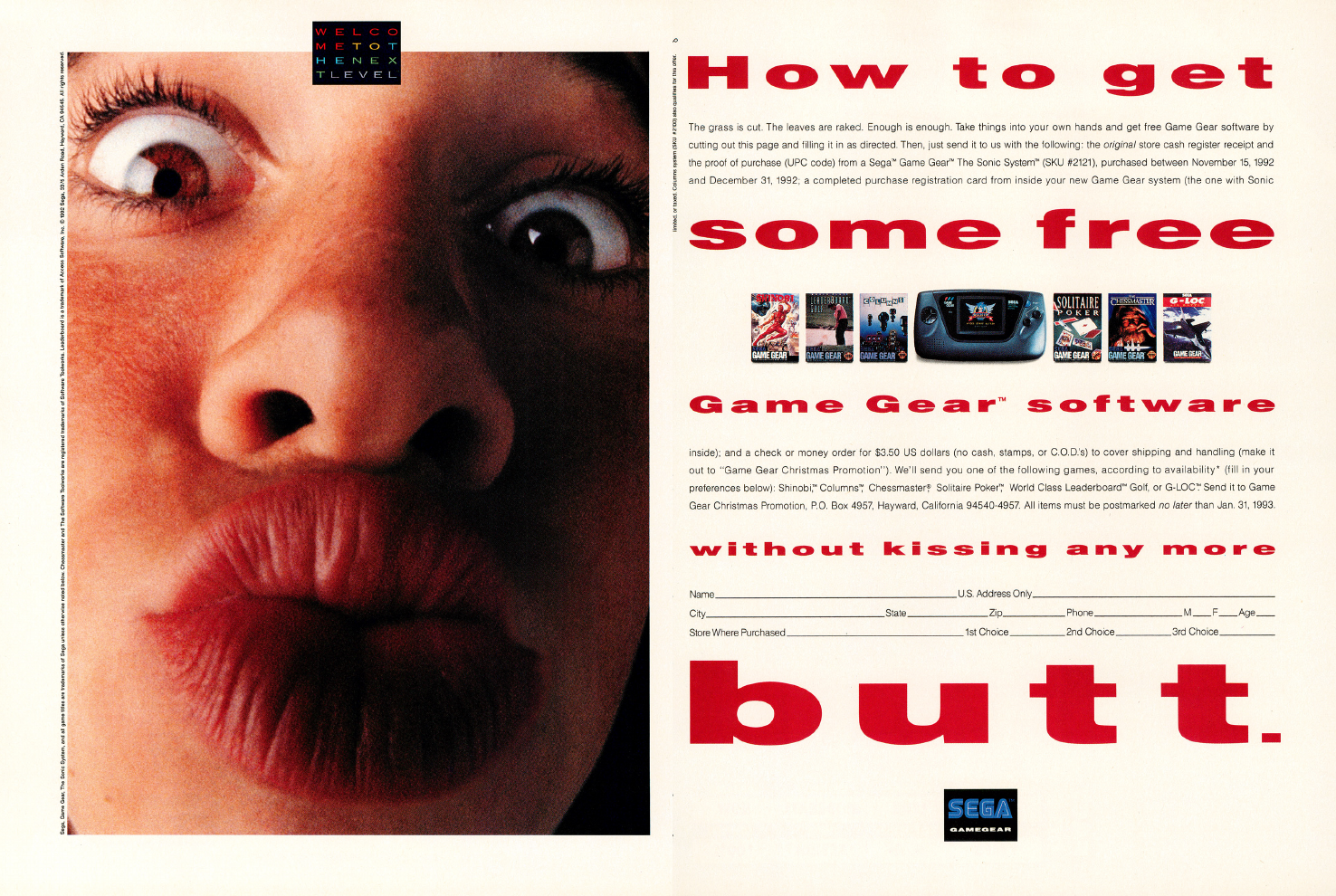
…or how about this one? Kids would, of course, find this rude humour hilarious. (EGM 041, December 1992)
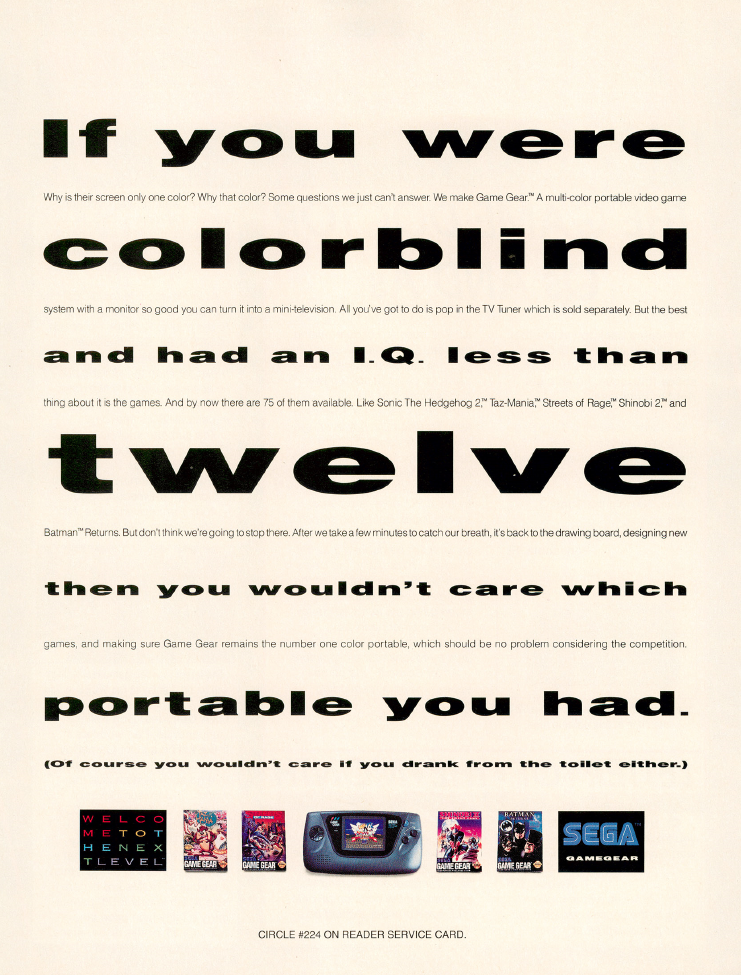
…or how about this extremely rude and moderately-offensive ad where they call you a drooling, toilet-water-drinking moron if you own a Game Boy? It’s memorable, but goddamn was this level of attitude and tribalism starting to get obnoxious. (EGM 043, February 1993)
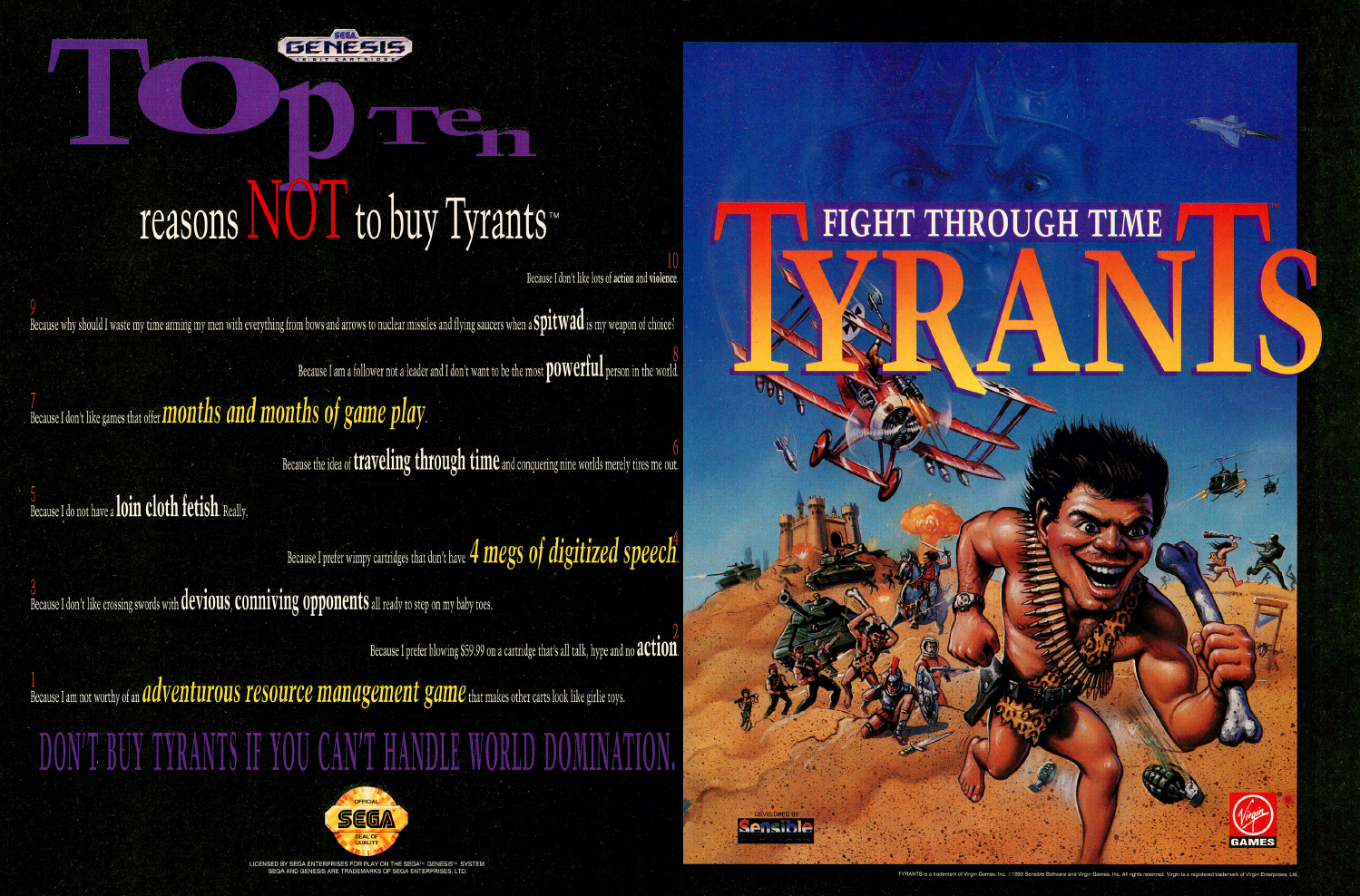
We have here another poor showing from Virgin Games (EGM 045, April 1993). Tyrants: Fight Through Time is a real-time strategy game… as someone who likes these kinds of games, they appeal to nerds. That’s not really coming across here, with boasted features like “lots of action and violence” and enough loin cloths to get you off. Of course, they also have to throw in a line about how you’re a sissy girl if you like other video games.
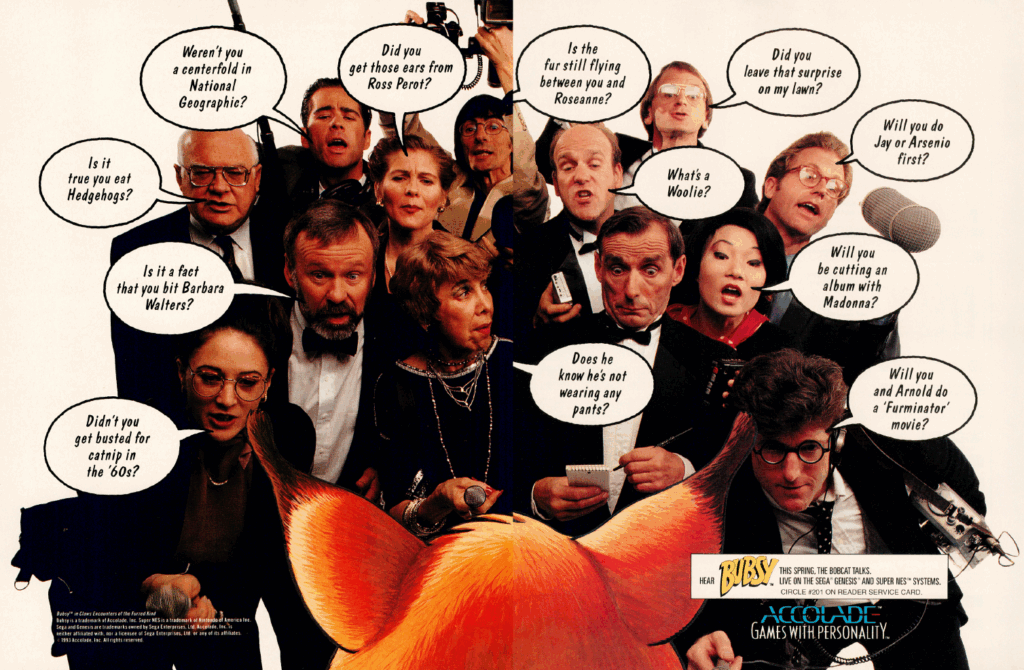
Lastly, we have a trend which started to emerge as more and more companies copied Sega: the mascot platformer goldrush. Where better to highlight that than with the most memorable Sonic rip-off: Bubsy himself. This ad checks all the boxes for this era of gaming: copious pop culture references, rude/risqué humour, and a ton of attitude for an unproven (and ultimately mediocre) franchise. There’s no info about the game itself, just a promise that Bubsy is gonna be “even more radical than Sonic!”
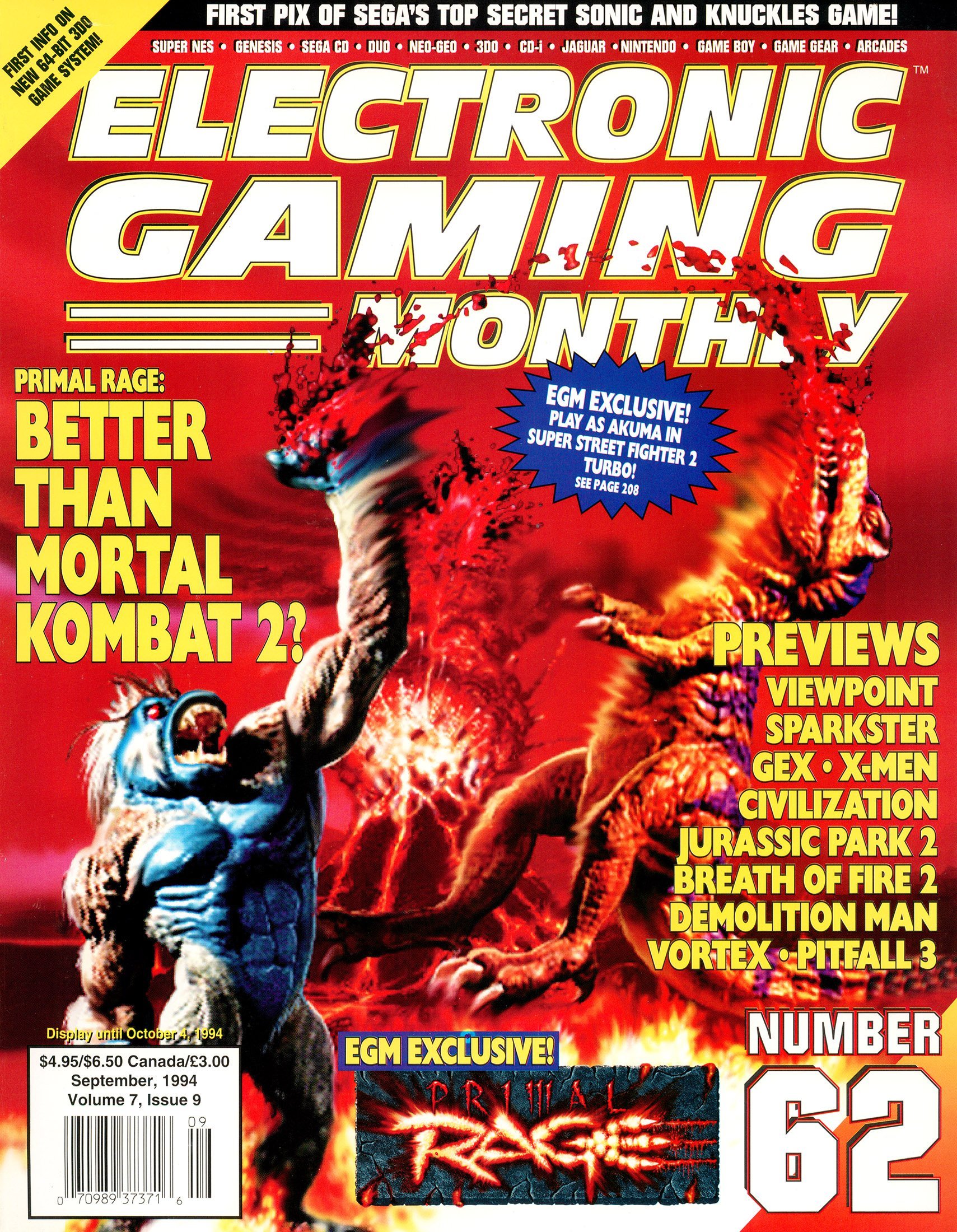
Pushing the Envelope (mid-1993 to mid-1995)
Mid-1993 bore witness to a gaming culture which was growing increasingly more obsessed with violence and mature themes. Street Fighter II and Mortal Kombat were absolutely dominating gaming’s cultural zeitgeist. After years of escalating attitude and edge, the family-friendly artifice that video game advertisers had propped up suddenly gave way, and the dawn of the stereotypical “video game ad” would take shape. The previous years’ flashy, eye-catching ads were no longer good enough to stand out. Marketing teams began pushing even more obnoxious amounts of attitude, claimed that their products would contain explicit violence, used gross-out shock tactics, and began dabbling with very juvenile and superficial sex appeal. As these tactics caught on, the all-ages demographic of video game ads gave way as we steadily transitioned to a teenage boy-focused industry towards the tail-end of the 16-bit era…
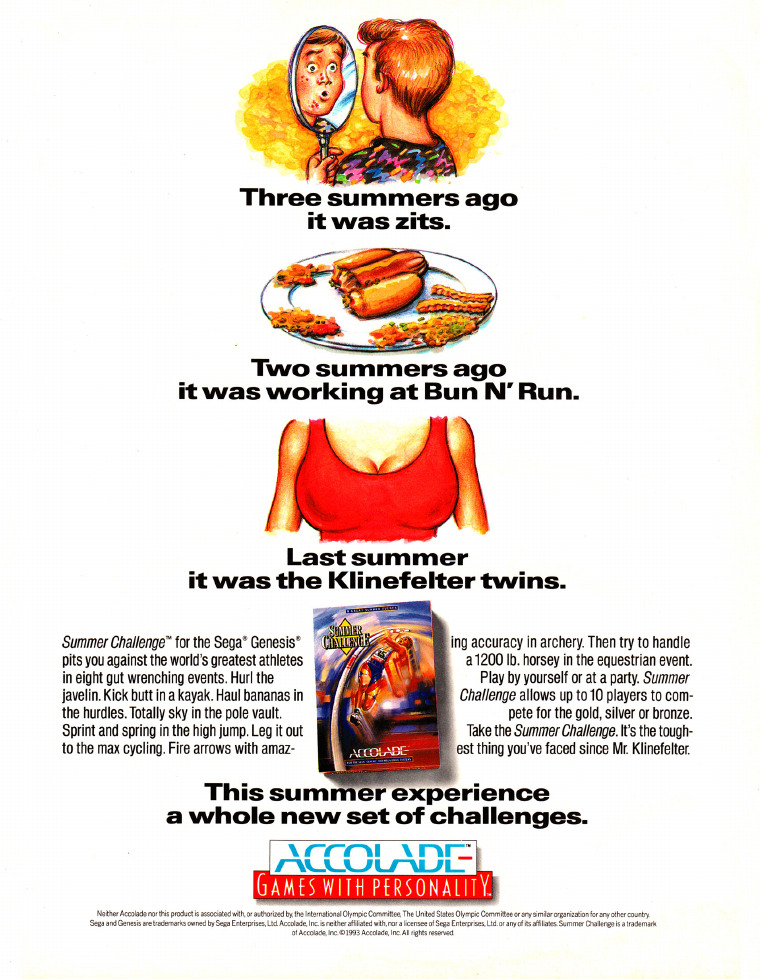
This ad for Summer Challenge (EMG 048, July 1993) is the first instance I could find which was obviously directed towards teenage boys, and the angle that they took to appeal to them was sex. Bear in mind: this is an Olympic sports game. There’s nothing sexy about it that would warrant a big ol’ pair of boobs to be front and center in the marketing. What really sends me is that they don’t even show what the Klinefelter twins look like. As far as the teenage boy fantasy scenario is concerned, they’re literally just a pair of hot titties – quite an appropriate early example of the sort of shit to expect from video game ads going forward!
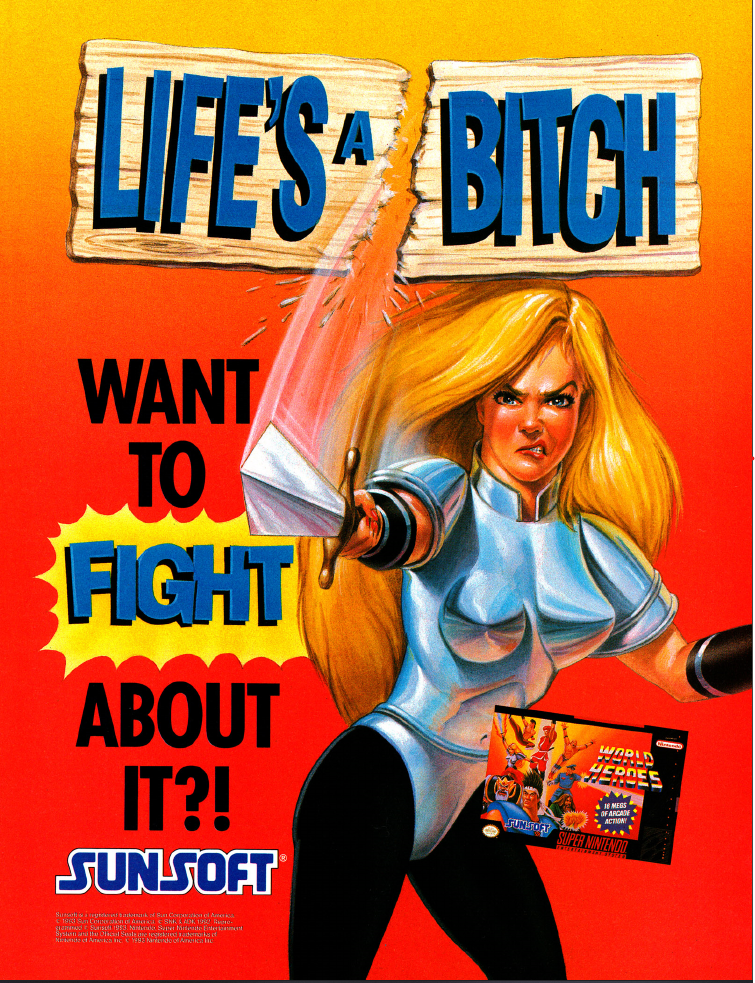
Just look at how sudden the shift in tone was for these advertisers: in a matter of months, we went from being terrified of saying any swear words, to having “BITCH” spelled out in massive, bolded font (EGM 049, August 1993). That’s not even getting into the off-the-charts amount of attitude and the extremely perky boobs on… wait, that’s supposed to be St. Joan of Arc? Holy shit, that’s hilarious!!!
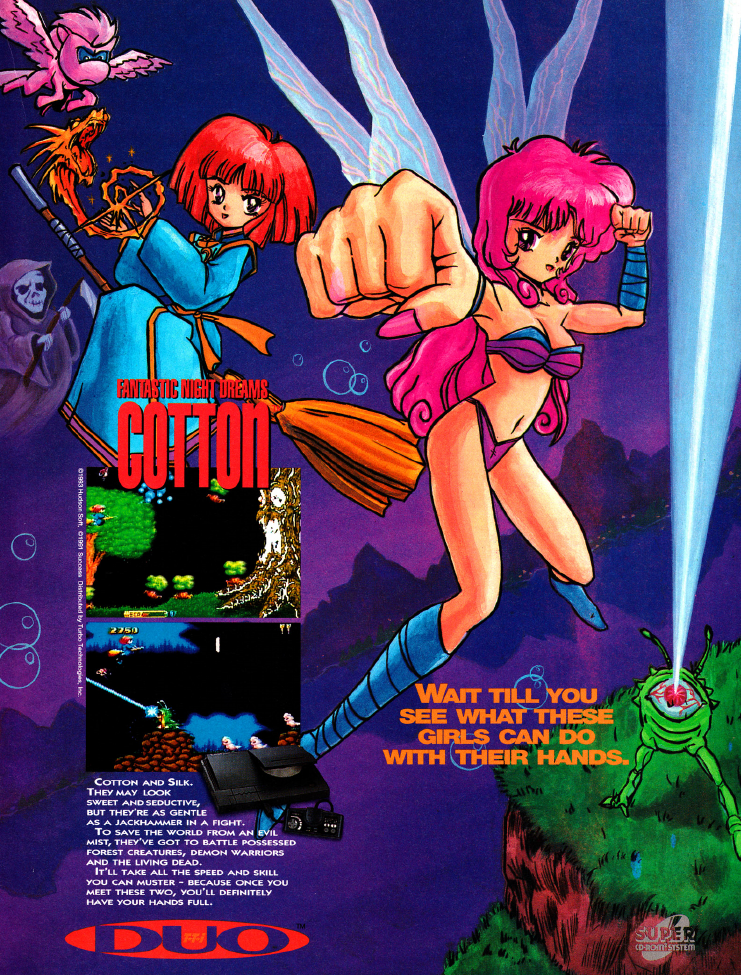
This ad for Cotton: Fantastic Night Dreams (EGM 049, August 1993) establishes another very common pattern that would come to define video game ads. Its tagline (“Wait till you see what these girls can do with their hands”) is memorable, lurid, and doesn’t really have anything to do with the game itself. However, the small text blurb describing the game ends with a call-back to this tagline, which is something that most video game ads would adopt going forward.
Also… “these girls”? Including age-unknown-but-mentally-five-years-old Cotton…? What the fuck, advertisers???

Here’s a trend you’ll notice with the rest of the ads from this era: they’re all two-or-three page spreads, which makes their bombastic imagery unmissable. General Chaos (EGM 050, September 1993) promises to allow you to blow the absolute shit out of your friends – it’s not exactly graphic, but it’s another escalation in the sort of violence that these ads are willing to portray.
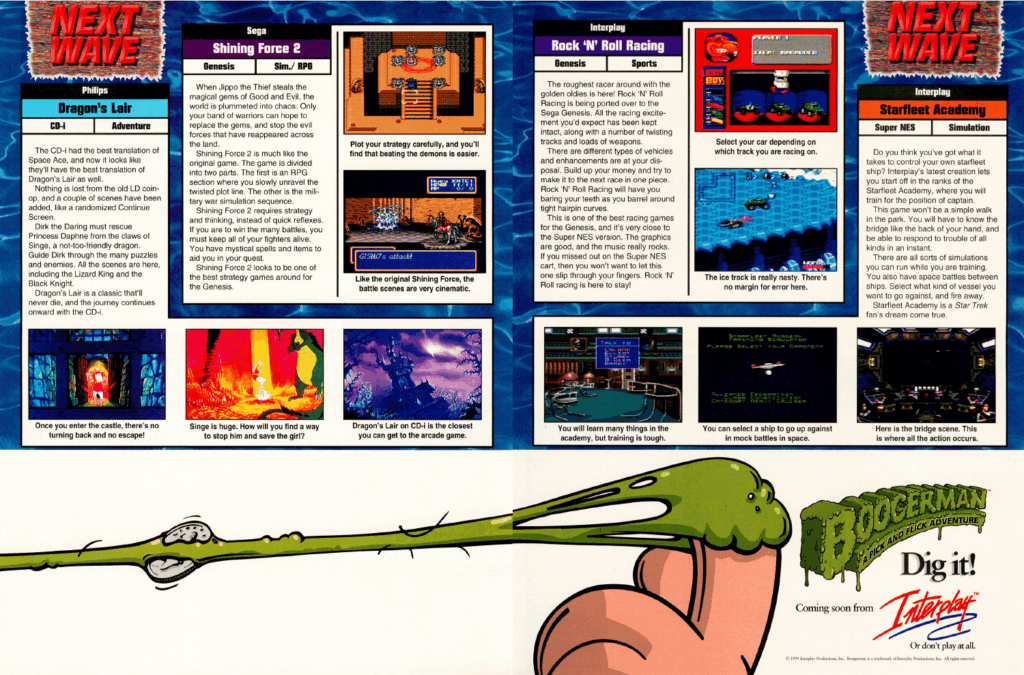
Here is, by far, the best example of a minor trend that was going on at this time: gross-out ads. I found a few examples of them during this era (usually revolving around repulsive-smelling things), but this one for Boogerman (EGM 060, July 1994) is by far the most disgusting. At least in this case, it seems like it’s representative of the game in question? I guess that’s one way to make your game stand out.
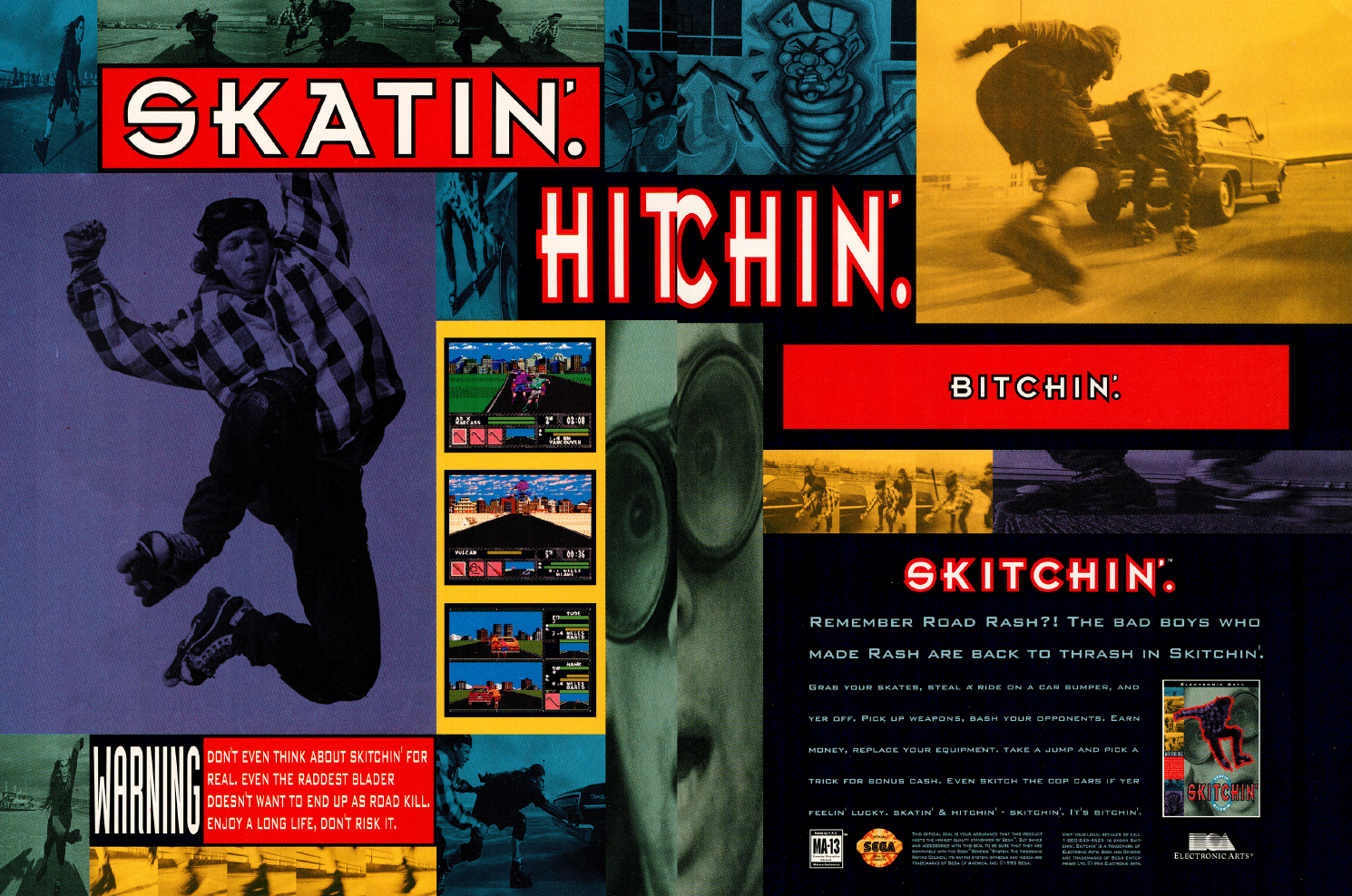
Y’know how your parents would try to drop a bunch of slag that “the kids are saying these days”, and end up sounding completely incoherent and cringy? This ad for Skitchin’ (EGM 057, April 1994) absolutely reeks of that desperation to be considered “cool” and “authentic”.

While Sega were the masters of marketing throughout the lifecycle of the Genesis, a new contender soon arose with the edgiest, most attitude-filled ads, bar-none: Crystal Dynamics. This ad for Samurai Shodown (EGM 063, October 1994) pushes the envelope in several regards: the pool of blood, the copious amounts of attitude, the swearing, and the promise of extreme violence.
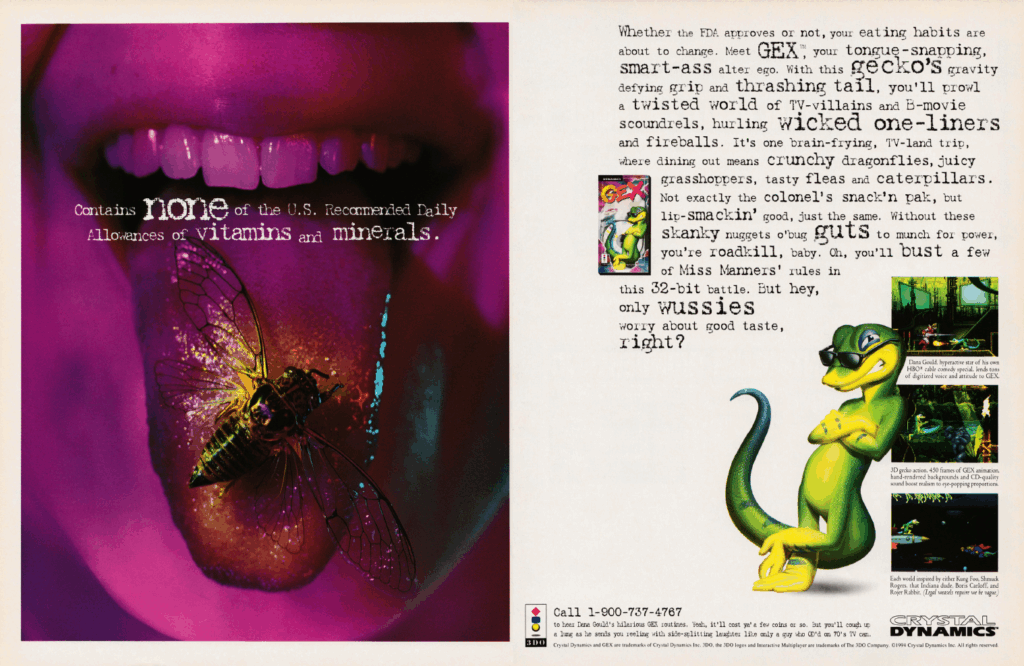
Also like Sega, Crystal Dynamics would run unified ad campaigns (this ad for Gex ran in the same issue as the previous one for Samurai Shodown), explicitly linking their products together and cross-promoting them in the process. It’s probably no surprise that Gex is clearly intending to take on Mario and Sonic head-on (too bad he tied himself to the infamous console flop, the 3DO). Crystal Dynamics’ edgy ads would be a staple of gaming culture for years to follow.
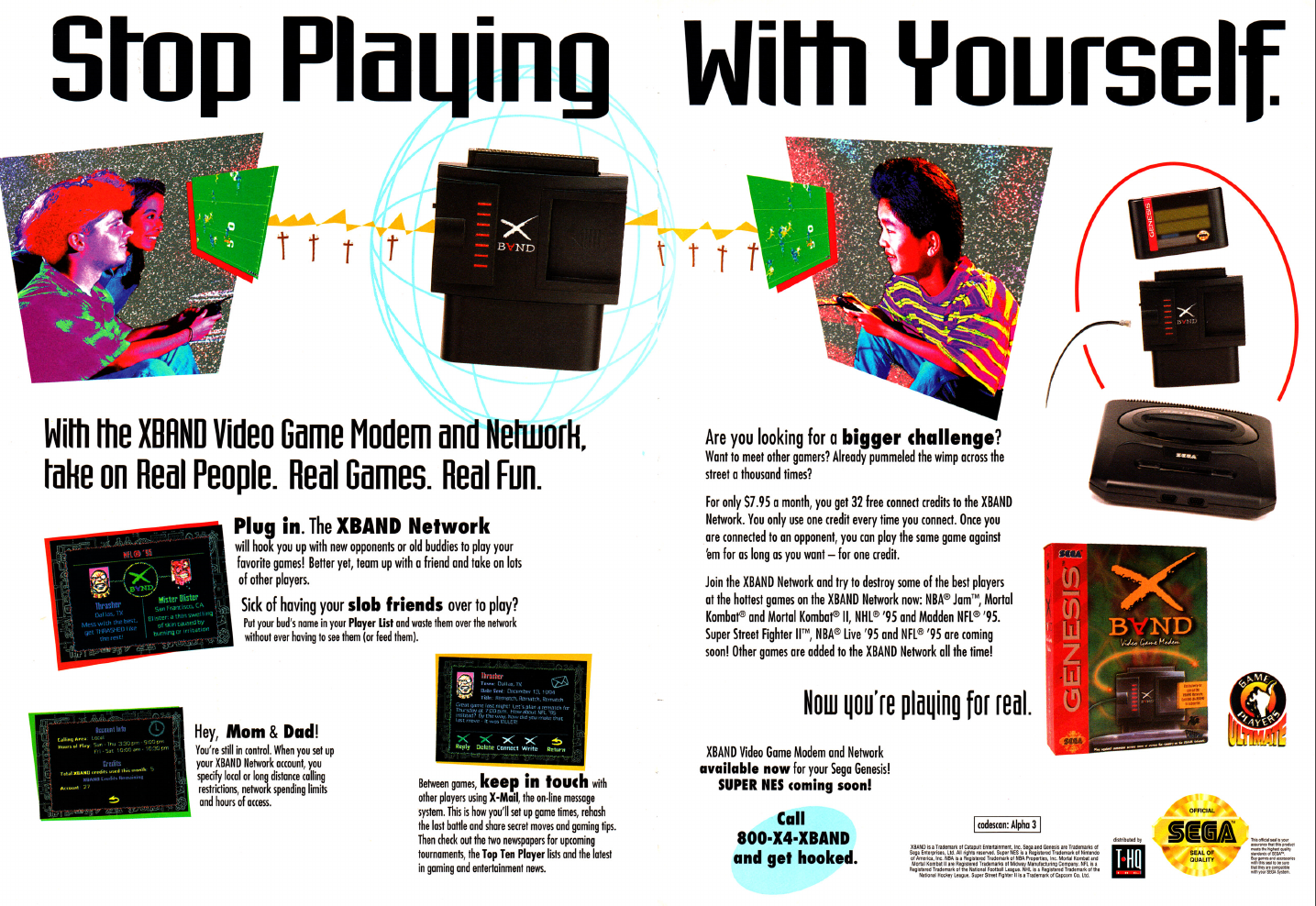
C’mon, you know why I chose to highlight this one (EGM 067, February 1995). “Hmm, how can we market our peripheral that allows you to play SNES & Genesis games online (in 1995!!!!!) to teenage boys? Oh, I know, we’ll tell them to stop doing their favourite activity!”
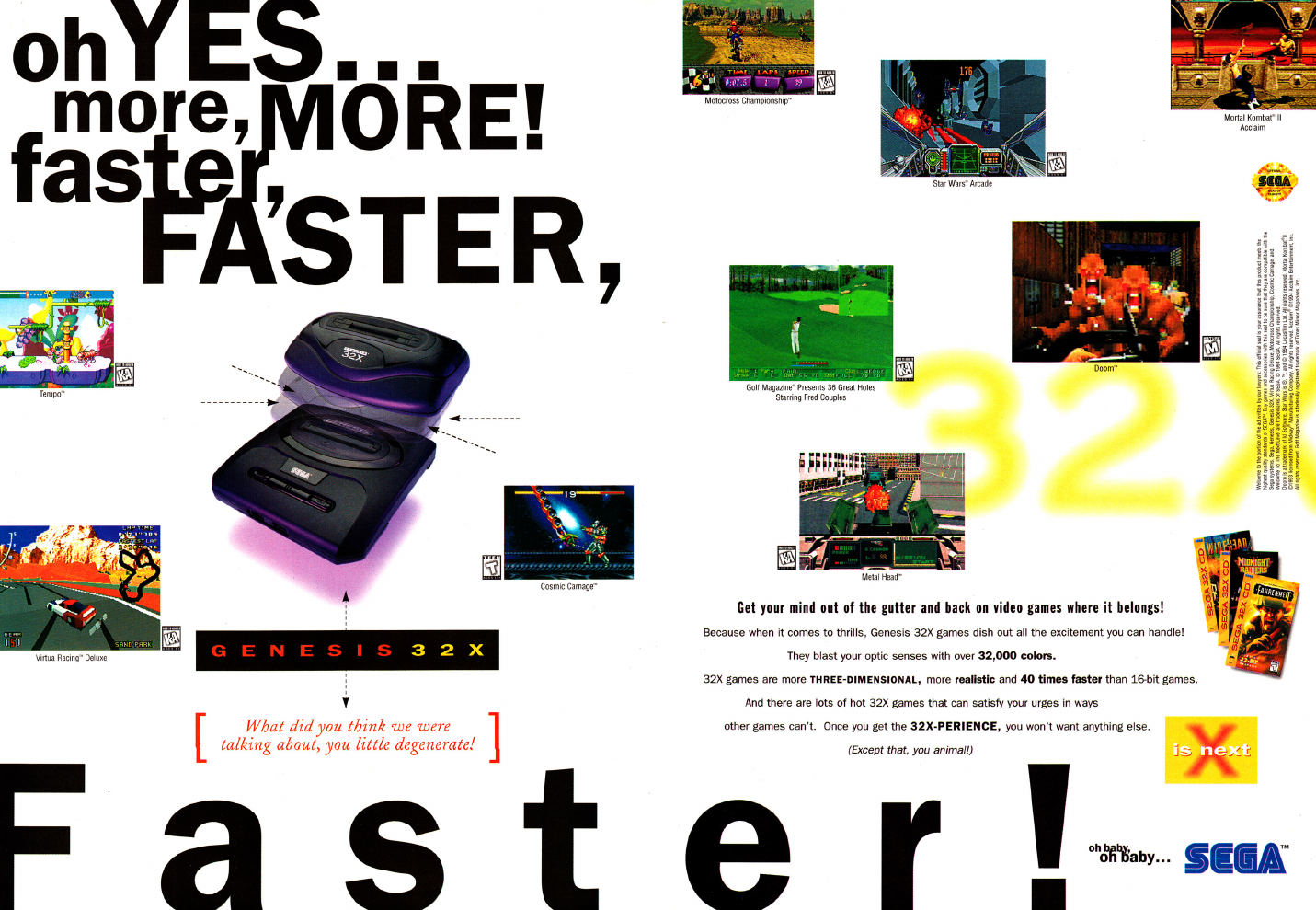
By the end of the Genesis’s life-span, Sega’s marketing had gone off the rails. This ad from February 1995 is completely unhinged. So much space is dedicated to sex that you can’t even tell what it’s supposed to be advertising (it’s the 32X add-on for the Sega Genesis, by the way). The fact that it has the temerity to accuse us of being the filthy-minded ones is the only thing about this ad that actually offends me. We are so far removed from the child-friendly ads that had dominated EGM only two years prior…
The Attitude Era (mid-1995 to mid-1997)
With the impending release of the PS1 and Sega Saturn, it seems like the entire industry flipped a switch overnight. In one fell swoop, the “mascot” era of gaming was ended. The entire industry began focusing their attention towards appealing to edgy teenage boys. Advertisers continued pushing the envelope further in order to stand out from the competition. Ads were frequently lewd, often very risqué, and were occasionally obnoxious. The era of the stereotypical “video game magazine ad” was well and truly upon us at last…
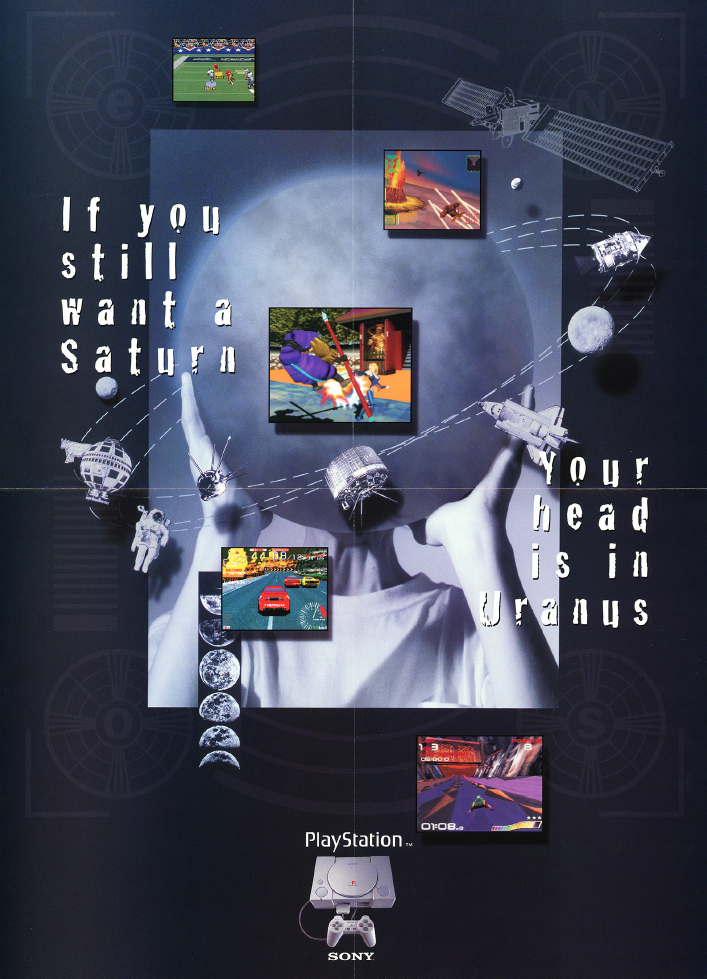
Sega’s marketing arm completely collapsed during this era, with their attempts at attitude coming across as weak and out of date. Sony, on the other hand, outdid Sega at their own game, establishing the PS1 the best place to play the “cool” games (EGM 076, November 1995).
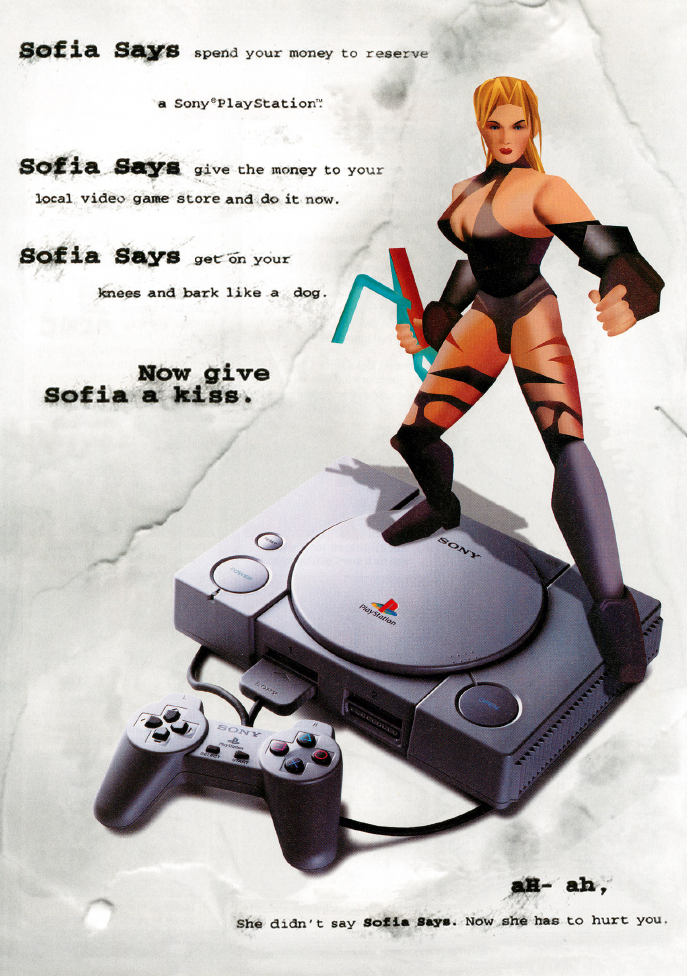
GUYS. DID YOU KNOW THAT ONE OF THE FIRST PS1 MASCOTS WAS A FUCKING DOMINATRIX!?!!
I’m being fucking serious here, somebody thought that they could successfully market the PS1 using Sofia from Battle Arena Toshinden (as seen here in EGM 074, September 1995)! That is insane, and her tenure as the PS1’s mascot did not last for very long, but the fact that it happened at all really goes to demonstrate exactly how much the gaming ad landscape had shifted in only a couple years’ time.

This ad from Sega (EGM 083, June 1996)… it’s basically porn, right? Like, you couldn’t look at this image at work, you’d get in shit… that’s literally NSFW. They completely fucked up the entire point of the ad though: your eyes are instantly drawn to the naked woman, then you notice the jokey blurb that you noticed the Saturn screenshots first… but, like, literally no one noticed the screenshots first. As soon as I finished reading the blurb, I immediately resumed staring at naked blonde chick. It’s so stupid. No wonder Sega were roundly ignored through this console generation.
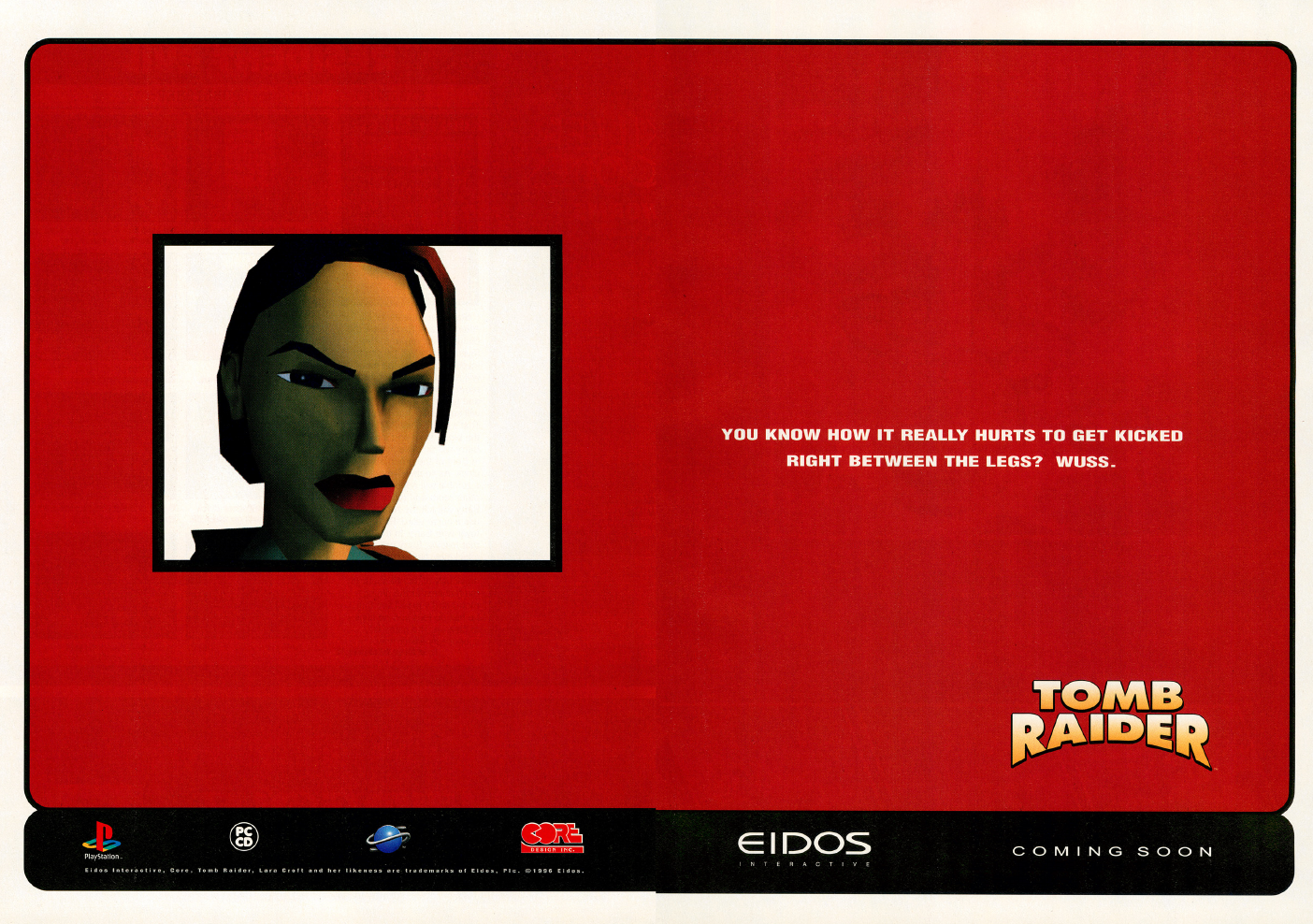
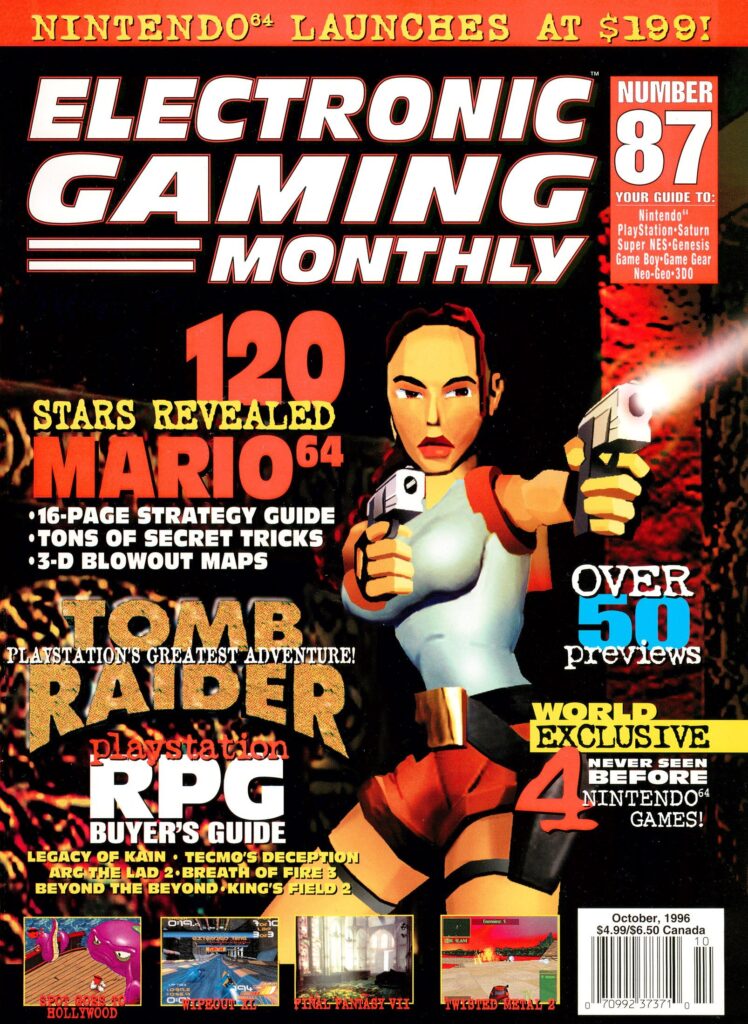
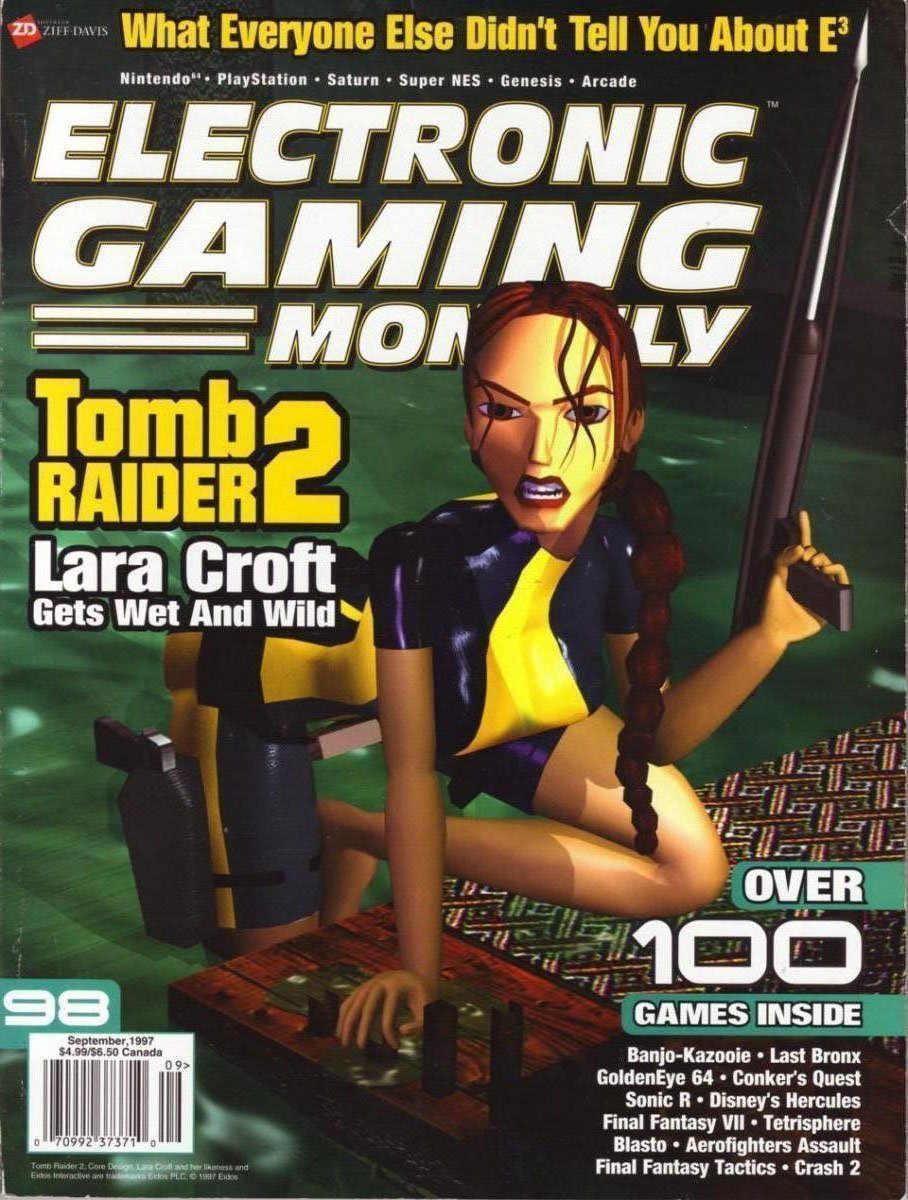
I find this ad (EGM 087, October 1996) particularly interesting, because it comes from a time before Eidos banked on Lara Croft’s sex appeal to market their game. Instead, they leaned hard into attitude to try to convince you to buy the game. Considering that the rest of the industry were leaning into sex appeal in their marketing, this is surprising. However, I think it actually kind of makes sense. Other games’ sex appeal was entirely superficial; Tomb Raider‘s sex appeal was baked into the game itself. A sexy game with a sexy lead character was something that hadn’t really been attempted by a major game studio, so it was risky new territory that they weren’t sure how to navigate yet. Teenage boys could see Tomb Raider as a “game for girls” because it had a female lead, so they took a “safer” route by emphasizing the attitude that was working for other games at the time.
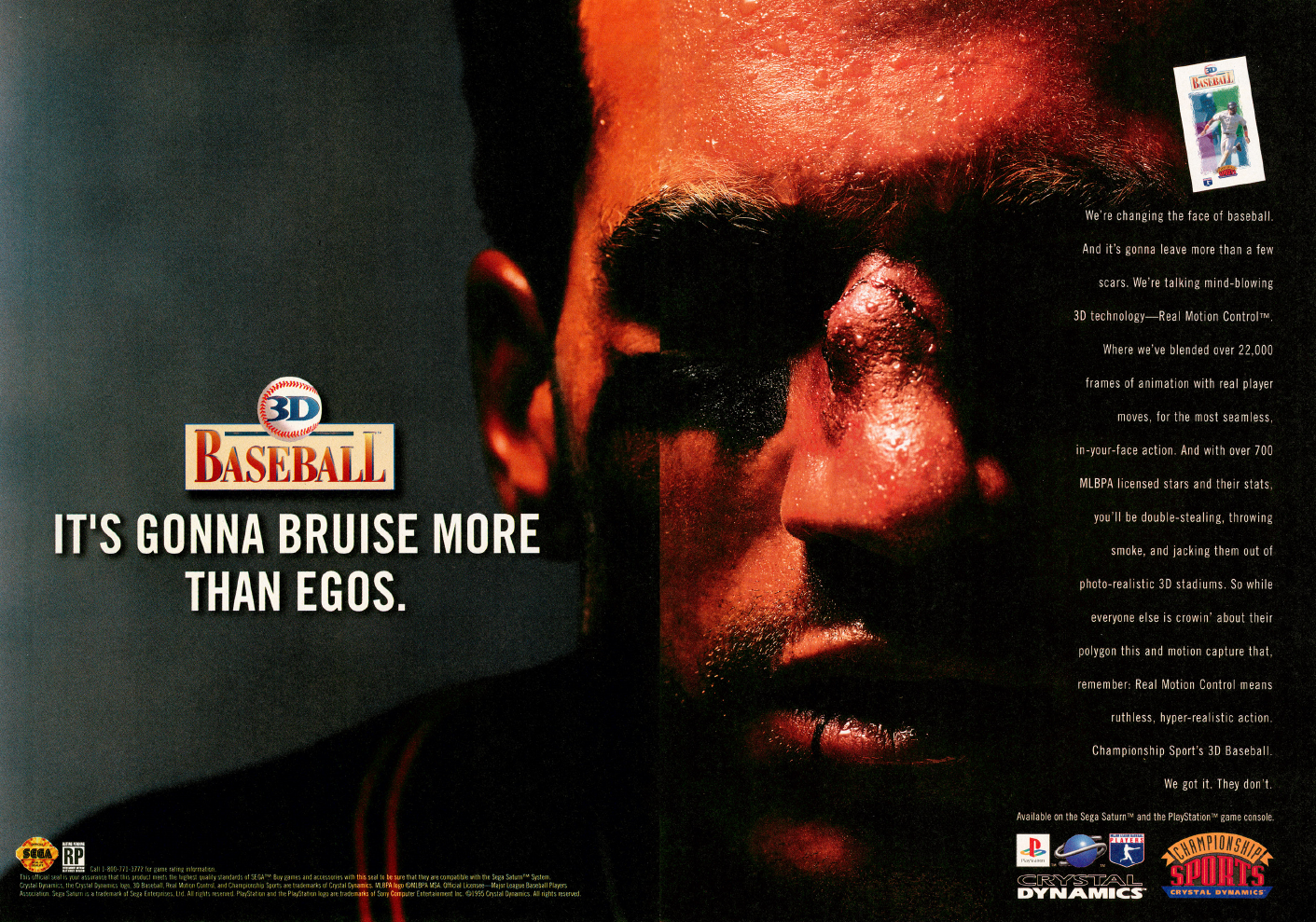
I sincerely hope that this ridiculously intense ad makes it obvious how unhinged the advertising got during this era. It’s fucking 3D Baseball. It’s the same as every other baseball game that’s ever been made, my dudes. Again, Crystal Dynamics’ marketing team were truly off the deep end during this era. (EGM 078, January 1996)
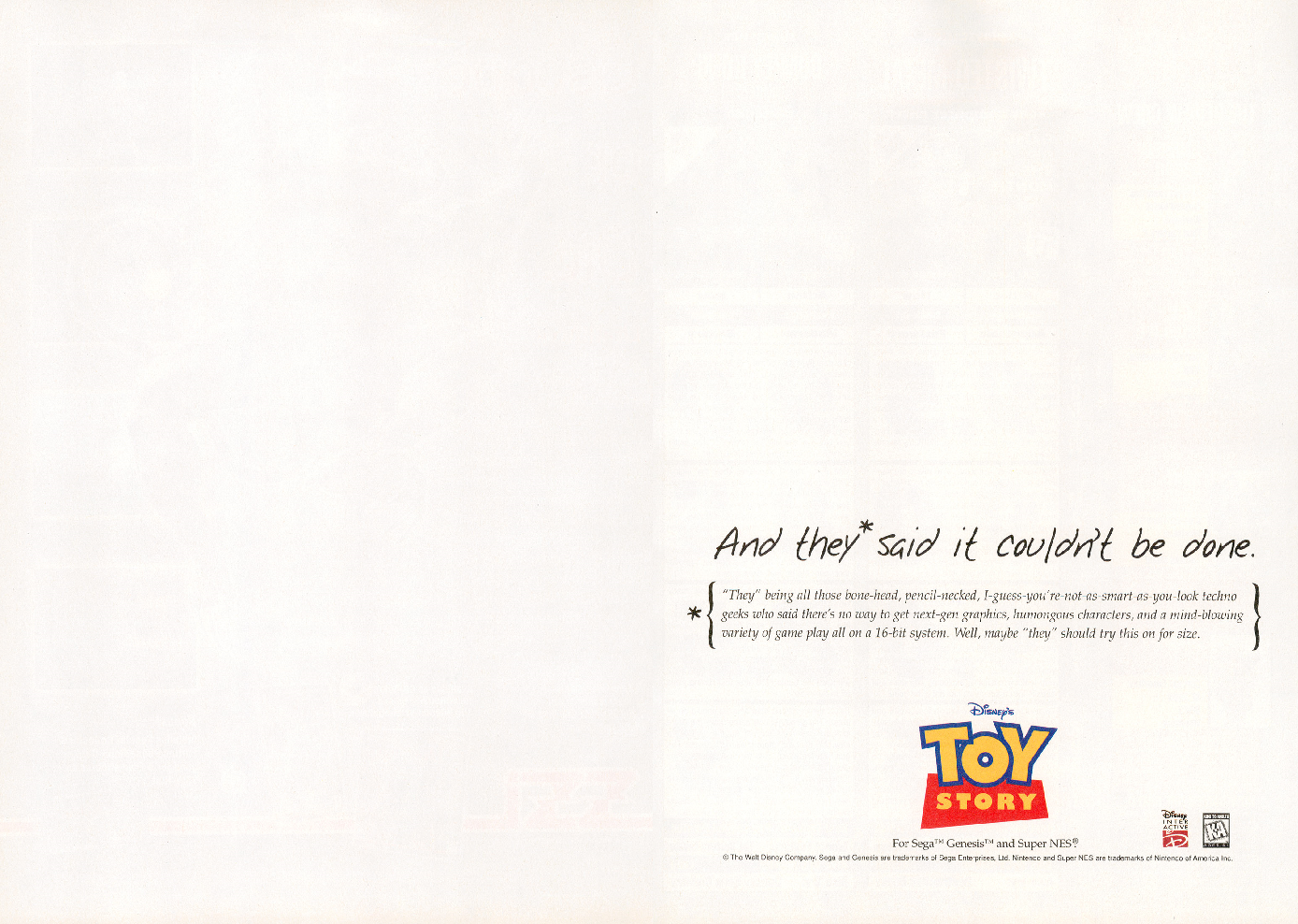
And here we have obnoxiousness coming from (of all things) a fucking Toy Story game (EGM 077, December 1995). Why so abrasive, Woody? Chill the fuck out!
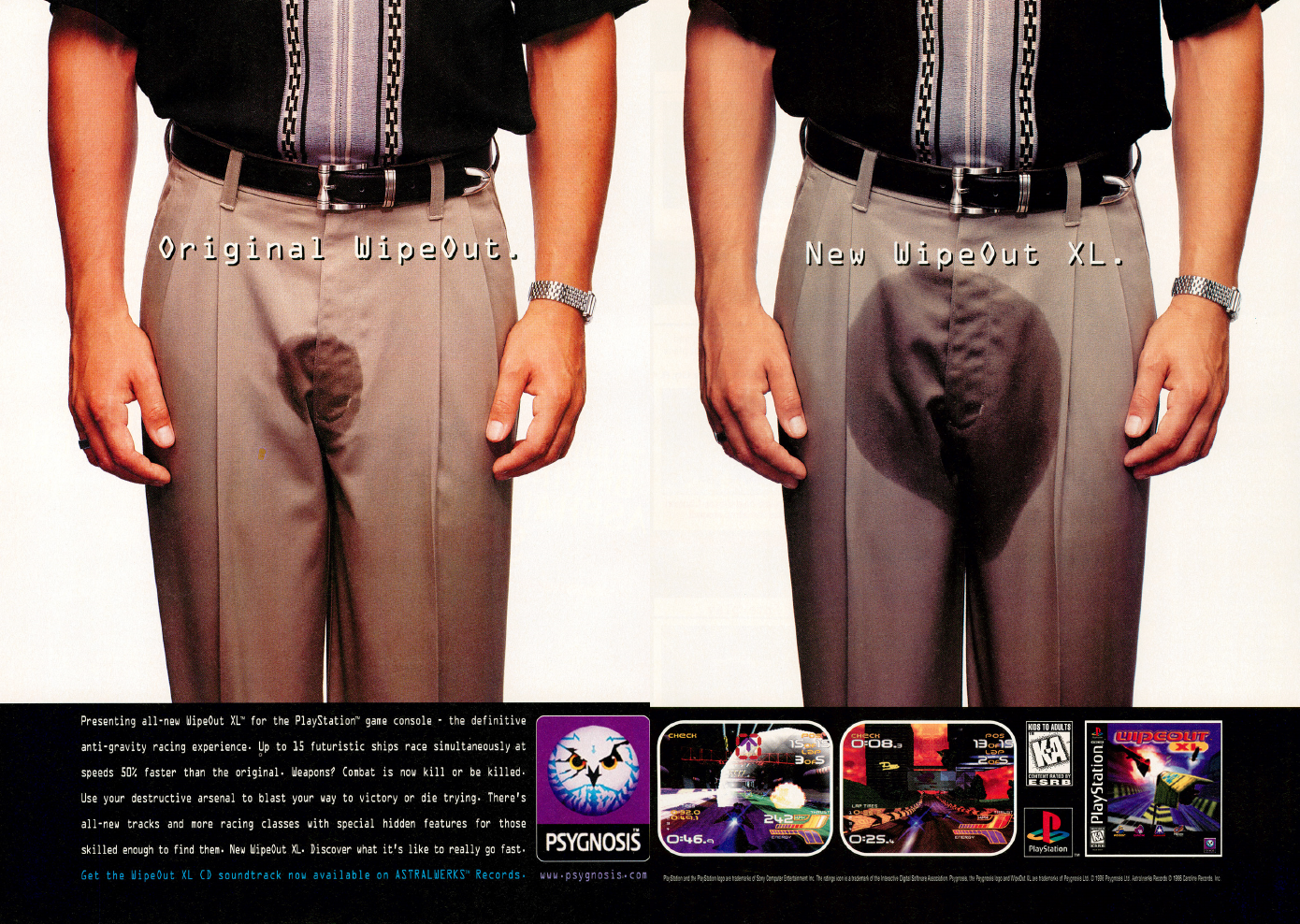
Oh my God. This ad for Wipeout XL (EGM 088, November 1996)… it’s literally saying “The original Wipeout made you uncontrollably cum. Wipeout XL is going to make you uncontrollably cum buckets.” Depictions of cum is a line I was not expecting advertisers to cross.
Maybe I’m just stupid and they’re actually saying that he’s pissed himself in excitement, but I don’t think so: that “discover what it’s like to really go fast” feels like a sly reference to me. And this is advertising a game that’s rated K-A (the old “E for Everyone”)!
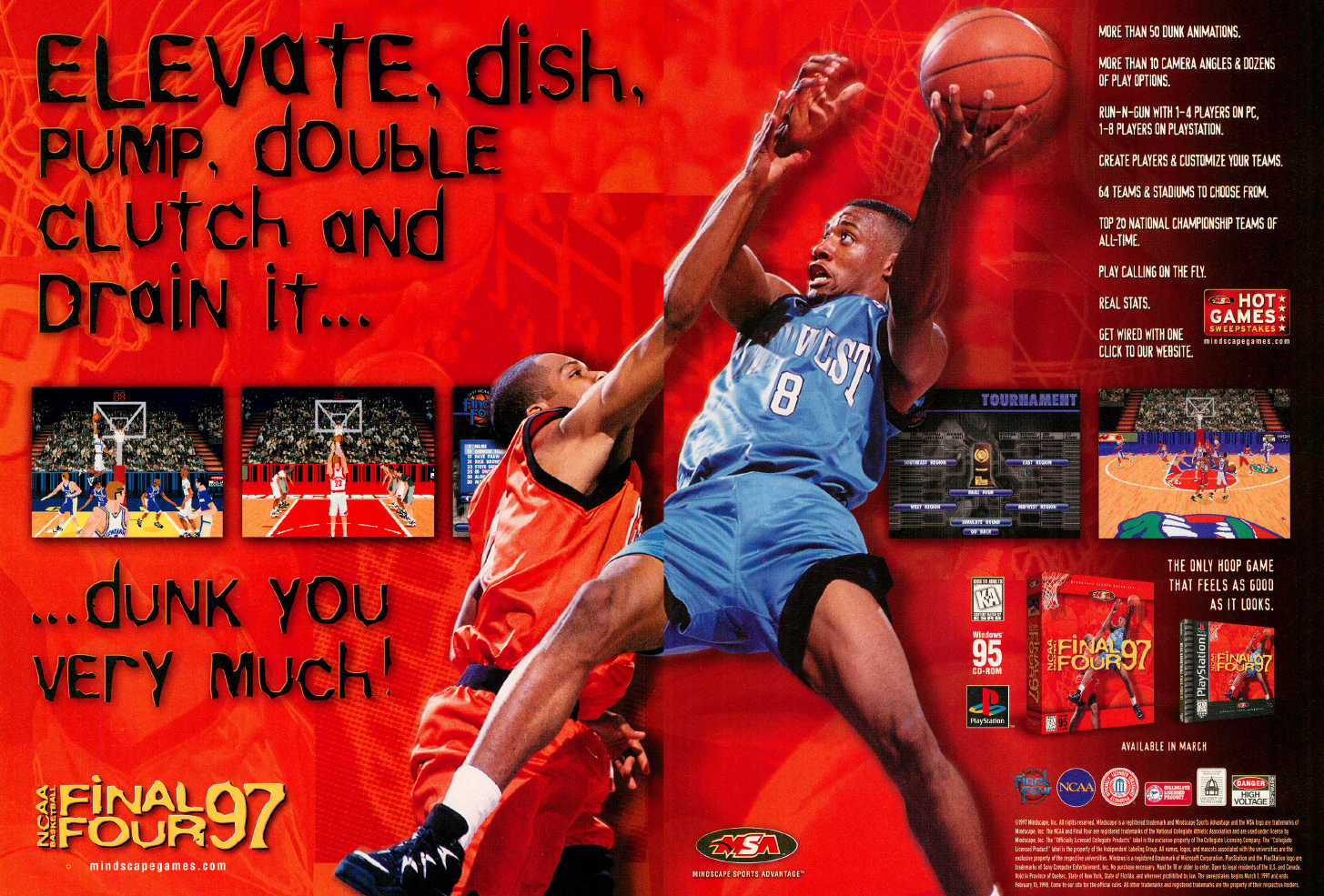
There were a lot of masturbation jokes in these magazines, often for the least-sexy, most kid-friendly of games (like this ad from April 1997, which is for a goddamn basketball game).
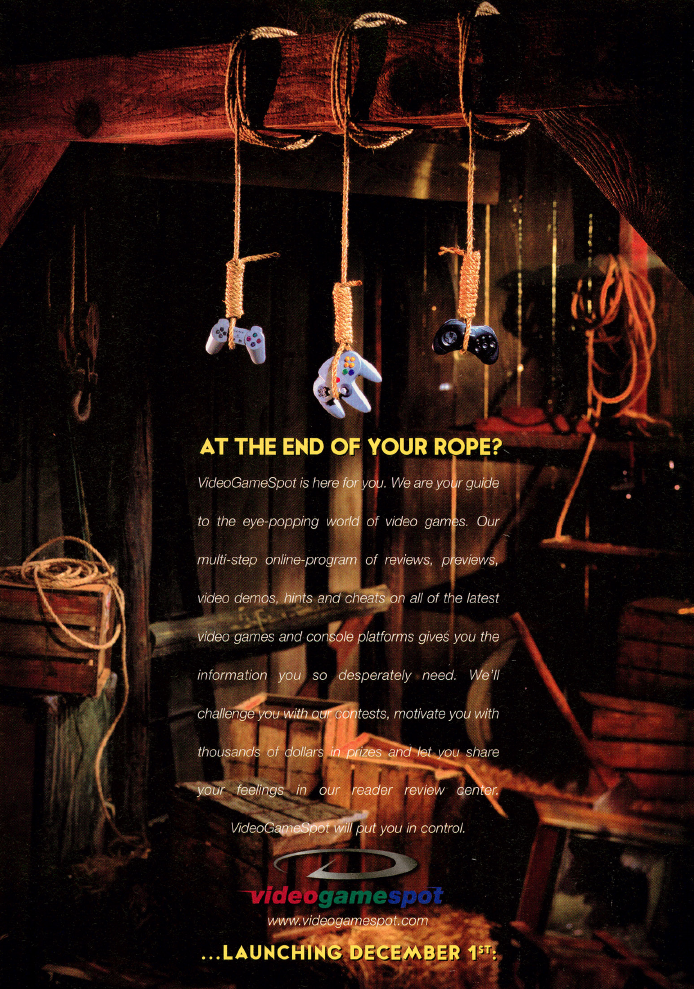
My jaw hit the floor when I saw this suicide joke ad from December 1996. People over-state how often things “just couldn’t be done today”, but you absolutely could not make an ad like this today without setting off a firestorm of controversy. Ultimately, that’s not because “people are too sensitive these days”: depression and teen suicide are more openly acknowledged and treated, so we know better than to use this kind of imagery lightly.
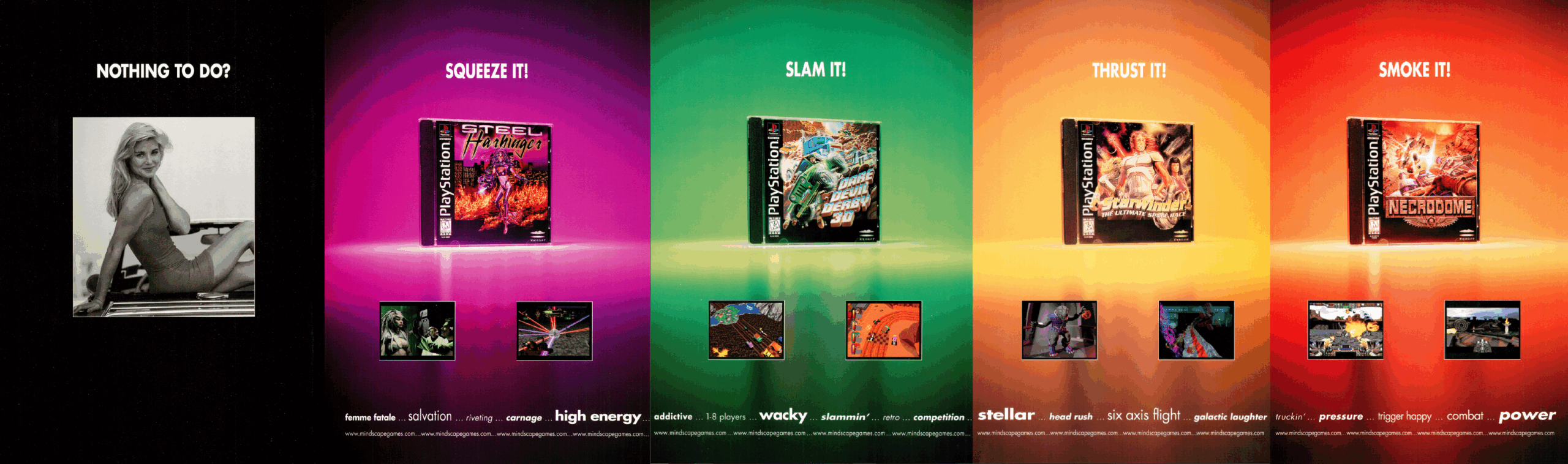
This series of ads for Mindscape Games’ PS1 releases (EGM 089, December 1996) is easily my favourite of this era. While most of the attention-grabbing ads of the era will take up two or three page spreads, these images were spread out over the course of five pages. The first page is slyly suggestive, before pivoting into a forced, but hilariously blunt masturbation joke. Whereas most ads would be done there, you then turn the page and the joke keeps going. Due to the surprise, it’s still funny. And then you turn the page and the joke is still going, and it stays funny because it delivers the most crass punchline they could have gotten away with. This does a terrible job of selling me on these games (I could not, for the life of me, name a single game being advertised here), but goddamn is it funny.
The Peak of the Stereotypical Video Game Magazine Ad (mid-1997 to early-1999)
As we were reaching the middle of 1997, I was thinking to myself: “Maybe the negative reputation of the video game ad was exaggerated. Sure, things had gotten more edgy and crass, but I haven’t been seeing a whole lot of truly obnoxious ads. Maybe that era of gaming history never truly existed…?”
Almost immediately after thinking that, I stumbled face-first into the peak of the stereotypical “video game magazine ad”. Advertisers had been pushing the envelope further and further, year after year, and they were finally going to reach their limits. This was no longer the juvenile attitude of years prior: advertisers were now being “edgy for the sake of edgy”, because that’s what they thought would make them stand out. Sex appeal became even more overt as Lara Croft became a gaming icon, and a certain fighting game franchise entered the market…
Look, there are so many unhinged ads from this short timeframe that I can’t narrow this era down to just ten selections… so instead I’m breaking these ads down into categories:
Edginess
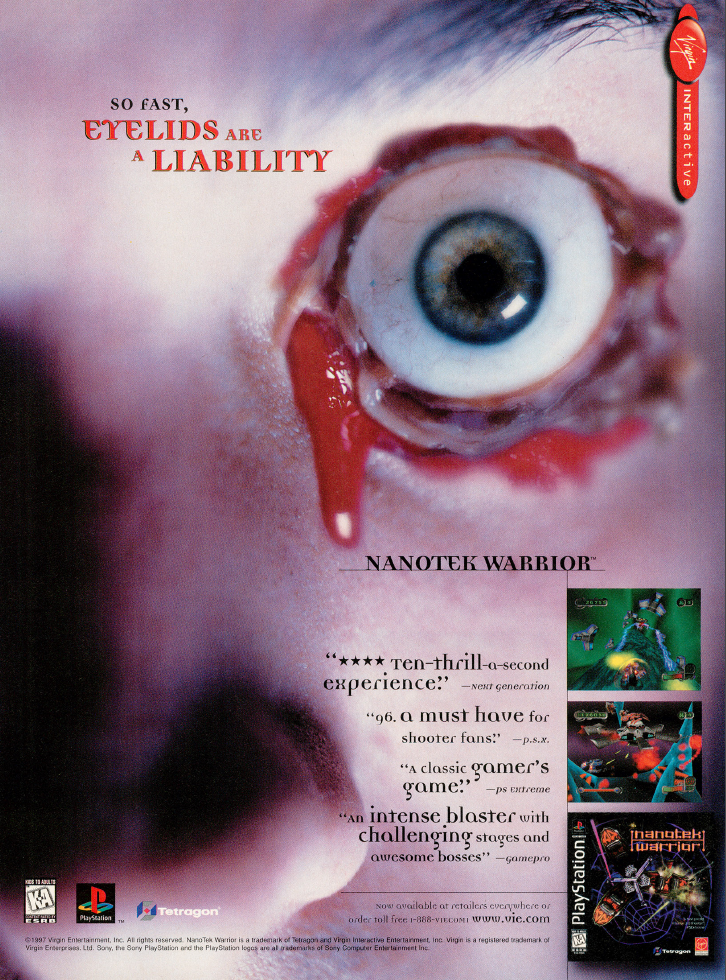
This ad right here for Nanotek Warrior (EGM 095, July 1997) heralded the start of this era of truly unhinged ads. Up until this point, we hadn’t really seen any sort of mutilation or gore, so this was pretty shocking stuff. In fact, this ad prompted a backlash by parents and readers who found it disgusting (to the point where Tetragon’s PR team had to lie that they didn’t think it was in any way offensive). Complaints about these kinds of ads would become a regular fixture of the letters section of EGM throughout this time period.

Bear that in mind as we go through this era of the video game ad: These aren’t “You couldn’t get away with that today!” ads, because you couldn’t even get away with it then.
Also: this ad is, yet again, for a K-A rated game. It is staggering just how many of the ads we’re about to cover were for games for kids.
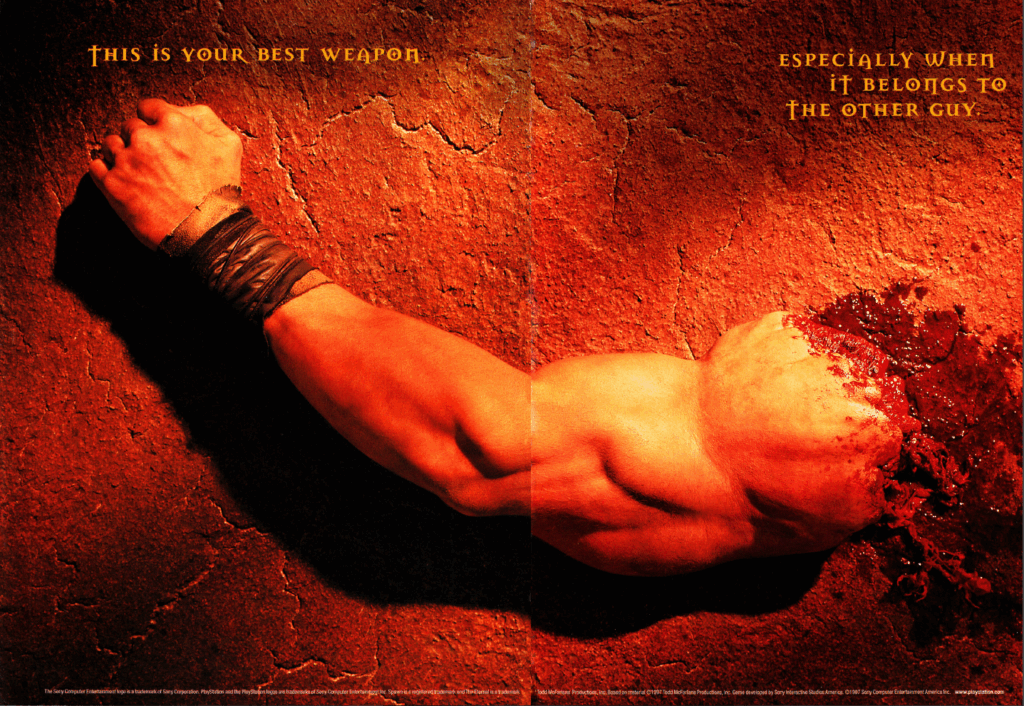
Nanotek Warrior‘s boundary-pushing mutilation was just another line that could now be crossed, so we soon saw even more explicit gore for Spawn (EGM 102, January 1998). Once again, this prompted some pretty severe backlash, which finally caused advertisers to begin to get cold feet about how extreme they were willing to get.
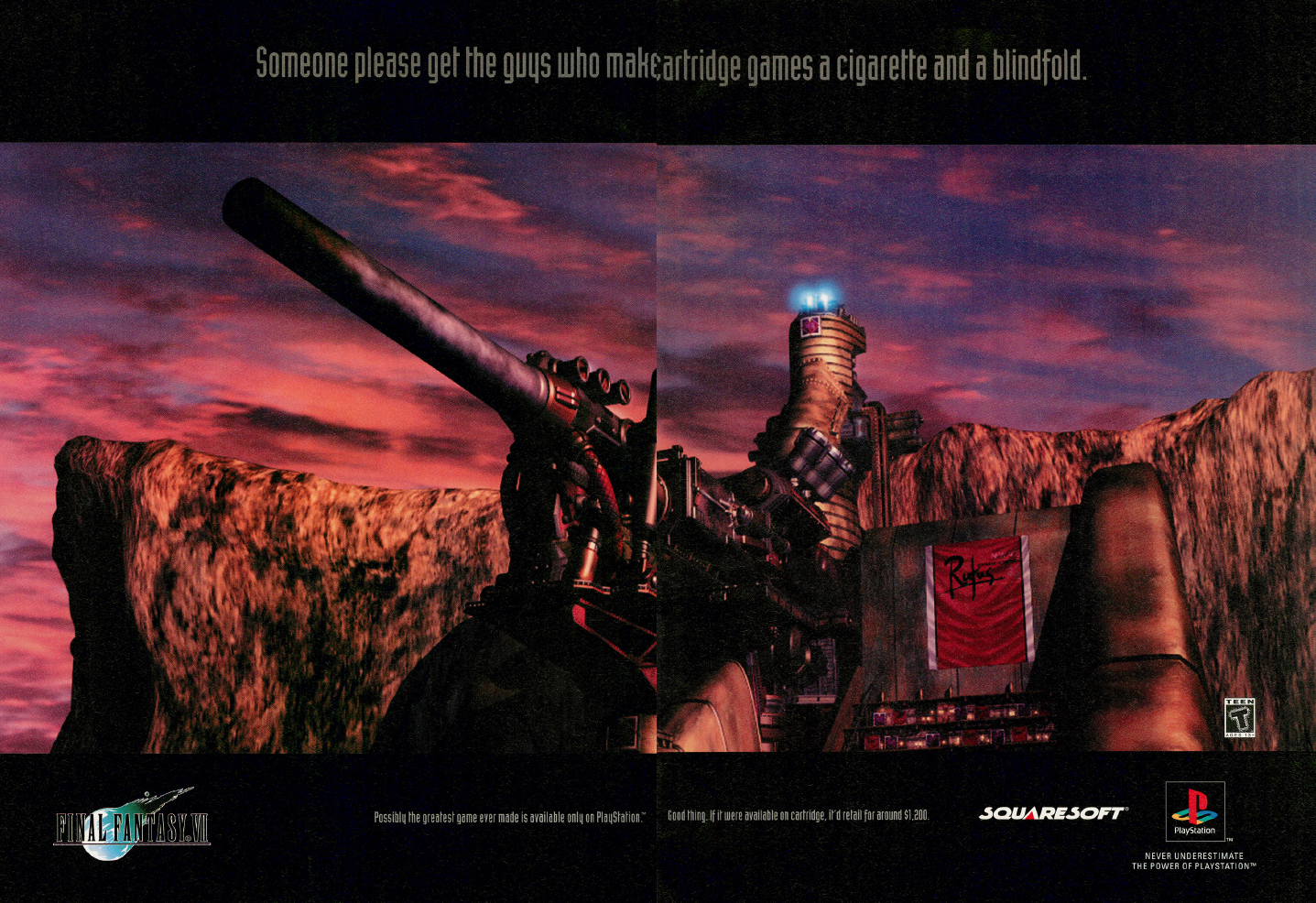
With gore off the table, advertisers were still able to find plenty of other ways to shock you. Take this ad for Final Fantasy VII (EGM 099, October 1997), for example. Final Fantasy VII is a game that kind of markets itself: it’s from a much-lauded franchise, its graphics were incredible for the time, it’s highly-cinematic, it’s hype is through the roof, and it reviewed incredibly well. However, Sony and Squaresoft decided to eschew all that and market the game by telling Nintendo’s executives that they were going to summarily execute them, oh my God! My jaw dropped at the sheer disrespect.
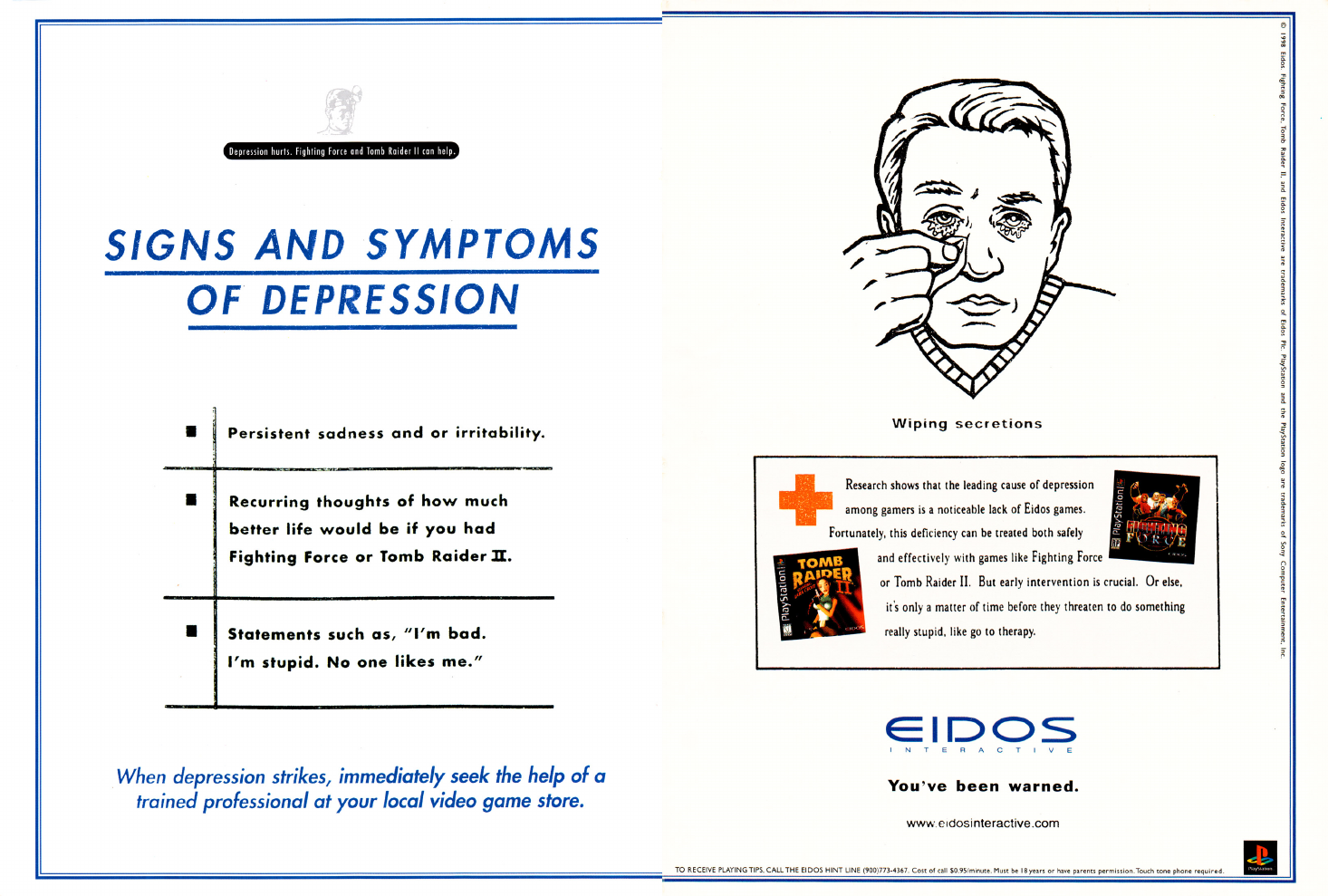
On the subject of suicide and not taking mental health as seriously as we do today, this ad for Tomb Raider and Fighting Force (EGM 105, April 1998) is also moderately offensive (or, at the very least, ignorant and insensitive) due to shifts in culture over the past couple decades.
I grew up in the 90s, I know what the attitude towards mental health was like. I didn’t realize I was dealing with anxiety, depression, and suicidal ideation until they were so out of control that I finally had to confront them head-on. So let me be blunt when I say that the line “it’s only a matter of time before they threaten to do something really stupid, like go to therapy” really pisses me off.
For what it’s worth, I guess I should just be thankful that they weren’t actively making fun of people with depression during this era of extreme edginess?
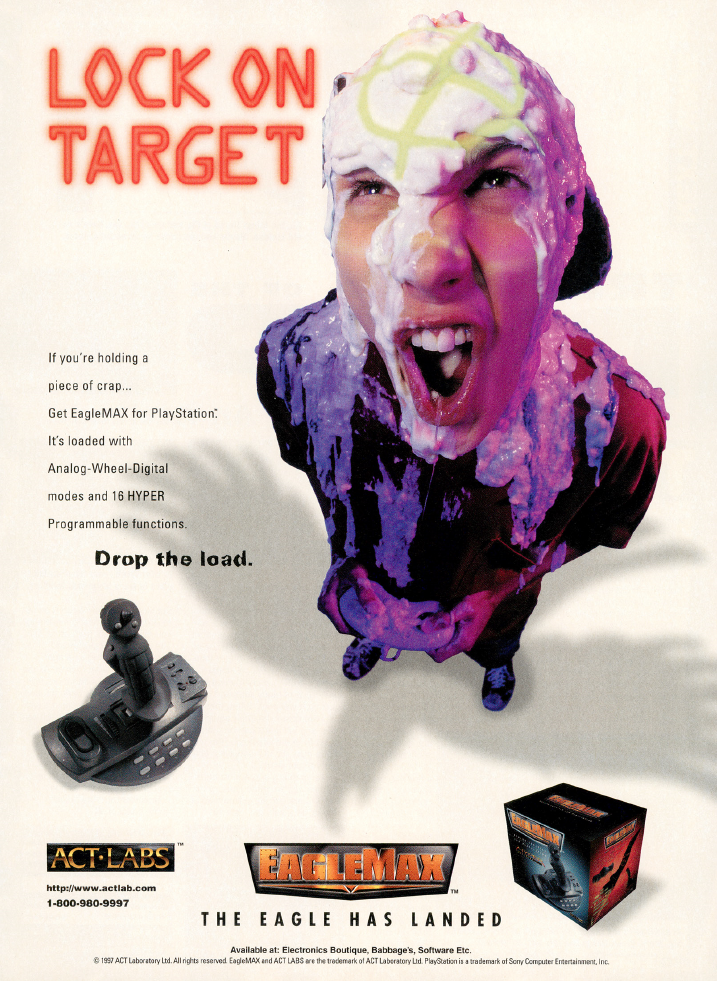
This one here from October 1997 is just plain gross. I can only interpret this ad as saying that you’re going to drop a steaming load of eagle shit on kids using any other company’s controllers… but, man, this is gross and graphic enough that it could very well be alluding to other bodily excretions. I wouldn’t put anything past this era of extreme advertising.
The fact that this poor bastard got some in his mouth too? Blegh…
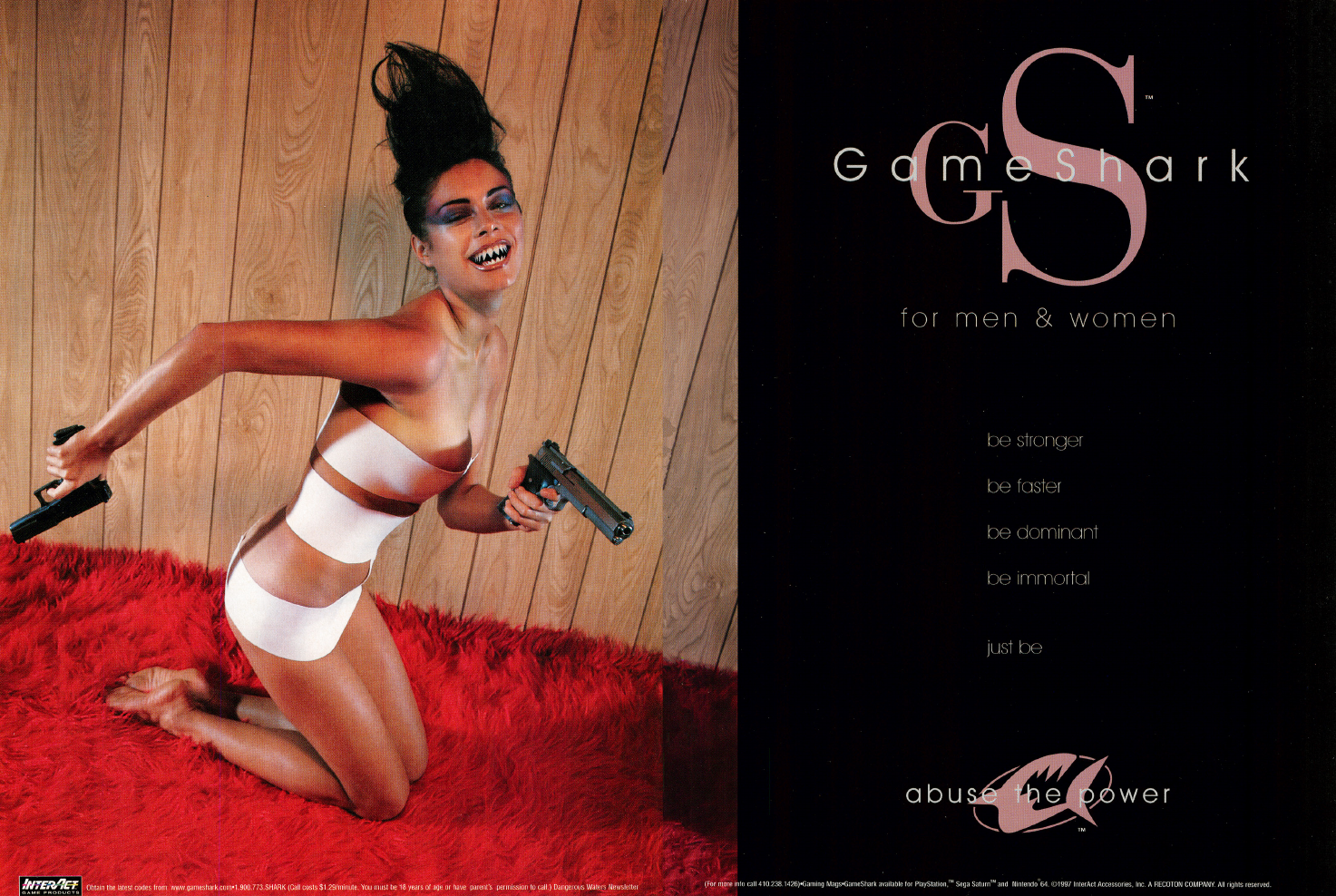
GameShark were running some really weird advertising campaigns at this time (in fact, they got wrapped up in some of the backlash alongside that Nanotek Warriors ad). I don’t understand what they’re going for in this ad from December 1997: you’ve got a nearly-naked woman awkwardly holding a pair of pistols and smiling with shark teeth (these shark teeth were a piece of common imagery that GameShark repeated throughout this ad campaign). I believe that they’re riffing on the language of cologne ads, and the dual pistols and near-nudity might be a Tomb Raider allusion… but I don’t really get what they were going for here. It’s just plain weird.
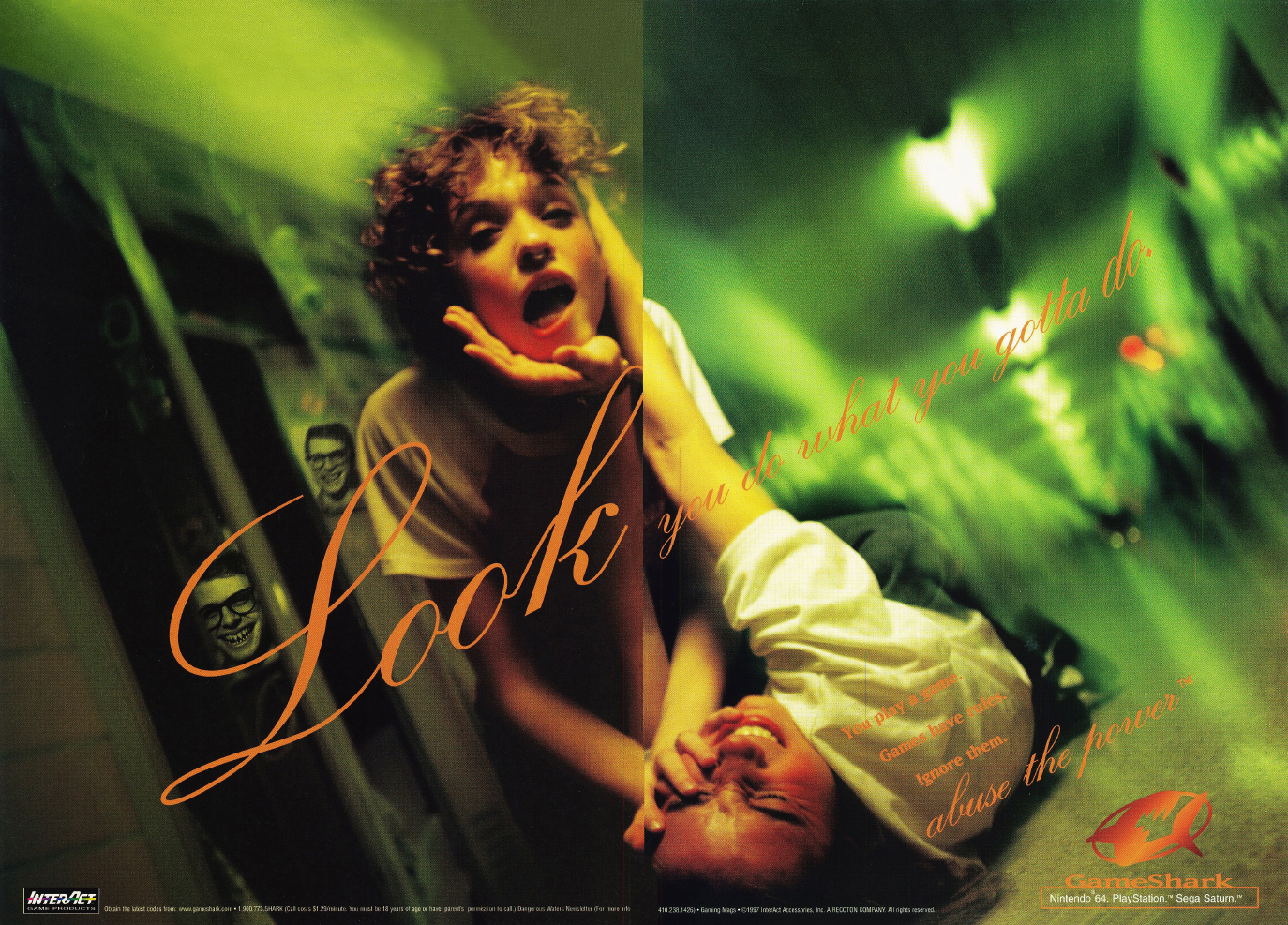
…however, maybe being weird is preferable to whatever the hell this ad is getting at (EGM 103, February 1998). The message in this ad isn’t really clear on first glance, but the more I think about it, the more unsettling it is. Let me spell out what I’m seeing here: it’s selling a fantasy of becoming a god in order to humiliate the guy who’s with the girl you like. The laughing photos of the nerd with the GameShark teeth imply that he’s there observing and controlling what’s happening. Then there’s a girl in a catatonic, zombie-like state beating up a guy who’s struggling to keep her away. In cursive, we have the tagline: “Abuse the power”. Look, I could be just over-thinking this, and there’s enough ambiguity here that you could interpret this differently, but this comes across as some nasty, incel-level, “nice guy” shit to me.
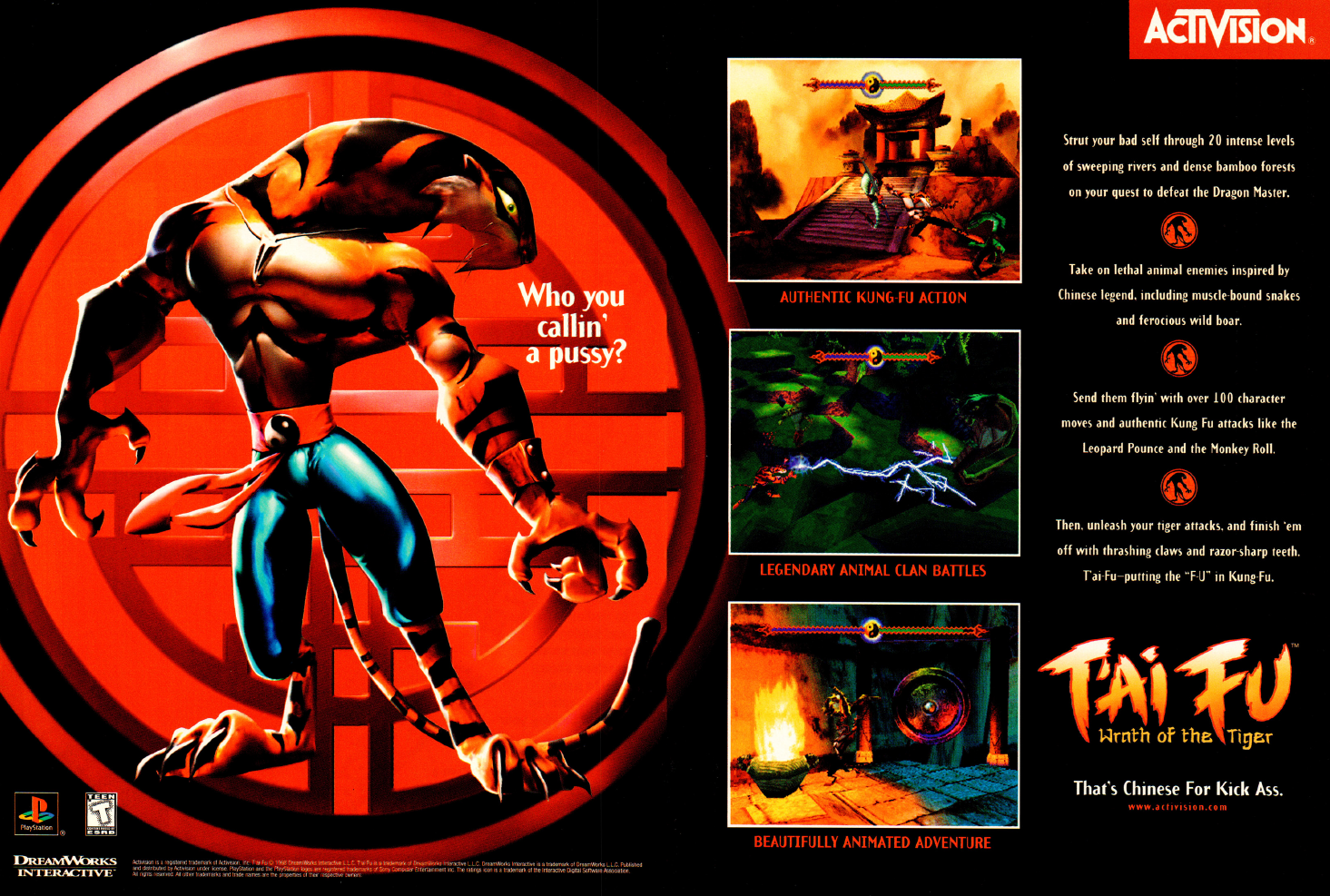
Even the few “mascot” games we were getting were reaching more extreme levels of edge (and got bumped up to a T-rating for good measure). This ad from November 1998 skirts around the limits of how much attitude you could get away with in a kid’s game.
Sex Appeal
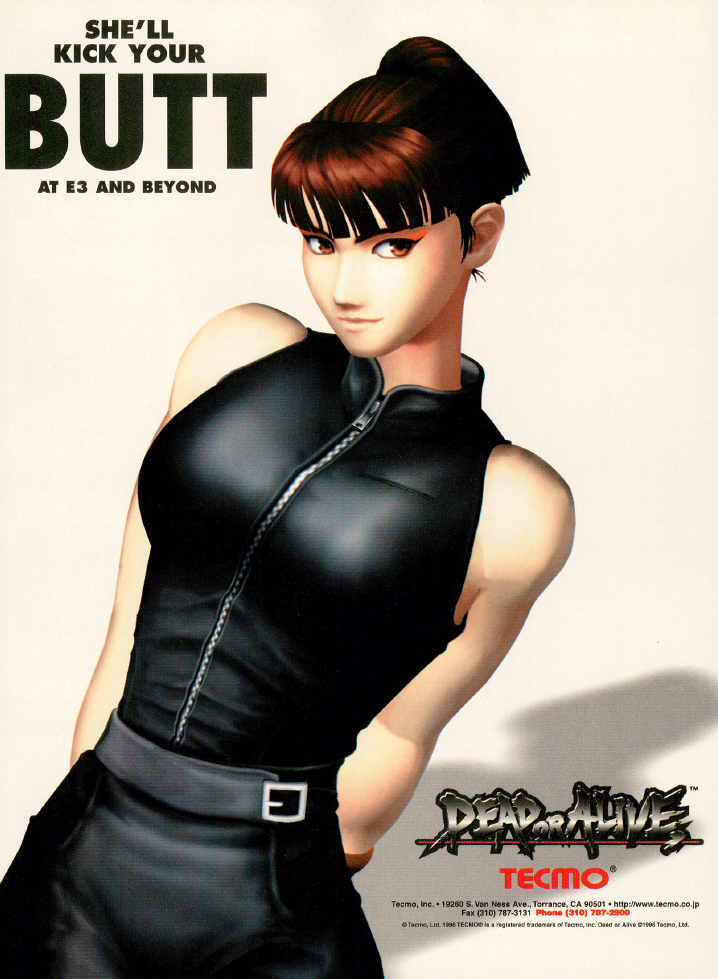
You didn’t think we were going to get through an article about video game ads without highlighting Dead or Alive, did you?
What’s particularly notable about this ad to me is how minimalistic it is. You’ve got a stark, white background, a tagline, a title, and then one image of Leifang looking extremely cute. It’s entirely banking on sex appeal to get you interested. What makes this even more interesting is that the ads for this first Dead or Alive aren’t even all that risqué! They just show a pretty woman and let your mind fill in the blanks from there. That’s some pretty impressive restraint for this era of marketing!
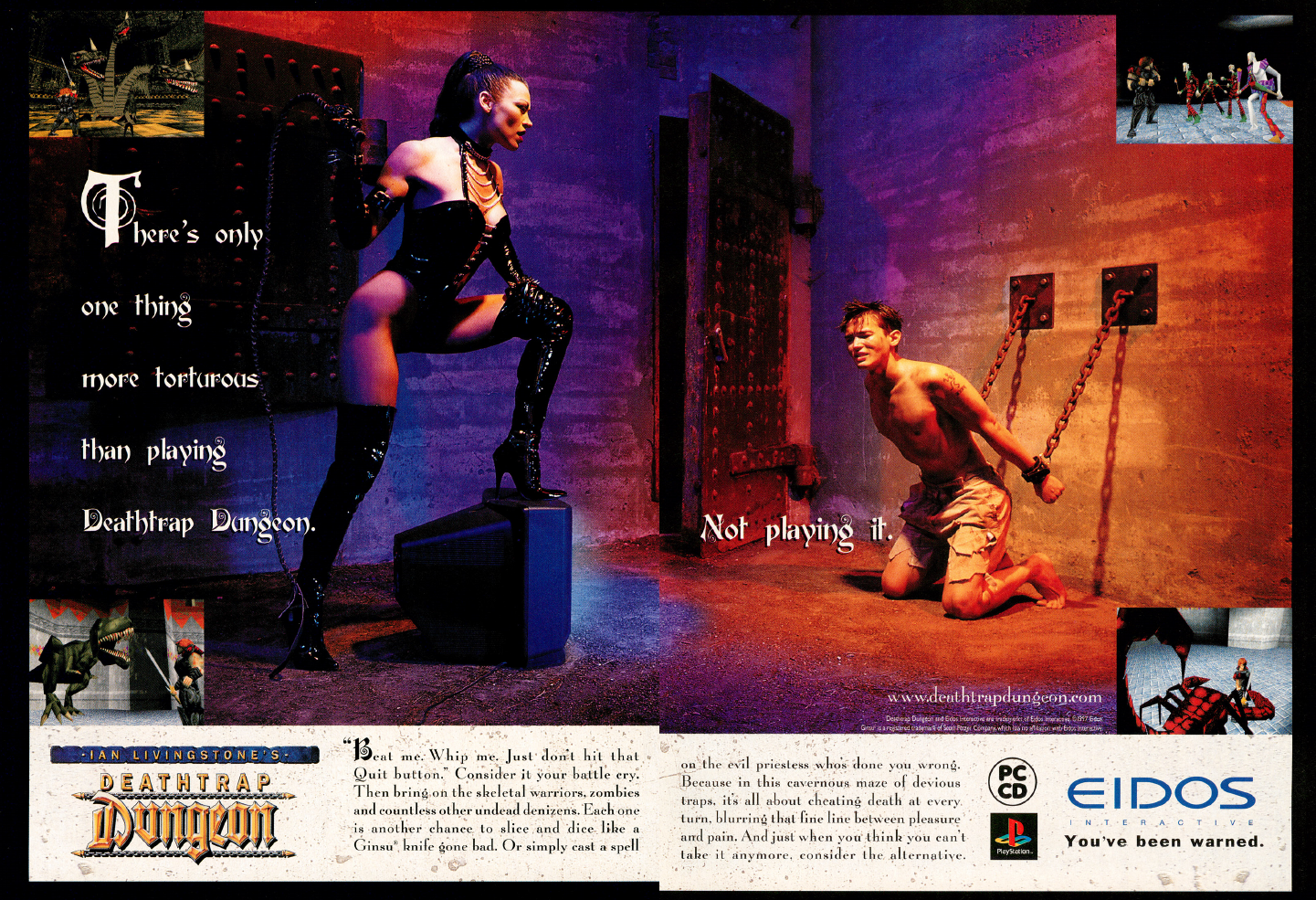
Man, the 90s sure had an obsession with dominatrixes, didn’t it? Oddly enough, this ad for Deathtrap Dungeon (EGM 097, August 1997) ran for a full year in the pages of EGM. Usually a game would get advertised for a few months prior to release in order to drum up hype, but this one started the hype train incredibly early… for a game that’s basically “edgier, fantasy Tomb Raider“.
God, we are so far away from the child-friendly days of years prior.
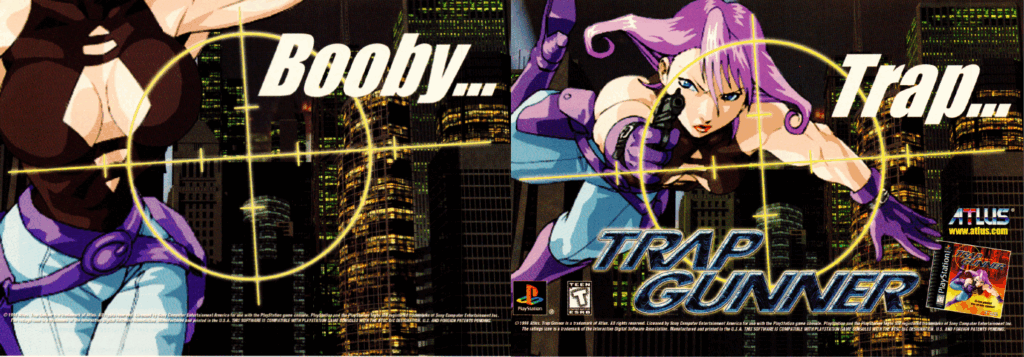
I appreciate the bluntness of this two-page ad for Trap Gunner (EGM 111, October 1998). It’s so shameless and to-the-point, I just have to applaud it.
As a side-note: I’m not sure if this ad pre-dates the use of “trap” as a slur for a transsexual or not. According to Quora (so take this with a huge grain of salt) it wasn’t a slur until around 2007. I’m not really familiar with Trap Gunner, so I looked up the character and she is (unsurprisingly) not trans, so that is certainly not an intended reading in any case. However, in retrospect, it adds an unexpected little twist on this ad, which is kind of funny considering it was clearly trying to titillate teenage boys.
How many times am I going to have to mention that most of the ads using sex and lewdness to sell their products are for games rated K-A!? WHY? It’s a fucking Micro Machines game (EGM 104, March 1998)!

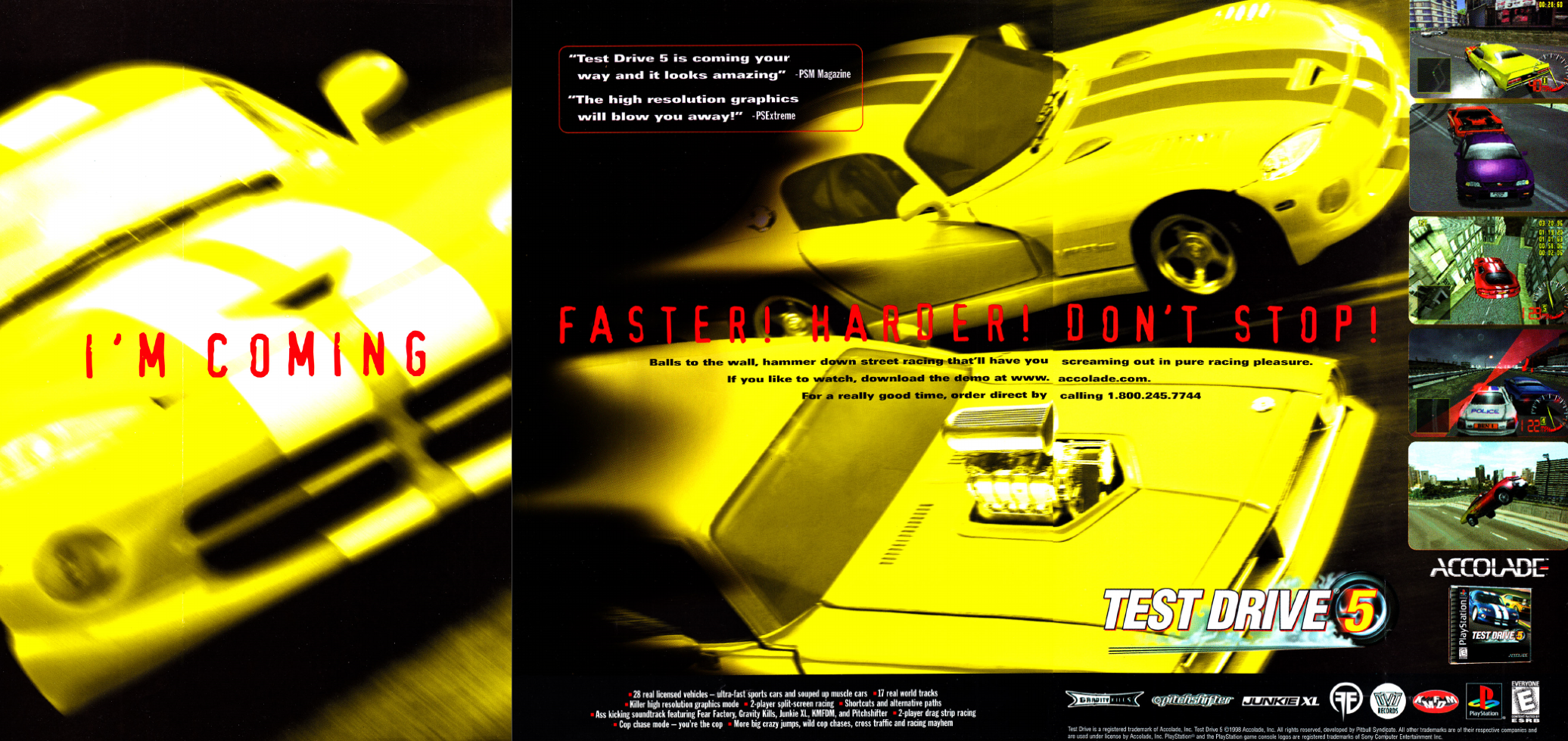
E-FOR-EVERYONE FUCKING WHY!!??! (EGM 111, October 1998)
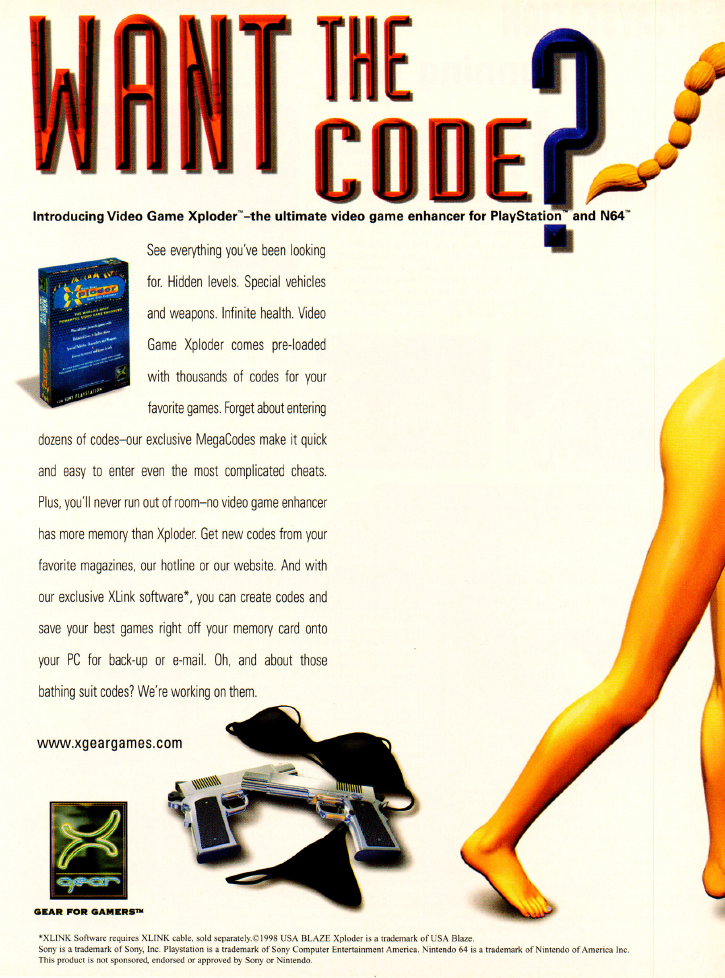
I can’t discuss the sex appeal of this era of game advertising without touching on the infamous “nude code” for Tomb Raider. This was an urban legend which claimed that you could enter a code to see Lara Croft naked. This XGear ad (EGM 112, November 1998) outright implies that they can deliver the goods, while being coy enough about it that they can skirt false advertising regulations.
Side-note: EGM themselves were also absolutely unhinged during this time period. At one point, they published a link to images of a modded Tomb Raider with Lara Croft fully naked in it (which earned them even more backlash and reader complaints in the process).
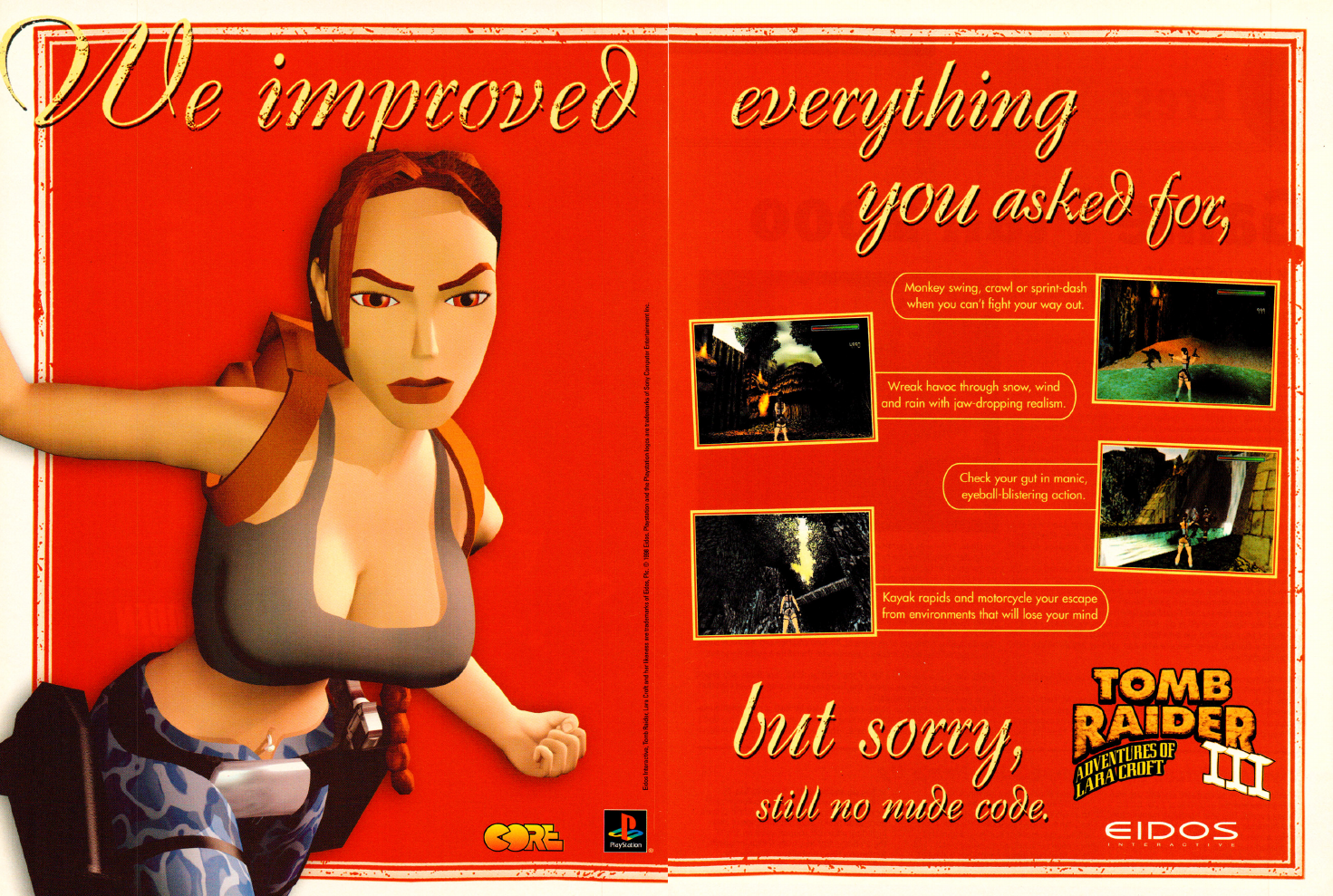
The “Nude Raider” urban legend was so prevalent that even Eidos themselves were leaning into it with their marketing! (EGM 112, November 1998)
Advertising to Fucking Psychopaths
I was legitimately shocked the first time I saw this ad (EGM 098, September 1997). “Wow, they sure are really desperate to get some attention.” Little did I realize that I was witnessing the beginning of a trend towards the extreme limits of edge: appealing to literal fucking psychopaths. More than anything else, this trend is what makes this particular era of the video game ad insufferable.
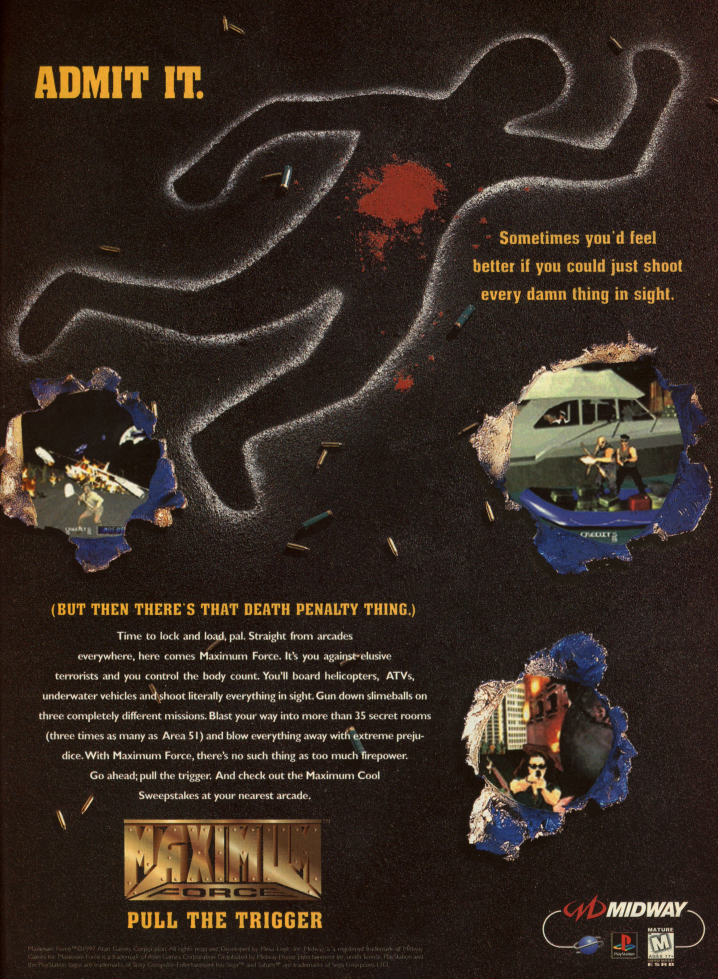
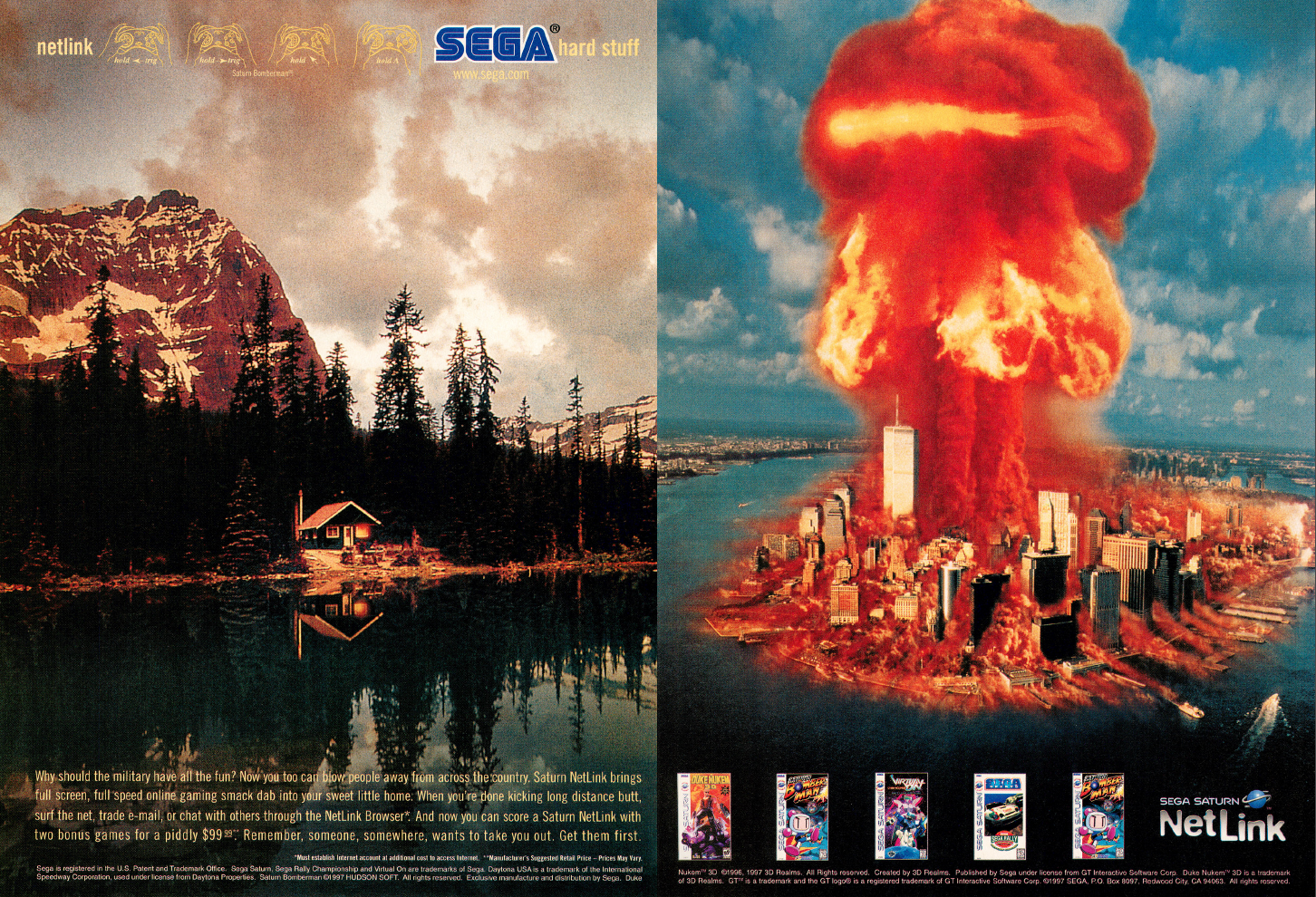
Look, committing acts of mass murder in a video game can be fun. I love my explicit, fictional violence, my horny gooner games, and pushing the envelope in the media I consume. However, having the advertisers themselves cater to a fantasy about nuking fucking New York City feels like a step too far to me, especially since this seems to be making a joke about domestic terrorism in the 90s. It’s one thing if your game has that sort of appeal to it, but having the advertisers themselves lean into it feels… wrong.
Also… man were the 90s a different time. People were so spoiled, so full of aimless rage and edginess, they were not ready for true trauma which was barreling down on them. Ads like this one feel so tacky in retrospect.
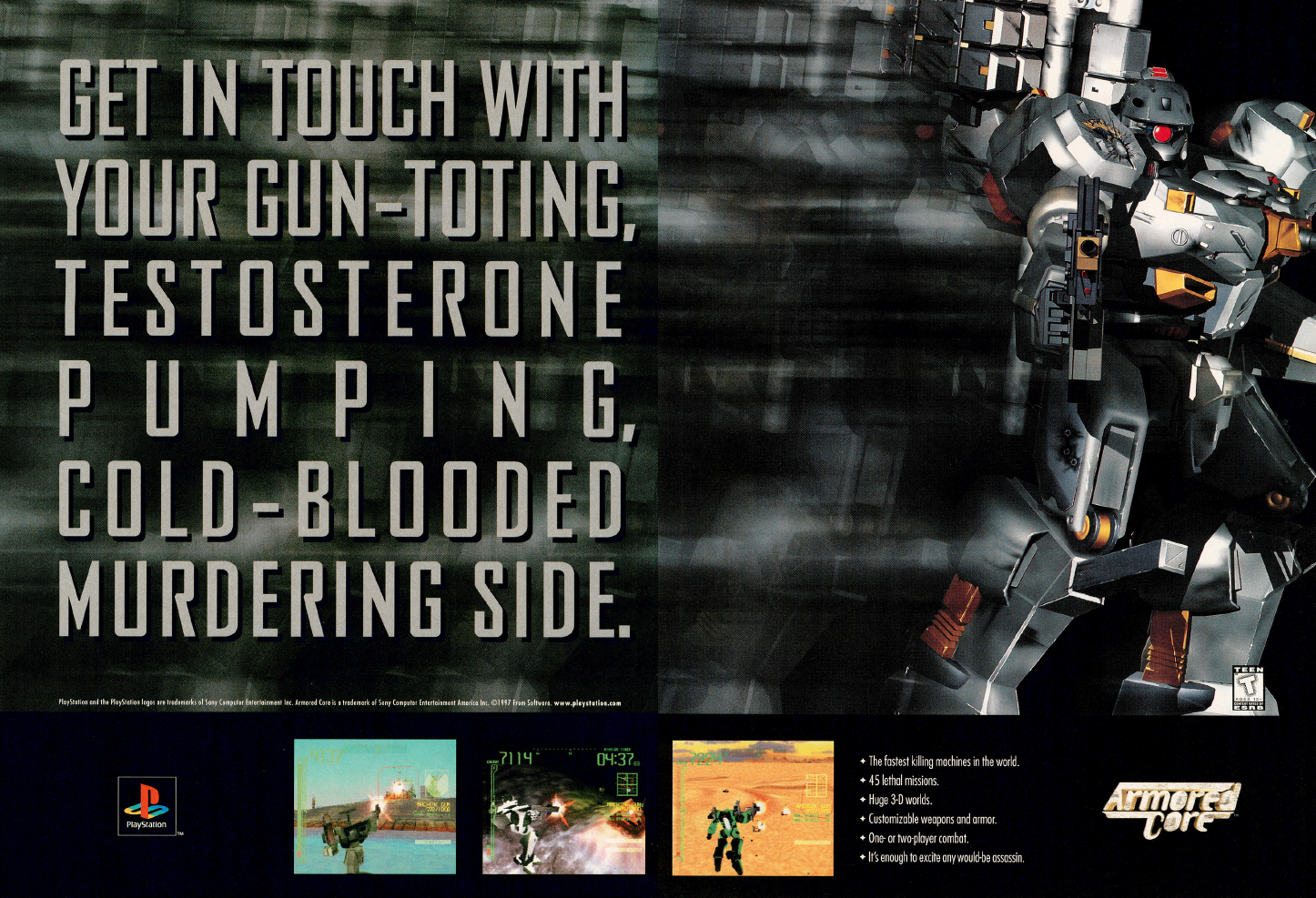
This ad for Armored Core (EGM 101, December 1997) isn’t as egregious as the last couple we’ve looked at, but still, the fact that they’re excitedly promoting cold-blooded murder feels… off. It’s not like the fantasy in most games is to commit cold-blooded murder: you’re usually squaring up in kill-or-be-killed showdowns against enemies that are posing some sort of threat to you. The fact that they’re playing that up here doesn’t really sit right with me.
Okay, if you thought that last ad was no big deal, get a load of this infuriating ad that Sega put out in a limp-dicked attempt to promote the Saturn (EGM 104, March 1998).
Look, I understand the intended message here: “Sega Saturn games are so good that you’ll neglect the rest of your life in order to keep playing them!” But why the fuck would you associate your product with imagery of an emaciated dog starved to fucking death??!
Fuck this ad, and fuck Sega for making it. Absolute psychotic idiocy abounds during this console generation. It seriously cannot get any worse, right…?
Wait, why are there 2 more slides…?

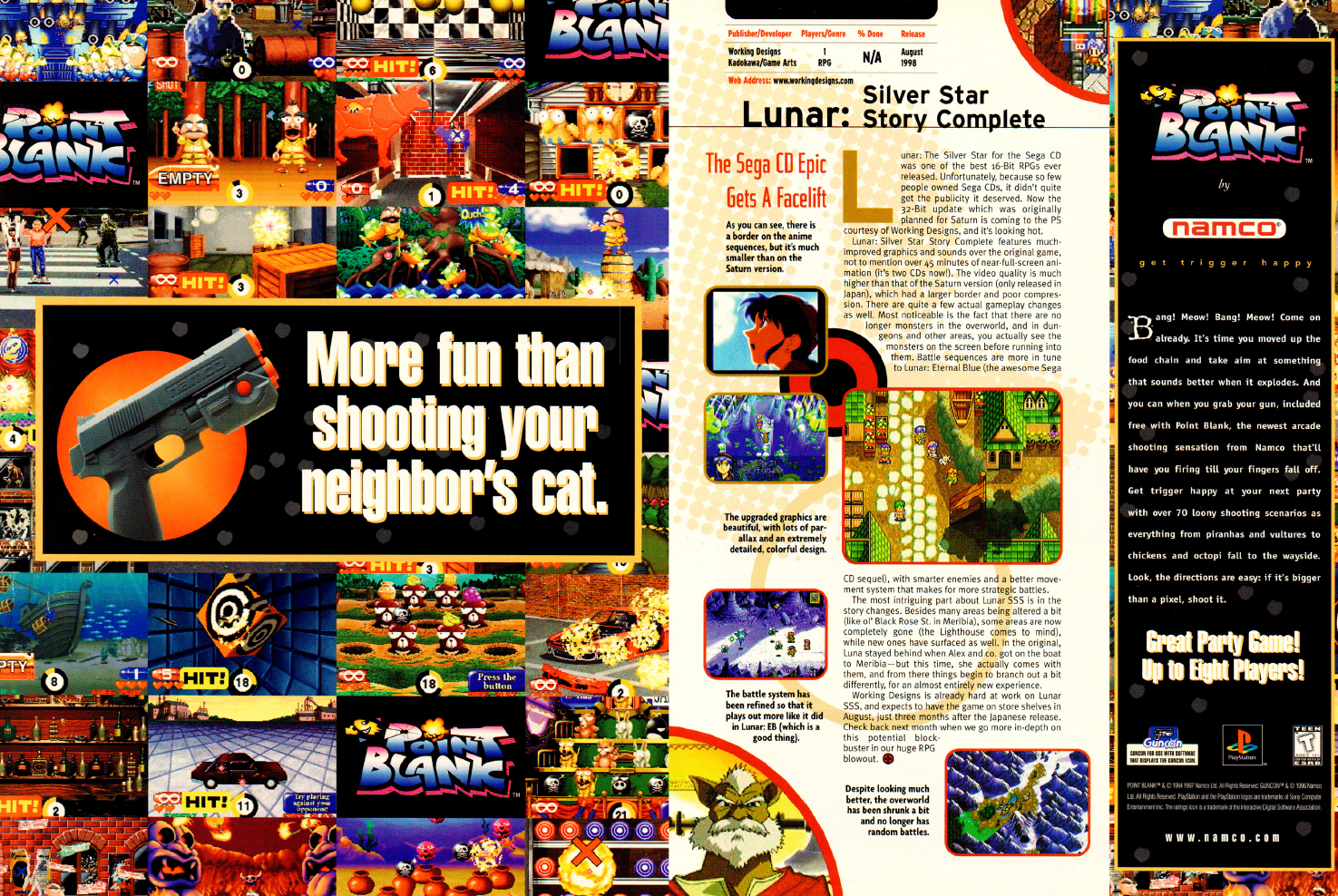
Okay, if it was not obvious before now, I hope it’s 100% crystal clear: video game advertisers were marketing their products to literal sociopaths in the late 90s. “Bang! Meow! Bang! Meow! Come on already. It’s time you moved up the food chain and take aim at something that sounds better when it explodes.” How else can you even interpret this ad…? That they’re appealing to people who aspire to be literal sociopaths…? The edginess of the 90s was batshit insane.
This ad may not look quite as bad as some of the ones we’ve seen, but it really pisses me off. This ad for Wild 9 (EGM 111, October 1998) is just straight-up portraying and glorifying animal cruelty.
Sure, it’s a slug, some people find them gross. I don’t care.
In spite of my coarse language and proclivity for jiggle physics, I still cling to a Christian faith at my core. As part of that, I have a guiding philosophy: God created other beings and loves them just as much as He loves me. Therefore, I should strive to treat them accordingly. As a result, it should come as no surprise that seeing a real living creature being tortured for fun in order to promote a video game leaves me livid.
Sure, they didn’t actually torture this snail (probably), but it promotes the idea of it as something you should do for fun and makes it out to be something hilarious – fuck this ad and fuck the edginess of the late 90s.

The Backslide (early-1999 to 2002)
The peak of the stereotypical video game ad was like the gastric consequences of a Taco Bell meal: putrid, but the stench quickly wafted away. Facing frequent backlash from parents and consumers after a string of offensive ads, video game companies quickly began to backtrack to safer territory. Ads of this new era were still beyond anything we’d seen by the end of mid-1997, but they never again reached the level of shock and offensiveness of the preceding year and a half. There was a steady, clear effort to push the line of taste, while simultaneously not getting too close to it for fear of sparking more backlash. Ads that toed the line were significantly less frequent than before, but there was a sense that advertisers were working their way back up to try to stand out.
However, this new, less-extreme era of gaming history did see one trend that was being explored more and more: sex. Video game ads were obsessed with it at this time, whether it made sense for the product or not. In addition, after the pioneering work done by Tomb Raider and Dead or Alive, sex appeal was increasingly baked into the games themselves, a feature that their marketing departments were keen to exploit.
This era would see the waning days of the PS1 and N64, and the dawn of the next generation consoles, starting with the Dreamcast. Once again, Sega’s marketing arm completely failed to drum up excitement for their console, and the excitement for the PS2, Xbox, and GameCube quickly put it out to pasture.
While this era was nowhere near as crazy or unhinged as the one before it, there still are enough notable ads from this era that I cannot bear to limit this down to only ten selections. As a result, we’re going to split these into two categories this time:
Sex Appeal (and Insecurity)

Ahh, the good ol’ “slap on an M-rating and imply that it’s porn when it really isn’t” marketing strategy was alive and well heading into the new millennium. (EGM 127, February 2000)
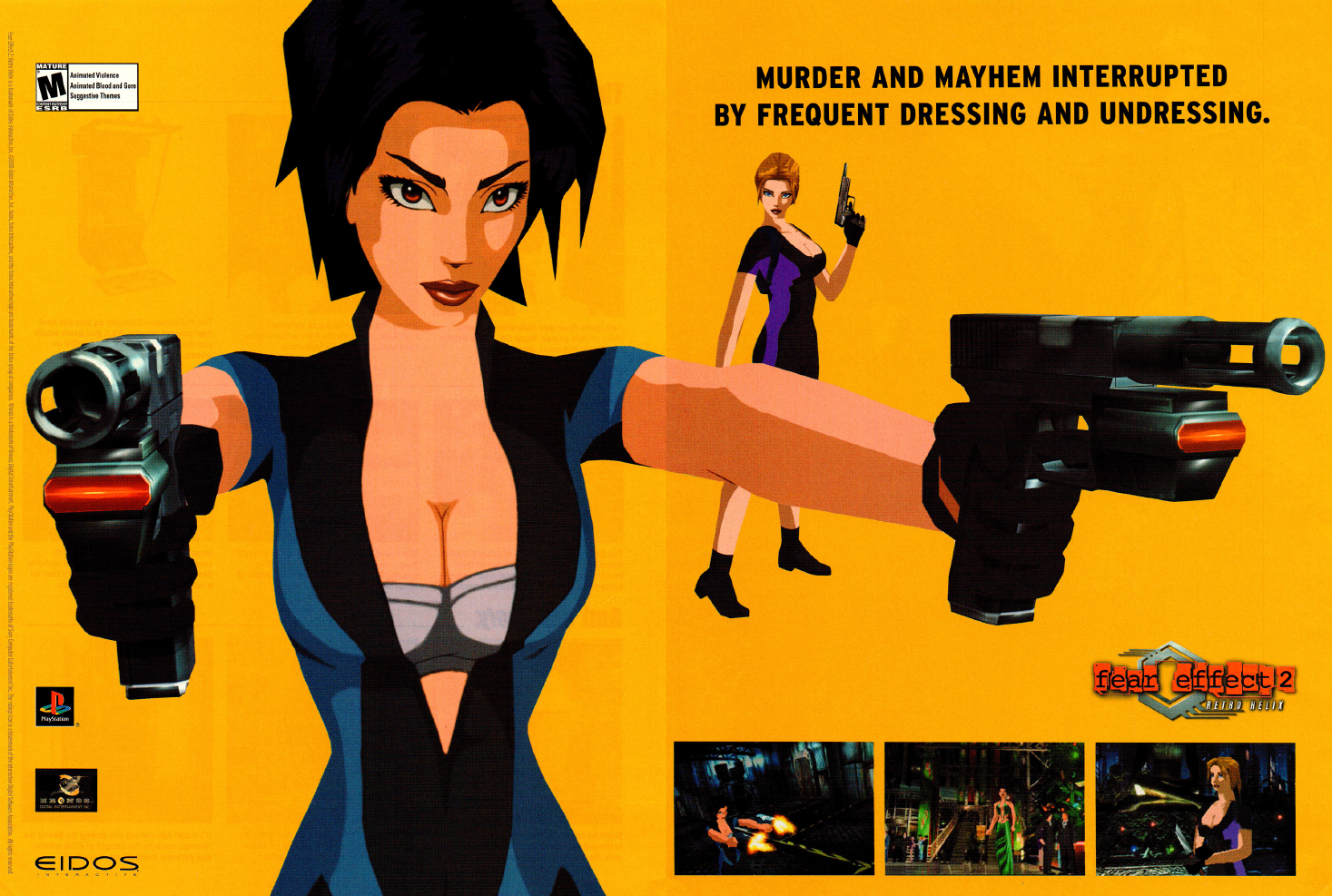
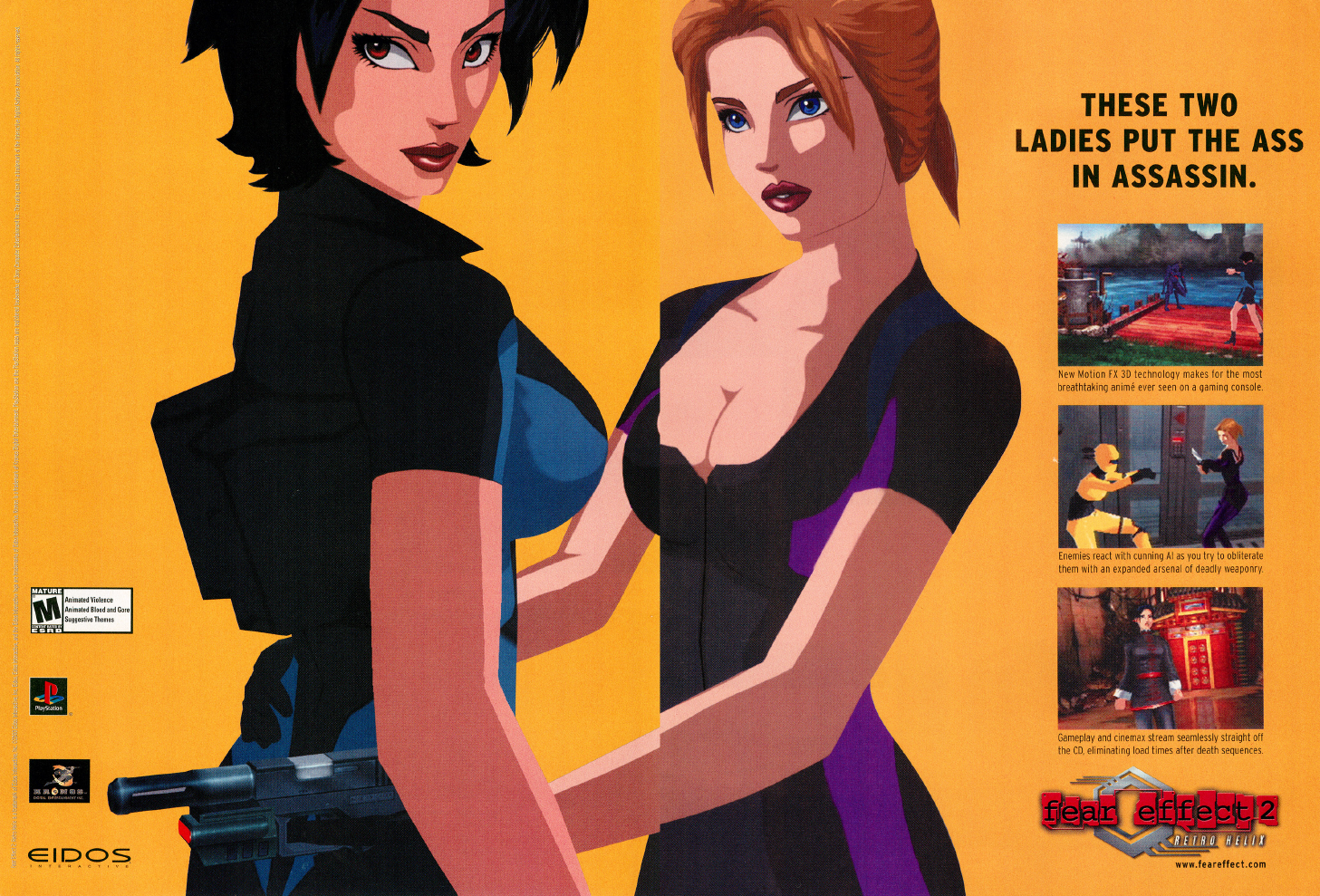
The original Fear Effect came out after Tomb Raider and Dead or Alive laid the groundwork for sexy games. In spite of this, its marketing didn’t lean into sex appeal (despite being an early game to feature openly-lesbian heroines). Fear Effect 2, though? It leaned so hard into sexualization, that it ended up horizontal. This is in spite of the fact that the game itself doesn’t really have any explicit sexual content or nudity, but you wouldn’t know that from these ads (EGM 137, December 2000 & 139, February 2001).
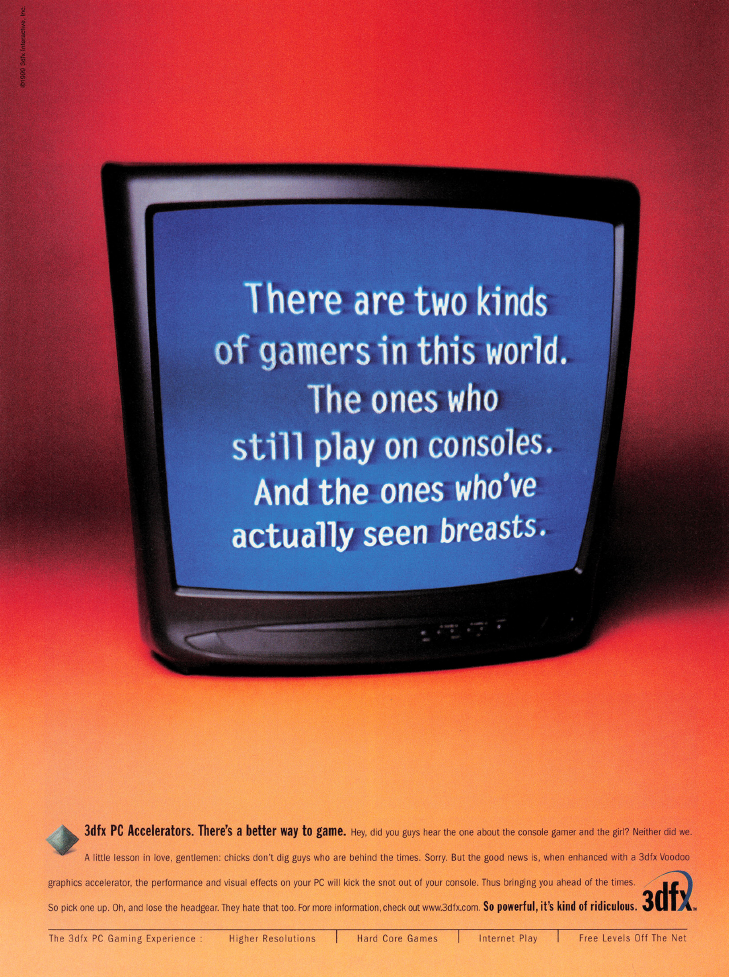
While sex was being used to market games more and more frequently by this point, there was also a growing trend of preying upon the audience’s sexual insecurity. This is just the teenage boy version of the “you’re uncool if you play Double Dragon instead of Bad Dudes!”, but now it’s “you’ll never get laid if you’re still playing games on a console!” It’s stupid, arbitrary bullshit that tries to fool introverted, socially-awkward nerds into spending money to solve their problems. (EGM 126, January 2000)
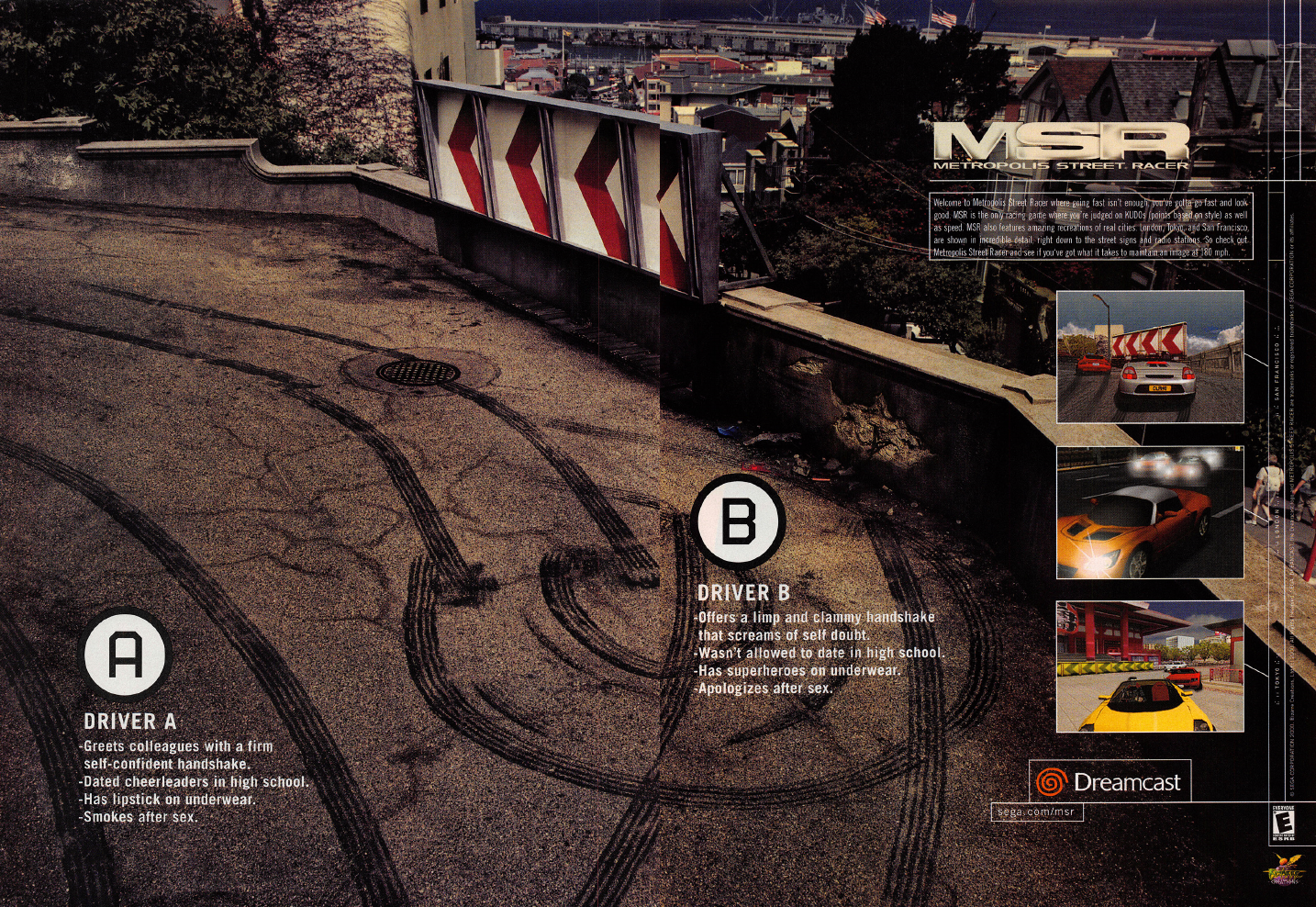
Here we have another example of the sexual insecurity play (EGM 138, Jan 2001). I find it kind of funny that this is basically a primitive version of the Virgin vs Chad meme. This one is especially funny to me because it appeared just a few pages after an anti-smoking ad… So, imagine you’re an pimply, nerdy teenage boy reading that anti-smoking ad, turning the page, and then there’s this ad proclaiming that it’s actually extremely cool to smoke, girls love it, and it will get you laid. Incredible.
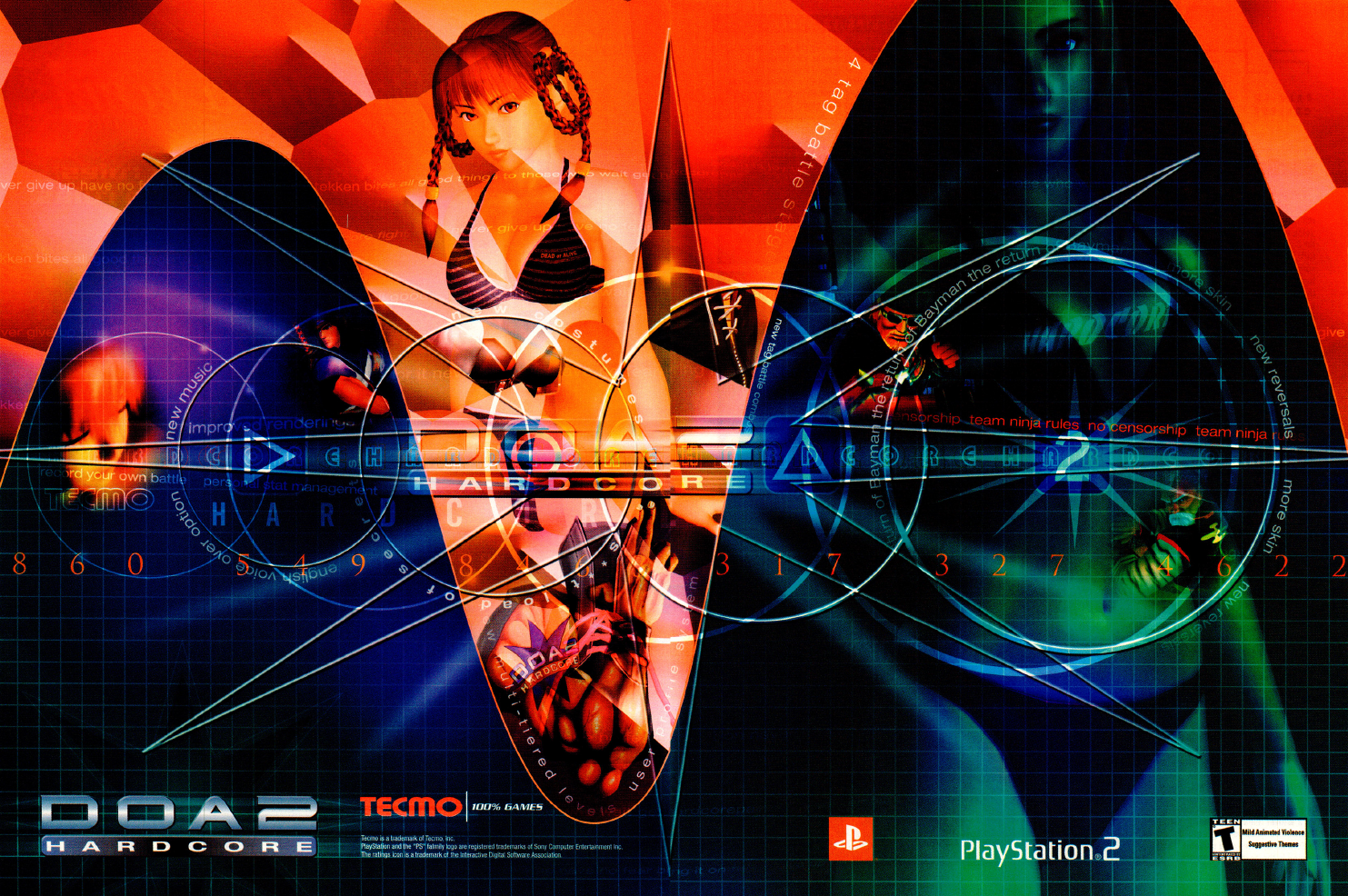
Tecmo amped up the overtness of the sex appeal in their various ads for Dead or Alive 2. Many of them (like this one from EGM 136, November 2000) feature Leifang, Kasumi, and Tina in various states of undress (done of which are actually viewable in-game). I find it particularly funny how the middle of the image just has a disembodied shot of Tina’s cleavage.
That said, there’s an artful elegance to this image which sets it apart from the blunt sexualization of other ads of the era (and even Lara Croft’s more straight-forward attempts at sex appeal). The use of strong, contrasting colours, the abstract composition, the snippets of features in the game which come across like whispered secrets… it makes for an ad that draws you in and leaves you finding cool new details the longer you look at it. I’m biased, but this is easily one of the best video game ads I’ve ever seen.
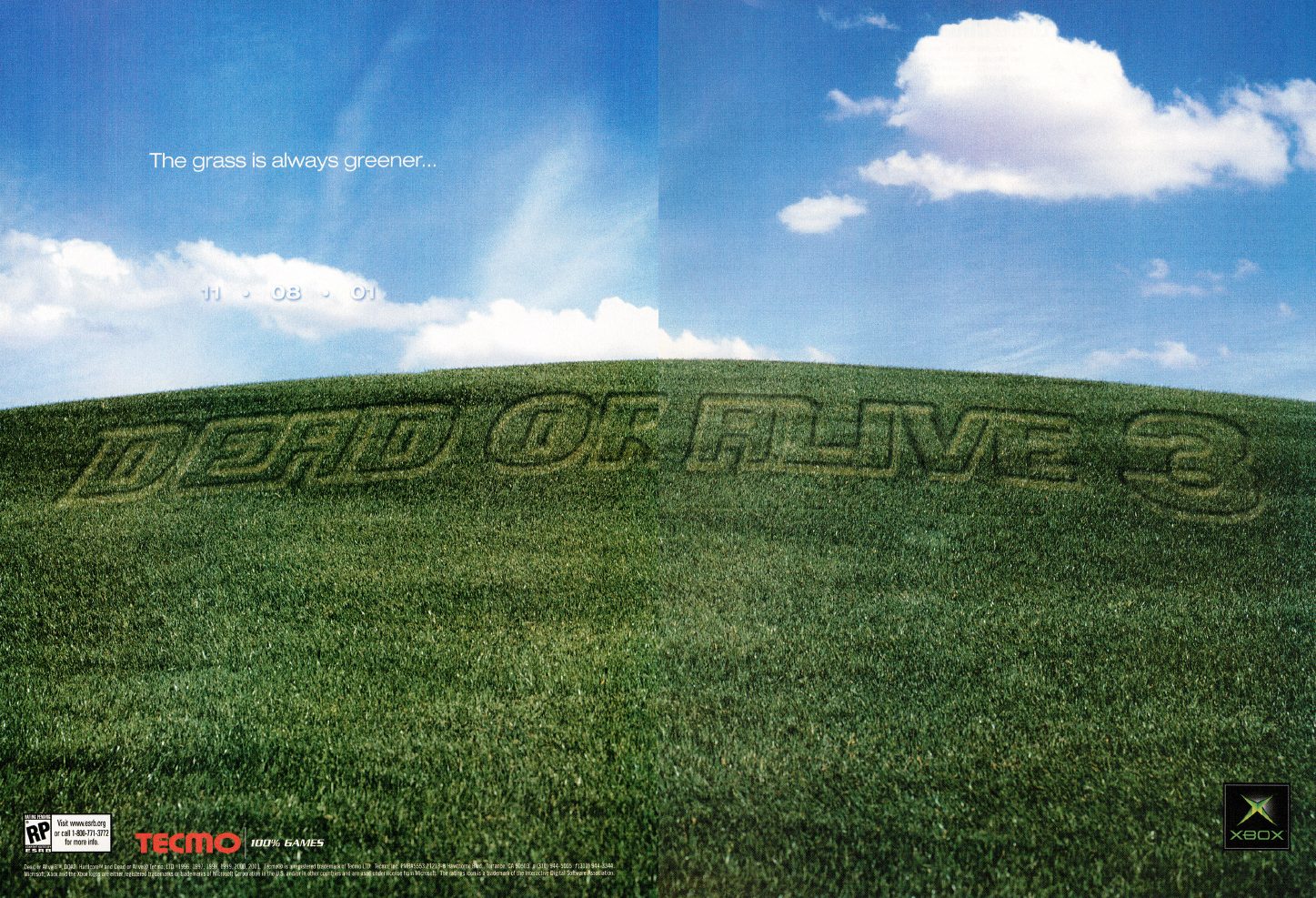
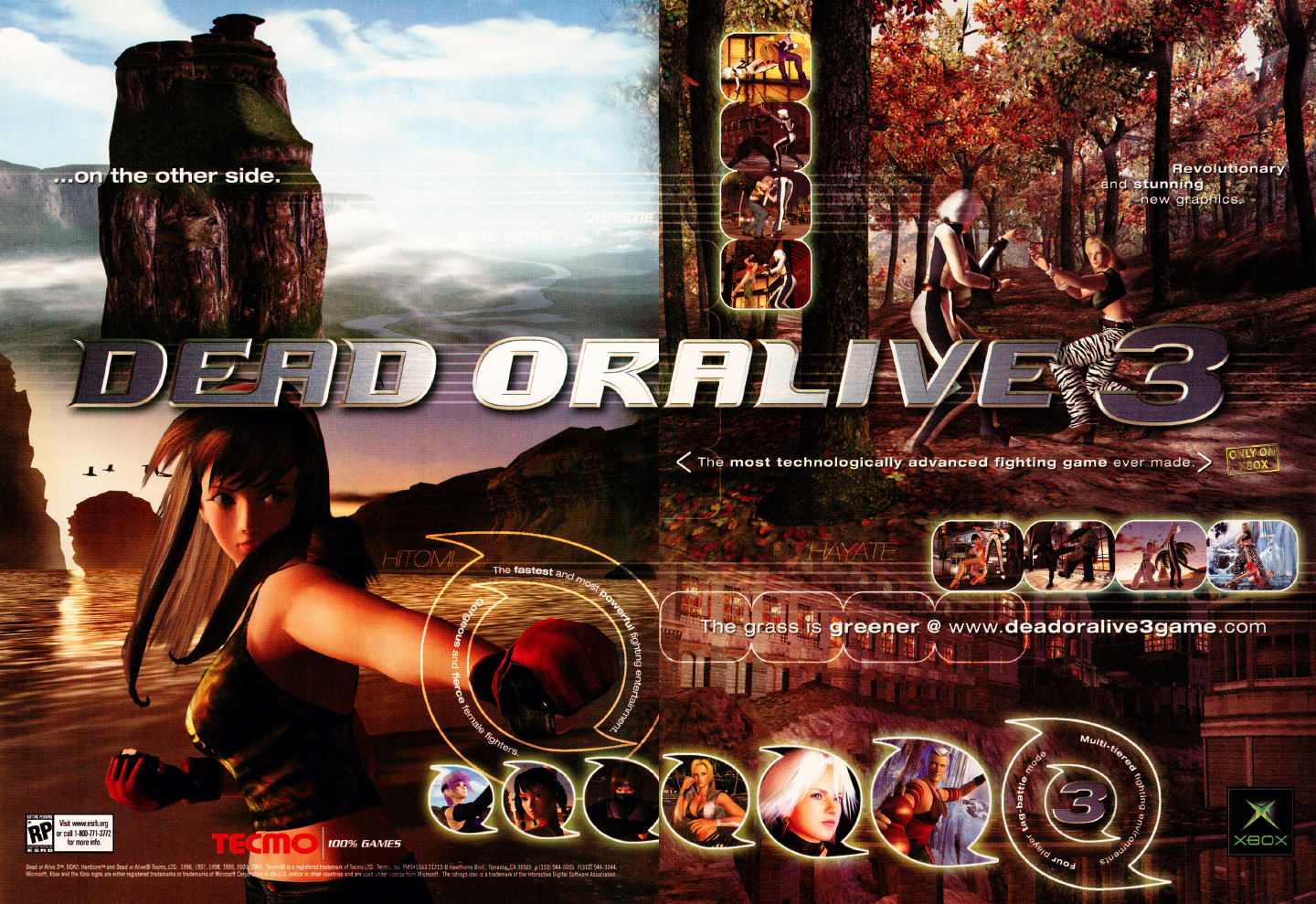
Side-note, but I find it interesting how much more restrained the marketing for Dead or Alive 3 was. I wasn’t able to find any overtly-sexualized ads for the game. Sure, they were now partaking in the console wars, but they weren’t being obnoxious about it like some of the ads we’ve seen. Maybe Tecmo were starting to think that it was time for Dead or Alive to get a more respectable reputation?
…but, then again, if that was their intent, why the fuck did they release the infamous (and incredible) “She kicks high…” commercial? (Or, y’know, announce Dead or Alive Xtreme Beach Volleyball immediately after?)
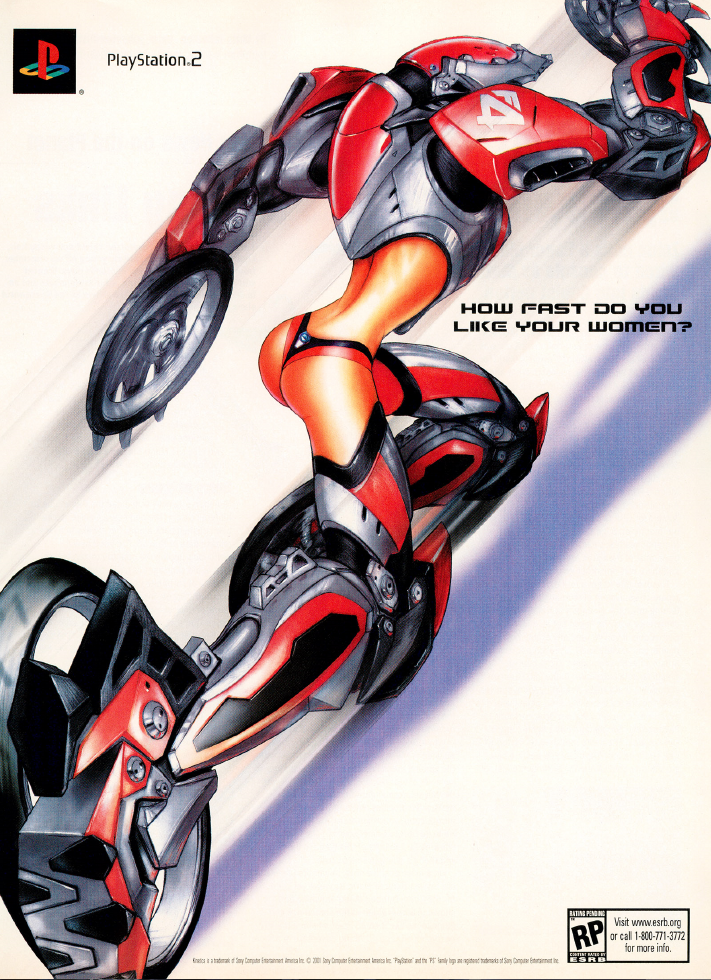
I’m pretty sure that this ad for Kinetica (EGM 148, November 2001) was one of my first sexual awakenings. Like… just look at it (not that I need to tell you to do that). The game itself is a pretty unremarkable, sci-fi, extreme racing game, but these ads have made this a game that I will never forget.
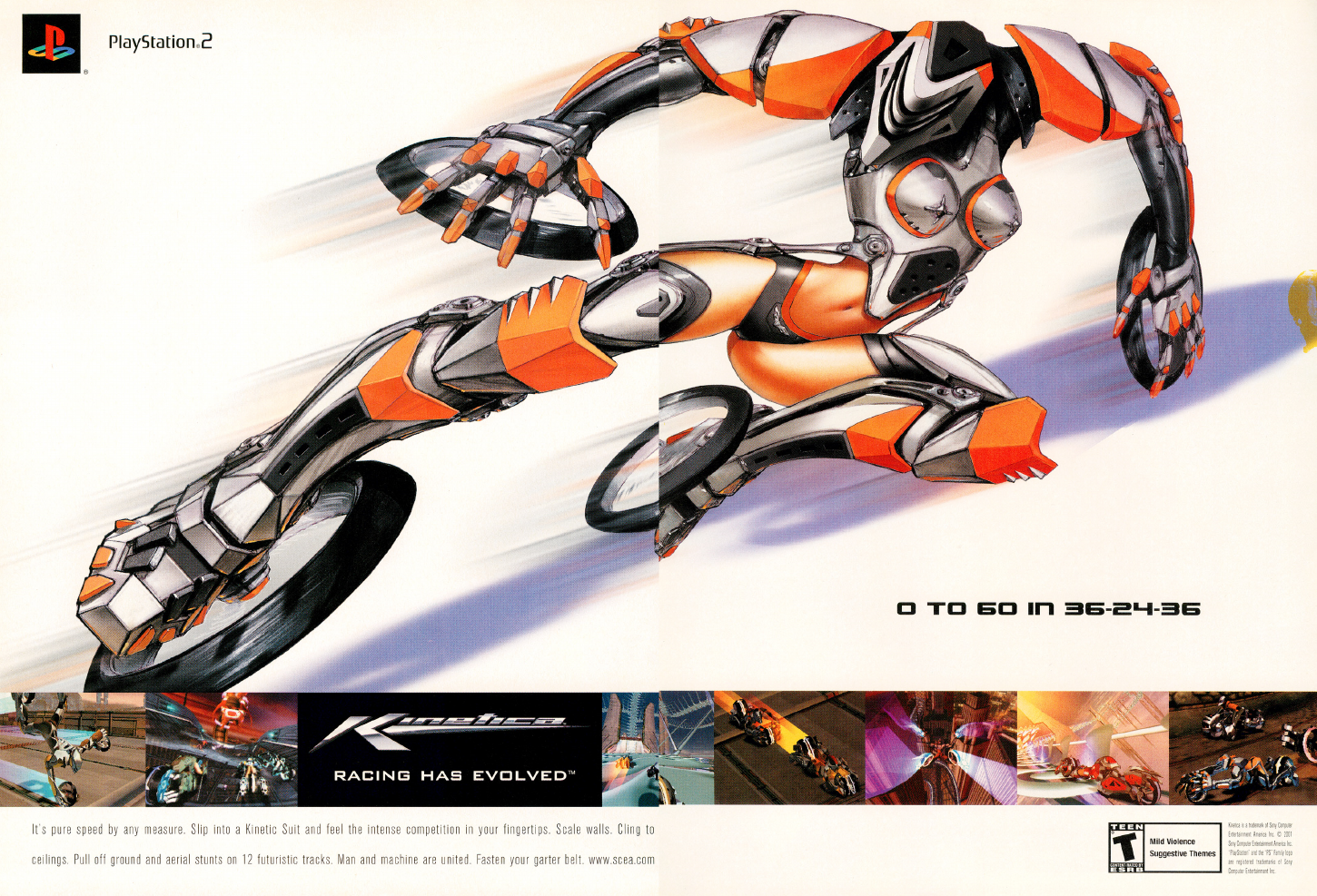
And here’s the other Kinetica ad from the following issue. This one? Not quite as formative for me, but it ain’t no slouch either.

Can we even call this “sex appeal”…? I mean… I guess for some people this is…? Even though this is clearly intended to be more funny and weird, this is probably the most explicit depiction of a sexual act in the entire history of EGM (which honestly, just makes it funnier). This ad for Seaman was far too bizarre to not get mentioned in any case. (EGM 132, July 2000)
Everything Else
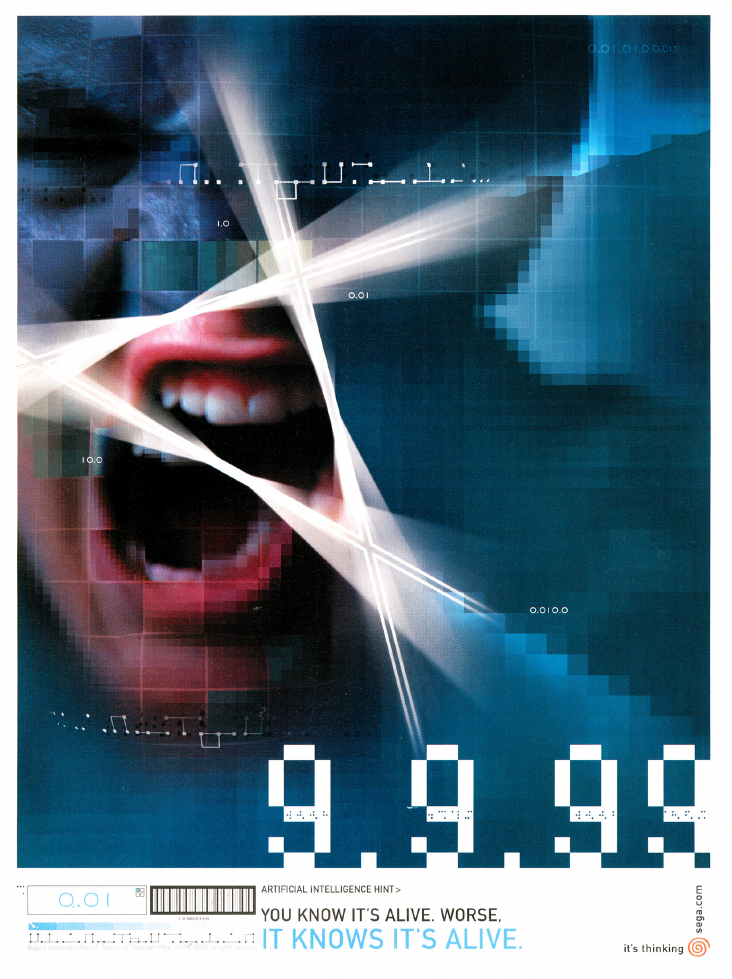
Sega’s marketing for the Dreamcast was really ineffective and strange. Many of the early ads for the system were like this: very abstract and implying that the Dreamcast is an AI-powered supercomputer that’s plotting to conquer the world. Maybe this made sense in the lead-up to the new millennium, but this marketing just does not resonate. (EGM 120, July 1999)
Around this time, we start to notice government ad campaigns making their way into the pages of EGM, particularly anti-smoking ads. In retrospect, this makes sense: I am actually just old enough that I can remember being in restaurants with a smoking section, and how those suddenly went away one day around the turn of the millennium. Anti-tobacco campaigns were everywhere, and today you can really see how effective they were. (EGM 130, May 2000)
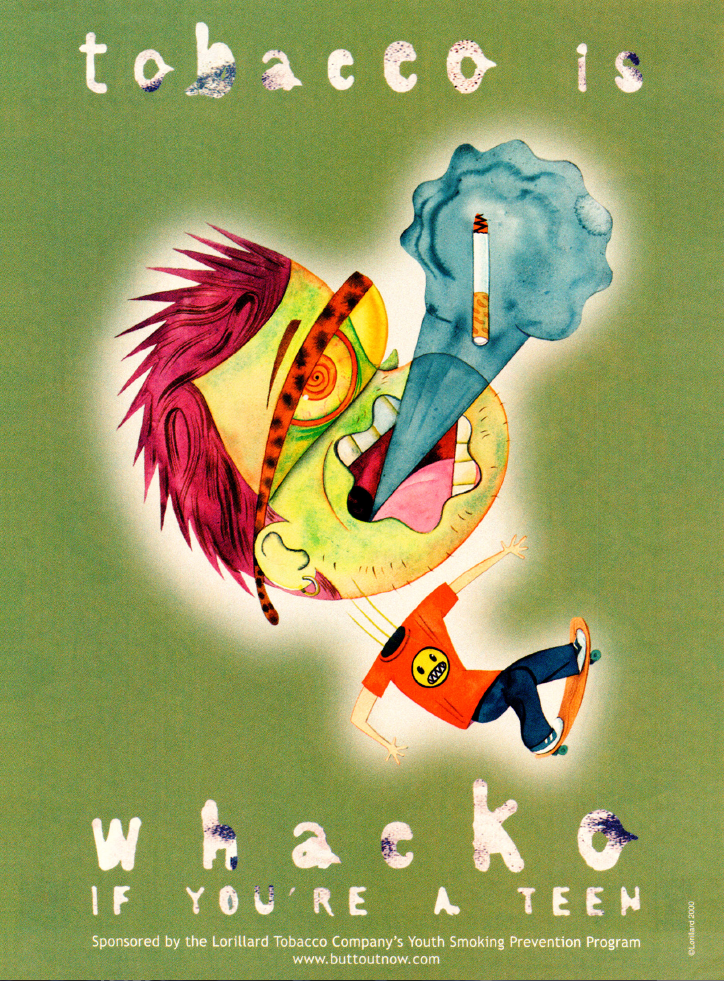

Alright partner: keep on rollin’ baby, you know what time it is. (EGM 132, July 2000)

While we were no longer at the extreme peak of the video game magazine ad, advertisers were still trying to test the limits of acceptability. This ad for Virtua Tennis (EGM 133, August 2000) marks the first time that they printed a full-on ass in the magazine. This, of course, drew a lot of parent complaints in the letters section… See, people aren’t overly-sensitive today, it’s just easier to see and find the people who are complaining in the age of the Internet.
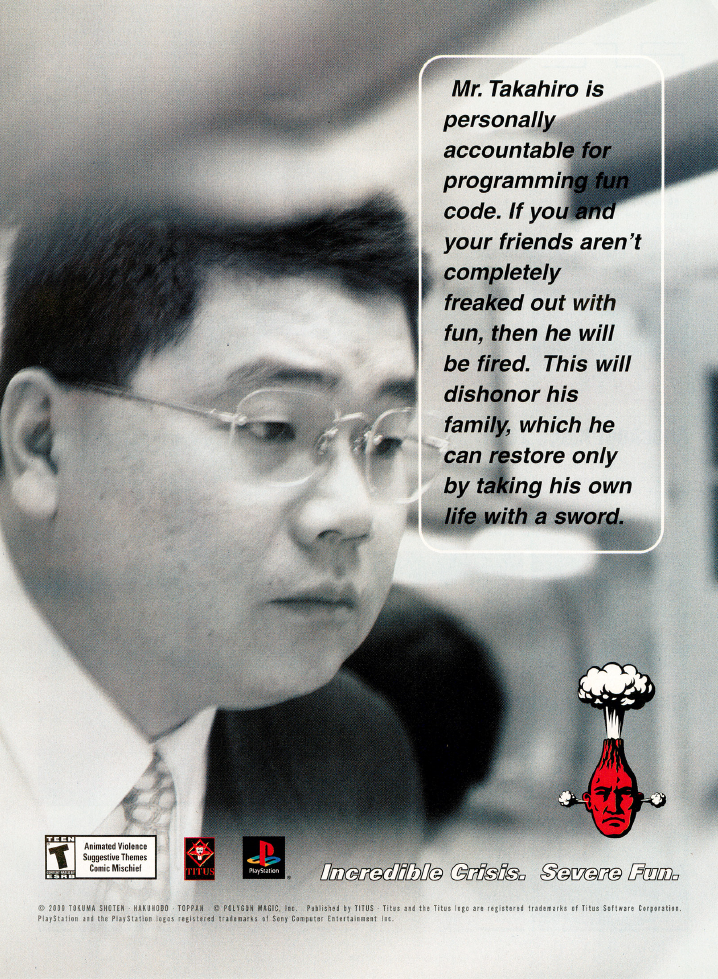
There weren’t a whole lot of objectionable, non-sexual ads in this era, but this one for Incredible Crisis (EGM 139, February 2001) sure gets there.
Then again, this is so tame compared to the ads we’d get at the industry’s peak a couple years earlier. At least this ad’s just making an edgy suicide joke; if this ad was released in 1998, it would frame making this guy commit suicide as an awesome thing that you should definitely do for a laugh.
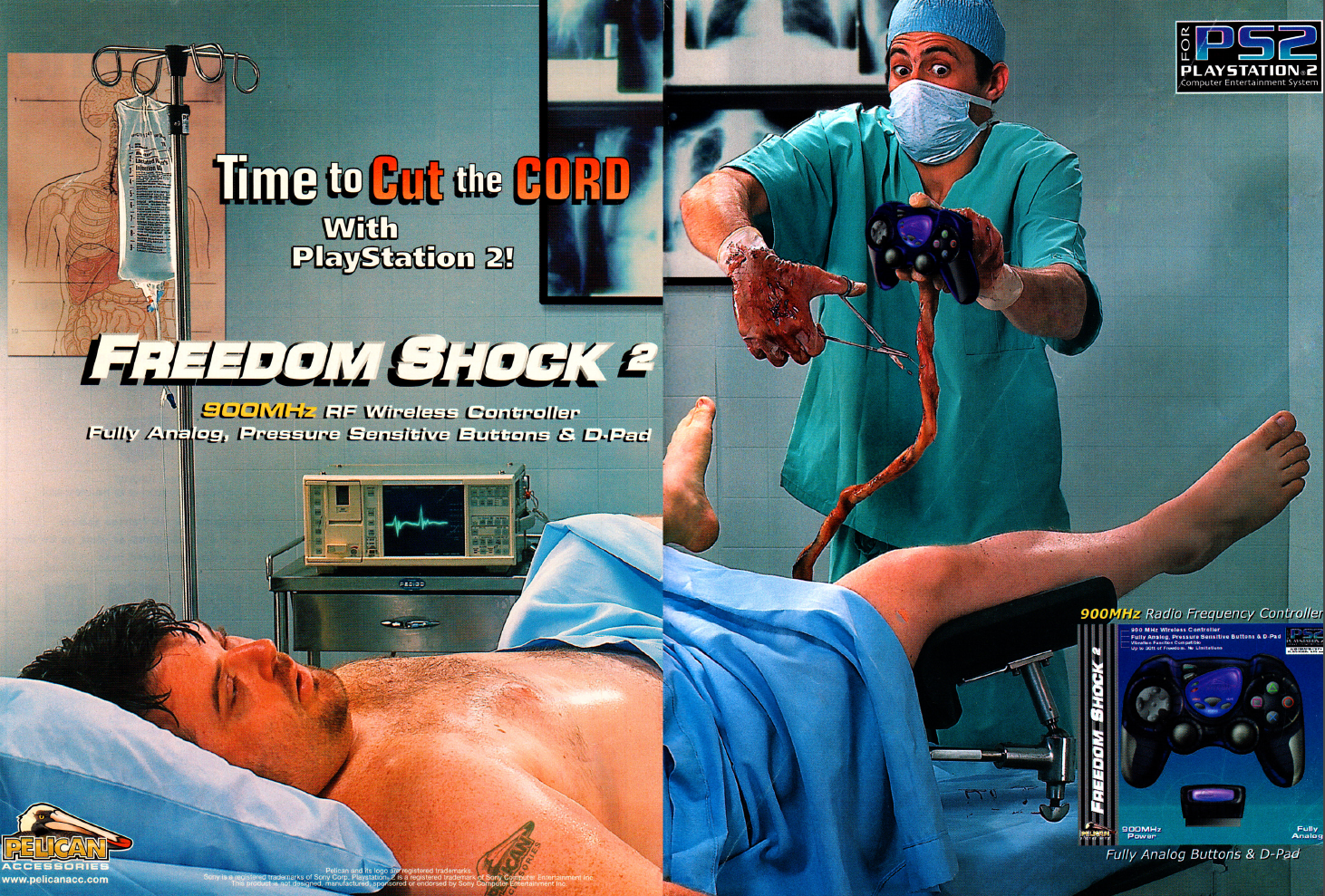
This was the only non-sexualized ad I could find from this time period that was gross enough that, if it was released during the peak era, could have still stood out. (EGM 134, September 2000)
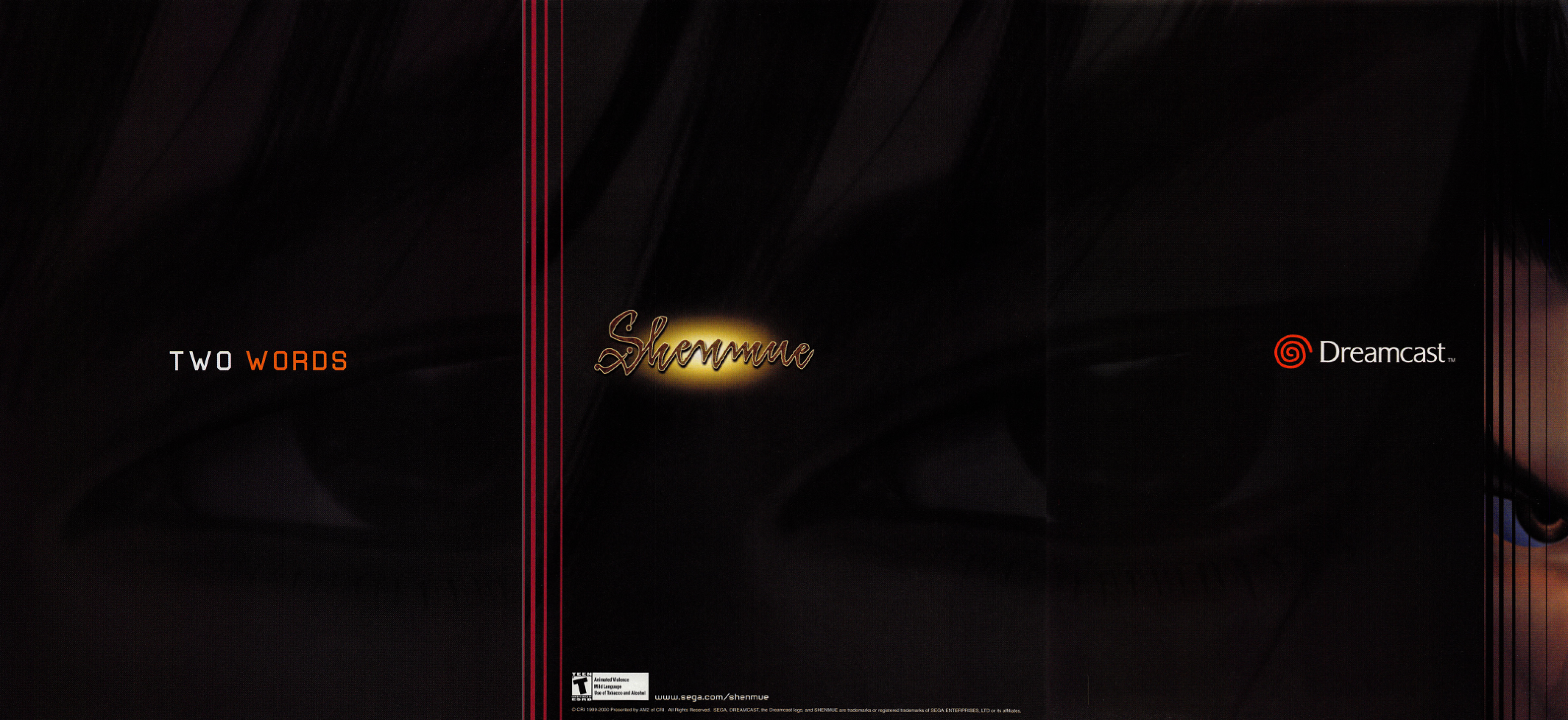
Poor Sega. After two console generations of impotent marketing savvy, they finally found something that worked with this ad for Shenmue (EGM 138, January 2001). The organic hype that this game is what makes it work: the game (and its reputation) speaks for itself, we don’t need to do anything else to convince you to want this game. It’s brilliant, but it also came far too late in the game for it to change Sega’s fortunes; the Dreamcast’s fate was already sealed by this point.
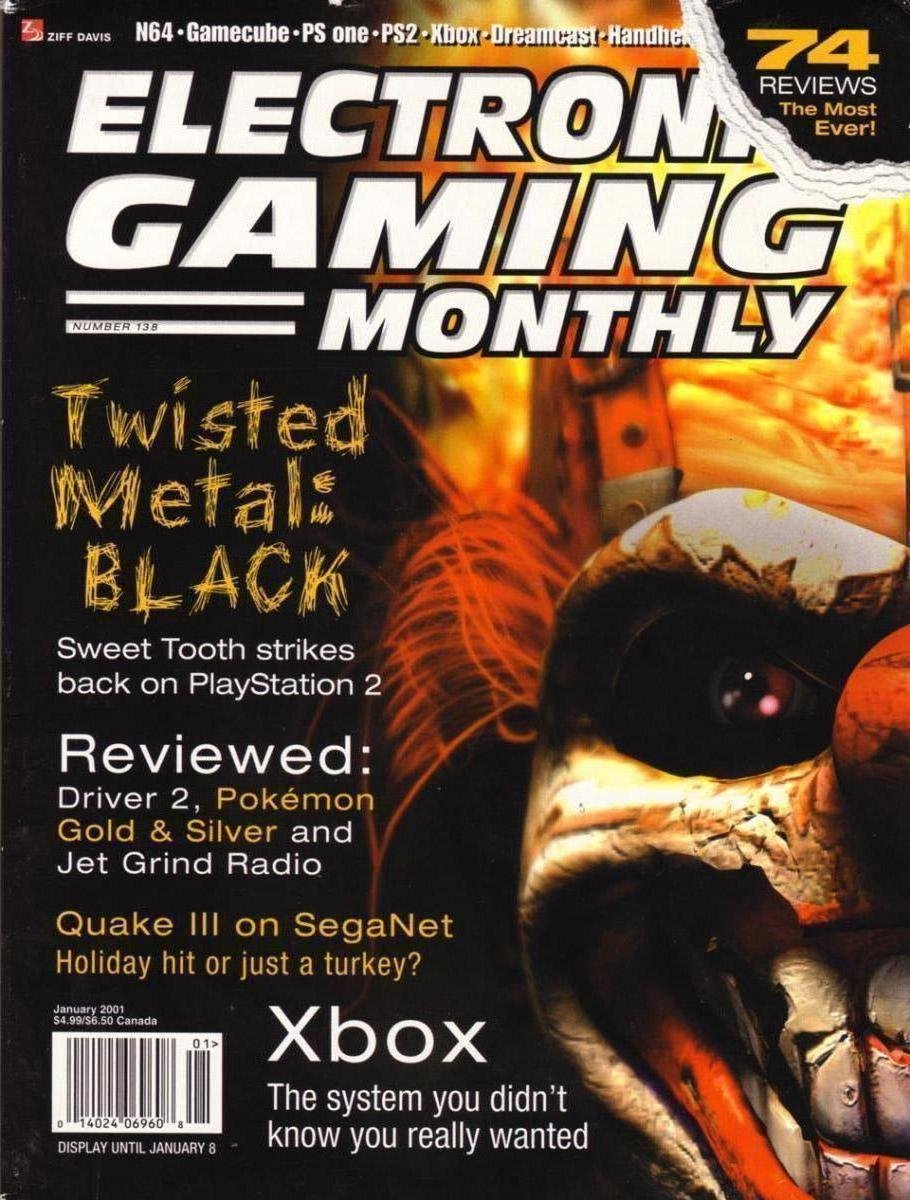
Finally, by December 2001, we see the first signs of The Big Event in the pages of EGM.
Monthly magazines take time to go to print, so the impact of major cultural events can take time to be reflected within the magazine’s pages. The interim issues can feel strangely out of date or disconnected as a result. Given how seismic the effect of 9/11 was on the wider culture, I knew that it was going to mark the end of one era and the start of something entirely new once advertisers had a chance to catch up to it…

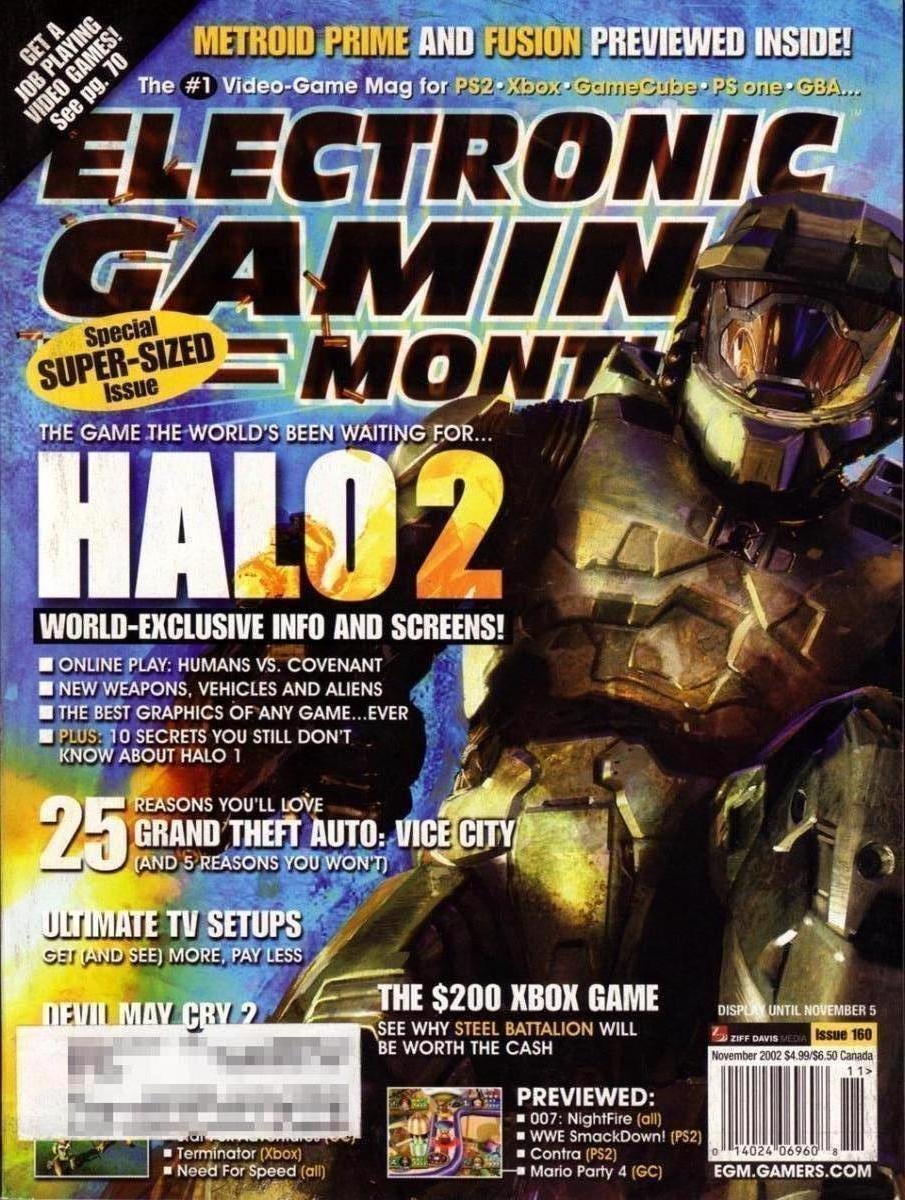
The New Status Quo (2002 to 2004)
9/11 was a cultural seismic shift and, as you would expect, and video games would be caught up in this as well. The appetite for aimless attitude and extreme angst died overnight. In response, marketers started taking on a more mature tone.
By this point, the floodgates were well and truly open for “sexy games”. With the increase in graphical fidelity, developers were more fixated on sexualized female characters than ever before and the marketing reflected this.
While the ads of this era were often more explicit than anything we had seen before, there was one massive difference between this new status quo and the obnoxiousness of the peak era: because they handled this increasingly more mature content with some tact, it doesn’t feel as egregious or shocking as it was in 1998.
One of the chilling elements of this era in video game magazine ad history is when the military recruitment ads start showing up. How many people chose to enlist because of these ads? How many didn’t come home? How many did, but could never be the same again? As silly as it may sound, you can read history between the lines in these old magazines, and it paints a fascinating picture of our society. (EGM 159, October 2002)

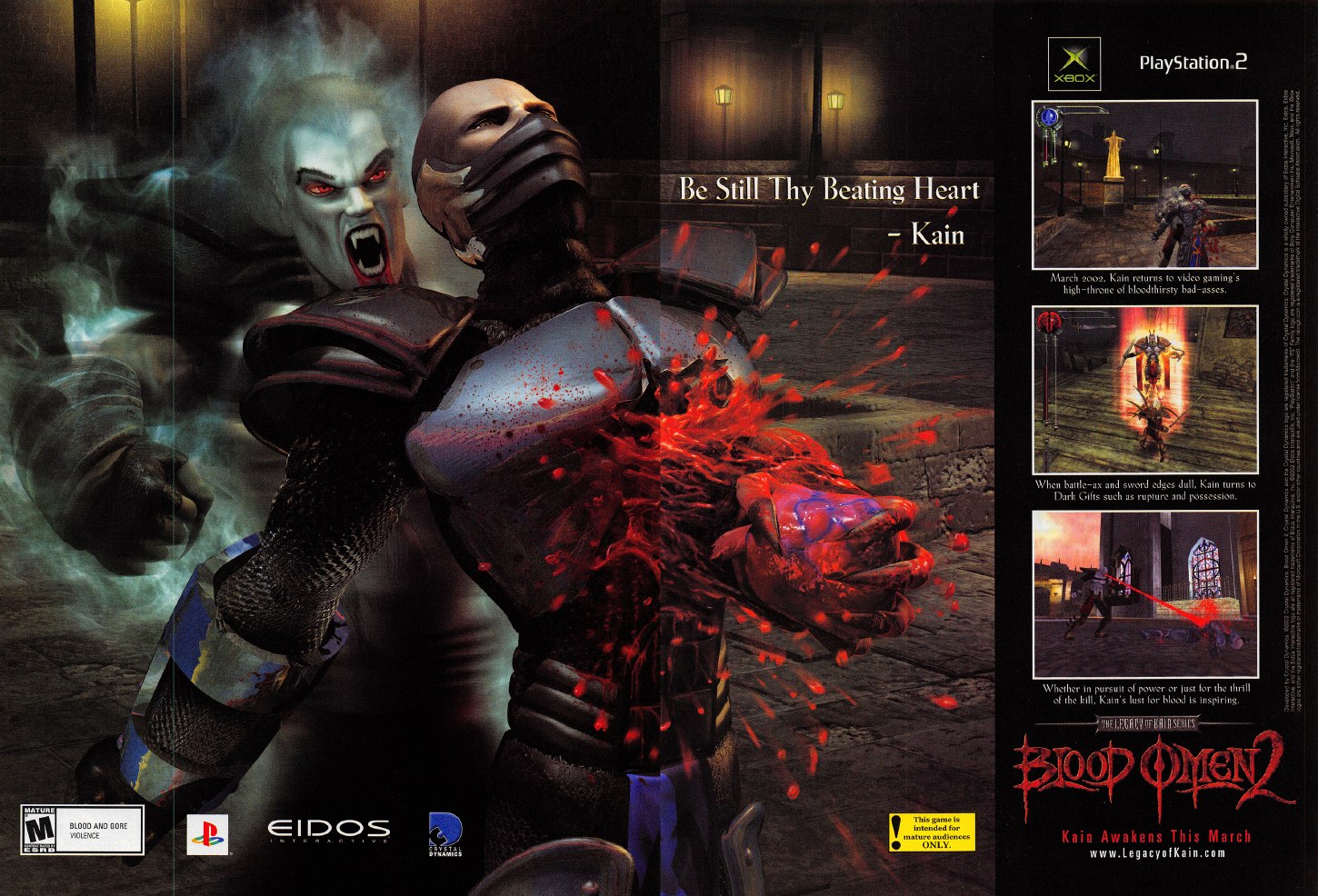
This image here is a great example of how far violence had come in only a few years (EGM 153, April 2002). The Spawn dismembered arm ad was quite shocking and envelope-pushing, but he we have Kain tearing a guy’s heart out and it doesn’t feel nearly as shocking. I think it’s down to the focus of the image: in the Spawn ad, the dismembered arm is the entire image, so it’s what you’re forced to take in. With this Blood Omen 2 ad, the heart-tearing is front-and-center, but it’s just one part of a much larger scene.
Also, trigger warning for the next slide: dead animals, maybe skip it if you do not want to see that.

Okay, this one’s a pretty extreme outlier, easily one of the most shocking ads of this entire era. Why did they think that people would want to see a snake eating a mouse in their video game magazine…? And the asshole cartoon ant, I guess he’s helping to push him into the snake’s mouth, because he’s a little shit? And this is for another goddamn E-rated game?? Best thing I can say about this ad is that at least its shocking content is just depicting nature doing its thing. (EGM 161, December 2002)
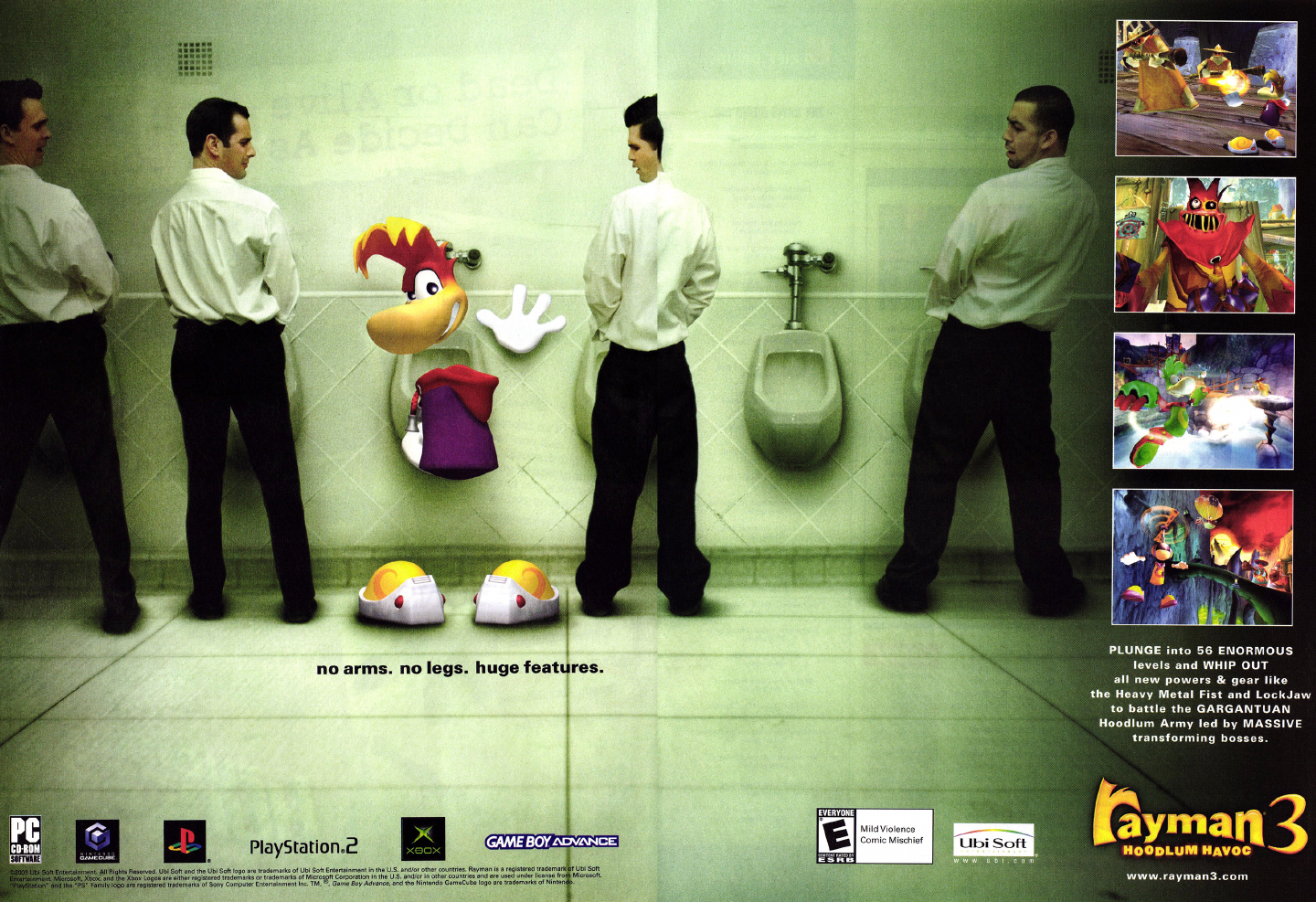
I love this ad for Rayman 3 (EGM 164, March 2003), it is so fucking funny. I want every mascot platformer marketing team to release an ad which references the size of their character’s dick, so that we can canonically determine who is packing the most heat.

With 9/11 and the War on Terror came the uptick in patriotic sentiment. As a result, we would see lots of military shooters which played into this jingoistic appetite. It would, however, be a few more years before we would get games willing to directly touch on the on-going conflict. (EGM 159, October 2002)
And here it is, the culmination of the “sexy game” trend: Dead or Alive Xtreme Beach Volleyball. As is becoming strangely common for this franchise, DOAXBV‘s ads are actually pretty restrained and classy. Like I said earlier, it’s all about the way the image is framed and focused. They could frame this FAR more egregiously and exploitatively if they wanted to, but no: this is some very tasteful appreciation of the female form, all things considered. (EGM 160, November 2002)
This game barely even needed the marketing push. To a Western audience, it was so unique and overtly sexy that people couldn’t stop talking about it even a year after it came out.

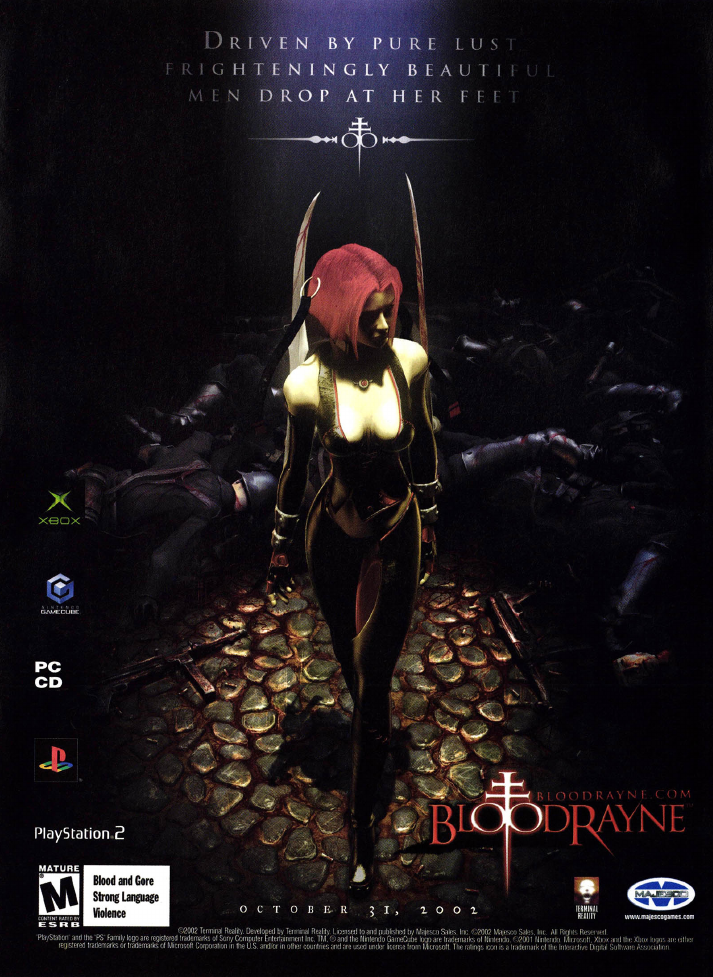
…and then we have the other end of the spectrum with BloodRayne (EGM 160, November 2002). Designed from the ground up to be overtly sexualized, Rayne’s idealized body dominates the frame in all of her marketing. This absolutely worked on me: despite never playing any of the games at the time, I’ve always had a fascination and fondness with this series (too bad the games and movies are all pretty bad).
And then there’s this ad…
I think it speaks for itself.
(EGM 165, April 2003)
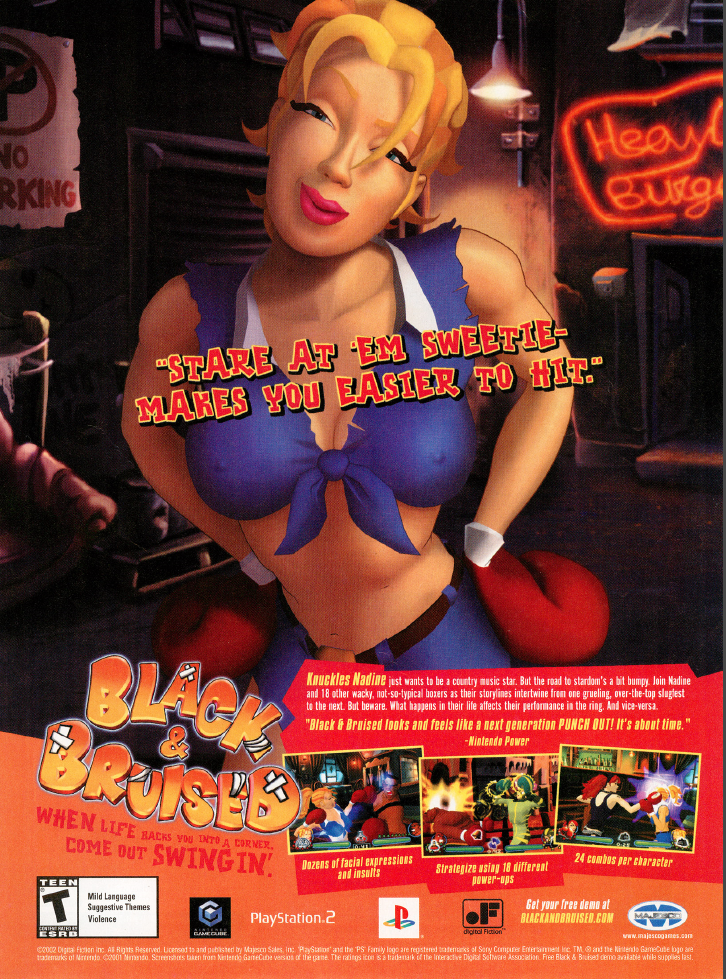
Oh my God, in case you forgot that it’s the early 2000s, we’ve got this straight-up fatphobic ad. (EGM 161, December 2002)


As the War on Terror continued and the Iraq War geared up, the recruitment ads became more frequent. Nearly every issue of EGM has ads for the army, navy, and marines. These ads are targeted at young men, fresh out of high school, trying to decide what to do with their future. They paint the military as an exciting alternative to college. Between the lines, war is underway and they’re trying to snare you into it. (EGM 170, September 2003)
The Slow and Agonizing Death of the Video Game Magazine (2004 to 2014)
It all started with a realization.
I was flipping through the September 2004 issue of EGM when I noticed that something was off. EGM issues do not have a set page count, but there was an expected pattern that had developed over the preceding fifteen years of issues. You could usually expect at least 130 pages throughout the year, but from September through January, the page count always increased significantly. Issues in November, December, and January would typically balloon to over 300 pages. Obviously, this is because the holiday season is the highest selling period for games, so advertisers would pull out all the stops to get their products in front of people. Video game magazines were traditionally the most important cultural touch-stone for gamers, so advertisers would compete for advertising space in them. As a result, EGM would add more articles and features during the holidays to justify the additional ad space: for the consumer, it was win-win scenario.
However, September 2004’s page count was only 129 pages. That was… odd. Then October only had 135 pages. Uh oh. And November had 173 – nearly 100 less than the year prior. And then December had only 187. As soon as I saw this, I knew what I was witnessing play out in real-time: the death of print media.
The old media was dying. Or rather, it was being killed off. Advertisers would begin putting less emphasis on print media each year as they transitioned to the Internet. Multi-page spreads, a staple of any good marketing campaign in years past, would become a rarity. Since advertisers needed to pay for each page they used, this shift to single-page ads indicated a decreased financial commitment from advertisers. Ads took on a very standard, safe language – print ads were no longer the primary marketing tool for these companies, but rather one arm of their marketing campaigns; consequently, they were no longer one-upping each other, and fell into a very rote pattern.
With this decreasing financial support, the page counts of EGM issues steadily began to shrink. There were less editorials, less previews, less… everything. Why would you bother to get your gaming news months after it happened when you can get it immediately on the Internet?
As page counts dropped, the first redesign of the magazine occurred, trying to revitalize the magazine’s fortunes. This was not to be. While the magazine continued to chug forth and put out some great work, by November and December 2008, page counts had dropped to only 101, each. Consequently, EGM‘s parent company went bankrupt and EGM shuttered with it.
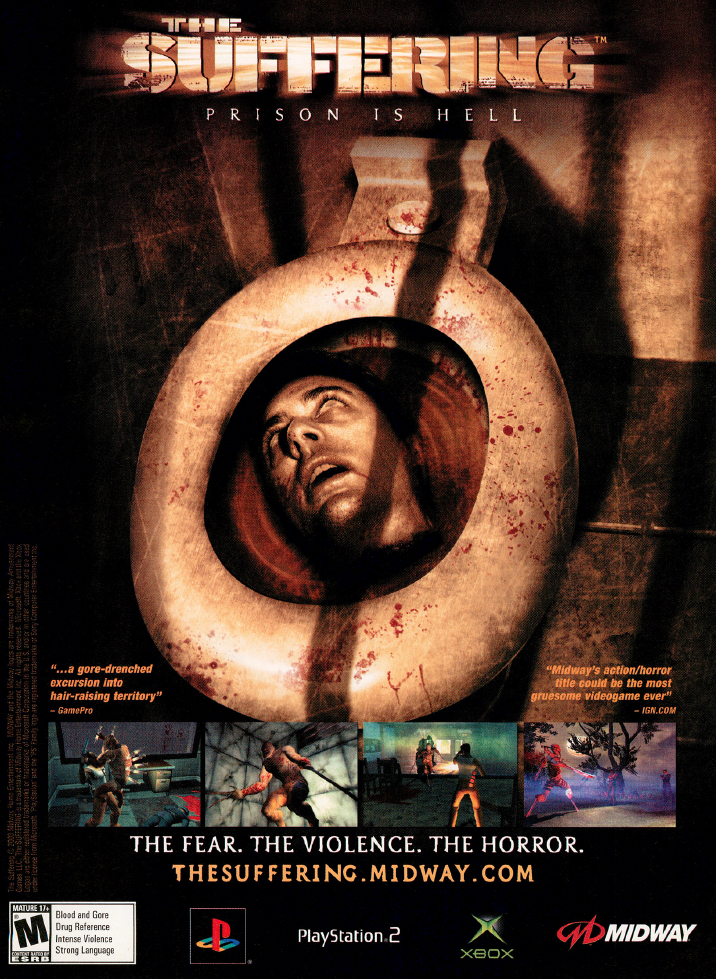
Here we see, once again, that advertisers are happy to show us scenes of violence far more explicit than anything seen in the 90s, but they don’t feel as shocking due to the way that the violence is framed. (EGM 177, April 2004)
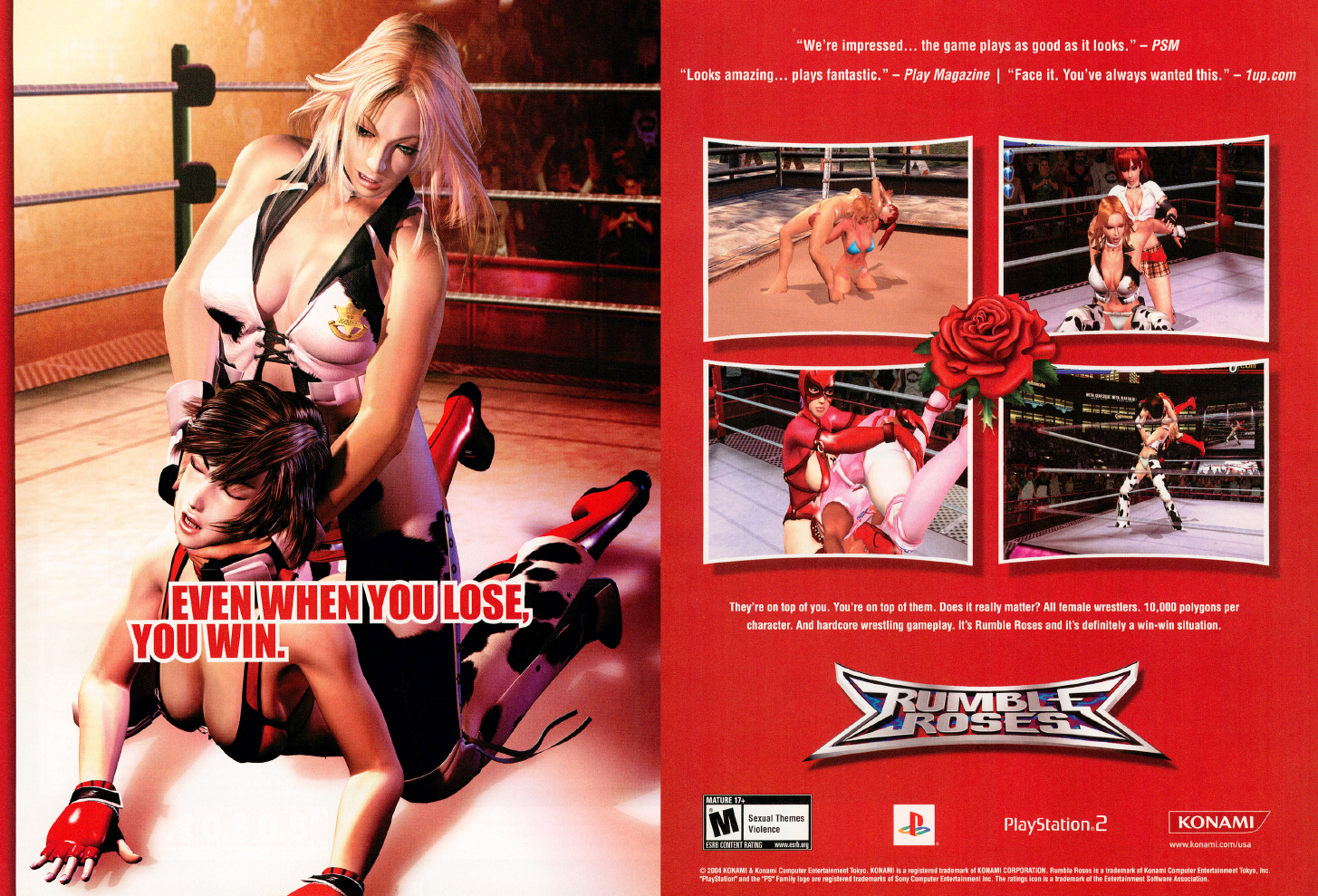
Female objectification was in full-swing by this time. Sex appeal was all that many games of this era had going for them to try to stand out. (EGM 184, November 2004)
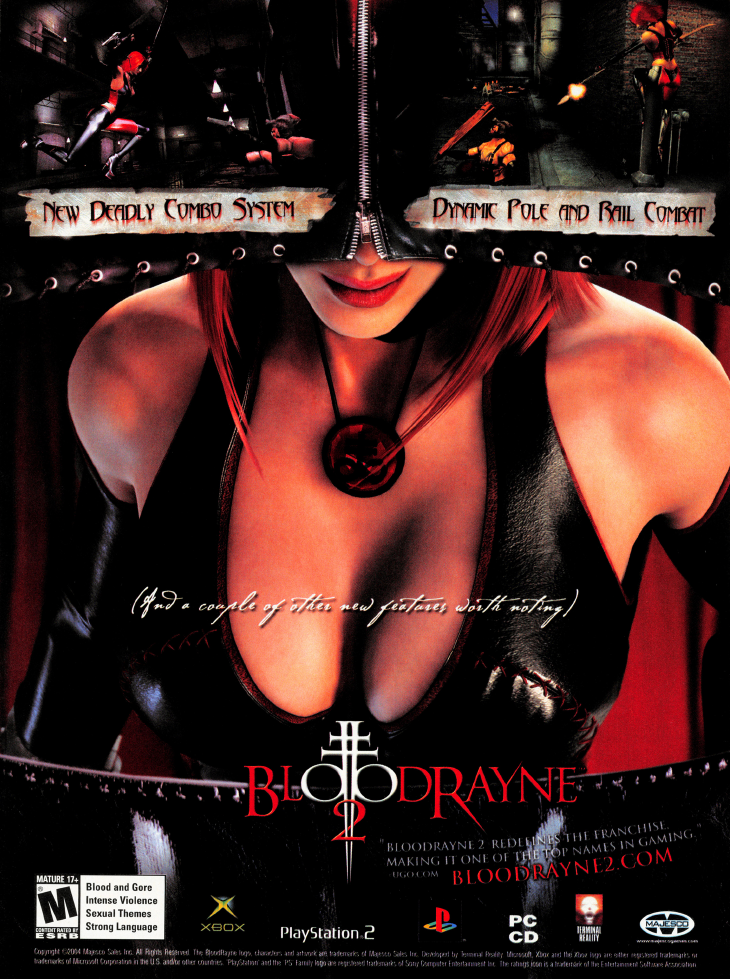
…case-in-point. (EGM 185, December 2004)
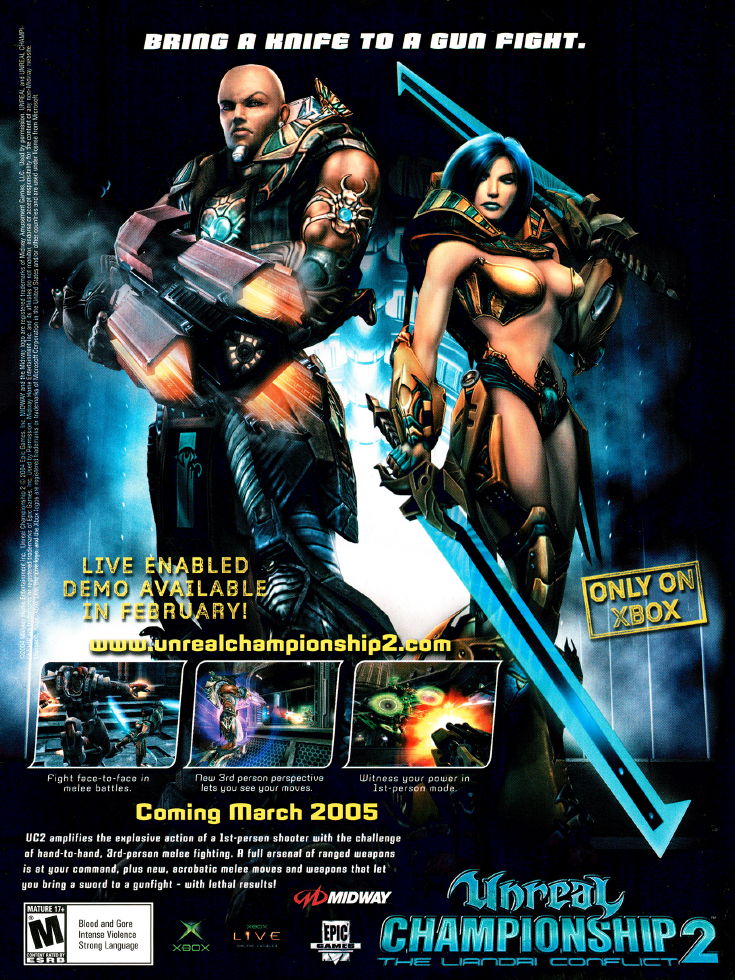
This ad for Unreal Championship 2 (EGM 189, March 2005) is just a perfect illustration of how men and women were treated in games at this time: game characters were either a big, muscly man, or a woman in a bikini. Character design was just plain absurd-looking at this point, and we were desperately in need of a bit more body type diversity.

I found this anti-piracy ad (EGM 183, October 2004) very funny in retrospect. It reads like I’m getting threats hurled at me by an old, Liam-Neeson-wannabe tough guy.
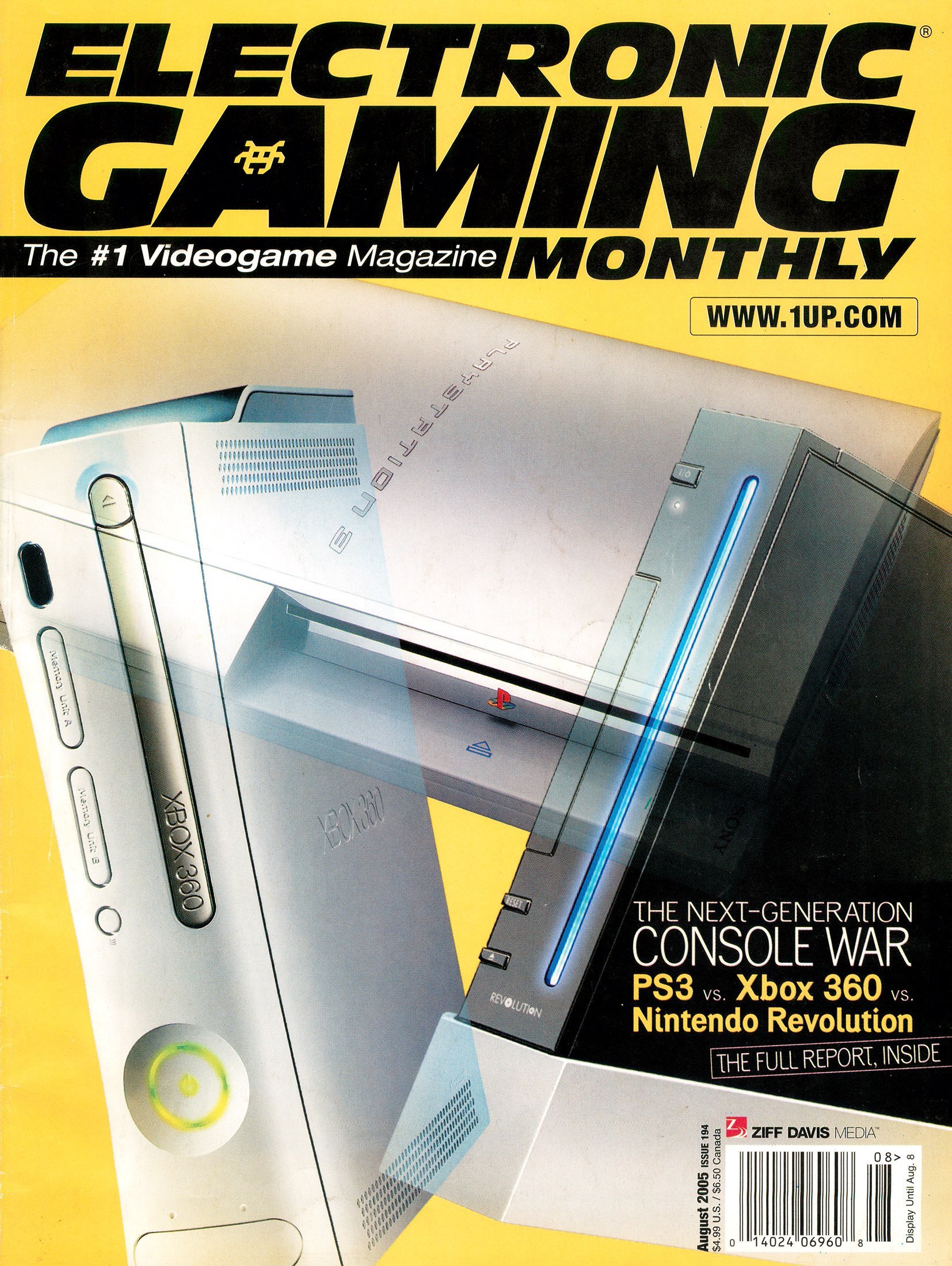
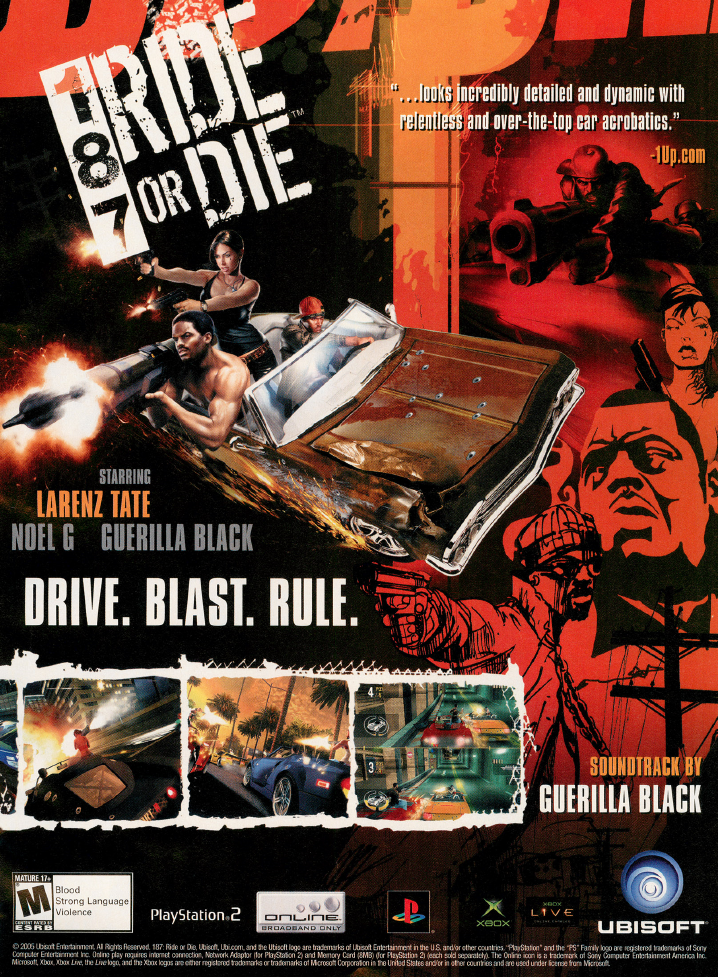
Another trend we saw around 2005 was the rise of “gangsta” games due to the popularity of Grand Theft Auto: San Andreas and rising popularity of rap music. Somewhat interestingly, since the open world game was still very difficult for most studios to mimic, these games would run a gamut of genres, only mimicking San Andreas‘s urban trappings. (EGM 194, August 2005)

This ad for Hitman: Blood Money (EGM 205, July 2006) ups both the sex and the violence, but like I’ve said, this is so artfully and tactfully done that it avoids the potential shock and outrage that this could have generated had it been released during a less-tasteful era of marketing.
EGM 190 Apr 2005: this marked the beginning of a cultural blight that would plague the pages of EGM for the next four years, as AXE body spray rolled out their “AXE will make every woman in the vicinity want to fuck you” ad campaign. They were such a fixture in these magazines that I had to give them special mention.


While AXE are remembered for being the most obnoxious body spray company, the most egregious ads I found were actually for TAG (does anyone even remember them…?). (EGM 210, December 2006)

With this ad (and the subsequent Old Spice Guy campaign), Old Spice figured out how to end the obnoxious, teen-focused body spray ads in favour of something everyone loved: charming, random comedy routines. (EGM 233, October 2008)
However, that was not quite the end. EGM‘s founder and former editor bought the rights to the magazine and relaunched it in 2010. To try to stand out and stay relevant at a time when online media had supplanted print media, EGM went through its second redesign. It now sported much more dynamic graphic design and more editorials. These issues barely had any ads at all (literally only like five or six per issue). Whether this was intentional, or they couldn’t sell enough ad space, it’s pretty shocking compared to where things were a decade earlier. Page counts were usually only 84, and never more than 104.
This last phase of EGM‘s life was just sad to go through. These issues were lovingly made, beautifully-composed, and full of good gaming journalism. It’s comforting… but it lacks anything to get me excited. As I flipped through issue after issue, it just lacked the magic of yesteryear. EGM was a centralizing, cultural force for gamers only ten years prior; now it was just a relic trying to emulate the websites of the day.
Accordingly, advertisers clearly didn’t view it as a good way to reach their core demographics anymore. The clear example of this is sports games. They aren’t exactly popular amongst gamers, but they make up a bread-and-butter for the industry, and would be heavily marketed throughout EGM in its golden years. In the final years of the magazine, the pages were filled with ads for more niche titles: stuff that would get crowded out in mainstream advertising spaces, but which would view a dying magazine for nostalgic millennials and Gen-Xers as a good opportunity.
Most ads in the final relaunch of EGM are like this one for Deathsmiles: low-budget anime girl games that no one has ever heard of… wait, what does that say?
“LOLIS SMILE BACK”???
Okay, this is the twist of the fucking century here: in the final, sanitized, boring years of EGM, they put out perhaps the most unhinged ad in this entire retrospective. The fact that the ad is so innocuous and then just has “LOLIS” as a selling point is fucking insane. (EGM 239, Summer 2010)


Like I said… a lot of low-budget anime girl games in these final issues. (EGM 260, Summer 2013)
…and occasionally low-budget anime girl games with marketing that looks like… this. Poor print media was scraping by at this point, this graphic design is of a lower quality than anything EGM had seen since the early 90s. (EGM 263, Spring 2014)

Soon, issues stopped being released monthly. We’d get a new issue every two months. Then every three months. And then they stopped coming entirely. EGM had made it a lot longer than many of their contemporaries, but the end finally came in the summer of 2014, when the magazine was shuttered and they were forced to transition to a web-only publication to try to keep the brand alive. They were defiant and proud to the end, but they could not prevent the inevitable from coming to pass.
As sad and painful as it was to witness these final thirty-or-so issues, they really just serve to remind me of how good the golden era of video game magazines was. I adored the evenings I spent as a teenager in the cubby under the stairs pouring through those hallowed pages, learning about games I never would have heard of otherwise. Despite being a printed publication, EGM and its contemporaries acted as a window into a global community of gamers, and helped us to foster a shared appreciation for this medium. In an era where entertainment is increasingly devalued, and we’ve discarded our centralizing cultural forces, I really think that we’ve lost that abstract thread that kept us together for so long.
Video game ads have, of course, not died out with print media, they just transitioned to online banner ads, slick video trailers, influencer sponsorships, etc. As video game budgets have increased and success is measured by capturing larger-and-larger slices of the audience, these modern advertising methods are all handled with a lot more tact and corporate sanitization compared to the heyday of the video game magazine. Even when video game magazine ads were at their worst, there was always a certain amount of charm seeing how marketing teams were going to try to convince you to buy their products. It’s a lost art, and one that I have enjoyed reminiscing on: I hope that you have found this trip down gaming history fascinating as well.
If you liked this article…
I hate ads. You hate ads. In order to stop polluting my site with obtrusive and annoying ads, I’ve elected to turn them off on IC2S. That said, writing still takes time and effort. If you enjoyed what you read here today and want to give a token of appreciation, I’ve set up a tip jar. Feel free to donate if you feel compelled to and I hope you enjoyed the article! 🙂
About the Author

Dude this was a blast to read. I actually collect game adverts from 90s/00s so eBay leaves me with empty pockets some months. I’m from England/UK and our gaming magazine adverts were also wild. I was 14yo in 1997 so these gaming magazines (and adverts) for me were some of my fondest memories. I remember even thinking they were risqué back then, they absolutely gave 0 fucks and I loved it! It’s cool to see the USA also went just as edgy though the UK didn’t lean into the guns, murder, bombings angle as much (kinda messed up, looking back at how blatant EGM could be). Anyway just wanted to say I had a lot of fun reading over these man. Appreciated!
Thanks for the comment, I had a ton of fun researching and writing this. I was actually quite surprised at just how unhinged the ads were back before I even started getting into video game magazines. While I do think that EGM made for a good case study, I know that there were a bunch of crazy ads out there that I wasn’t able to see because I stuck with one primary source… kinda makes me want to do a part 2, but the amount of research that would take is daunting to say the least. In any case, glad you enjoyed this! 😀
This is such a well-made article and a blast to read! For the record I was born in ’98 and was too young to get a eyeful of these unhinged as all hell print ads. Some of them are really interesting to look at from a visual arts perspective, though looking back I’m more amused and a tiny bit frightened at how sexually charged and adult oriented some of these ads are for E-rated children’s games.
I do like how you pointed out how truly awful Sega’s advertising game was when it came to the Saturn (not counting Japan, given the Saturn’s success there). It’s a pity because the Saturn is a truly underrated console; but once I saw those old Saturn commercials on YouTube I really wouldn’t have blamed anybody deciding not to buy one. Some of those commercials and print ads are just outright upsetting to look back on now.
Definitely, Sega just fell off a cliff during the Saturn era and never got their footing back. They got some of their swagger back for the Dreamcast, but it was too little too late.
And yeah, it’s wild that the raunchiest ads were consistently for kids’ games. I have to assume that they felt like kids would buy the games anyway and they were trying to convince older people to try the games out, or they were appealing to kids who “don’t want to play kids stuff”. Either way, it was shockingly prevalent.
Rereading the article again, I realized that these kinds of ads died off isn’t just because of games maturing as a medium, going mainstream and bringing in millions of dollars in industry revenue as well as major cultural shifts, but also how ratings boards really tightened their belts about advertising.
Say what you will about the ESRB and their leniency towards rating games, but they absolutely will clamp down on anything resembling the edgy, sexually charged game ads of yesteryears. I included this secondary source detailing their ARC guidelines, it’s fascinating stuff: https://www.esrb.org/ratings/principles-guidelines/
Ahh interesting, that definitely explains the drop-off in sexually-charged E-rated game ads. That said, it would depend on when these guidelines went into effect, whether more lenient international territories had more unhinged ads since they didn’t have these guidelines, and whether they would have even mattered since gaming magazines were dead by the late 2000s. Really interesting source for further research though! 🙂
Take my words with a grain of salt as the ESRB doesn’t specify when the guidelines were formed. I theorize ARC was formed sometime around the mid-to-late 2000s, which was when print was slowly dying. Most ratings boards were very hands off with edgy game ads when they were just formed and purely focused on the content within games; I think it was around the time after Hot Coffee and the controversy over Elder Scrolls IV: Oblivion being re-rated from T to M that had companies thinking “well shit, we actually can’t get away with anything!” and the ESRB deciding that advertising self-regulation was the way to go as well.
I should note that PEGI has very similar guidelines that formed a bit later; no unhinged edgy ads there either unless you want a hefty fine. https://pegi.info/pegi-code-of-conduct